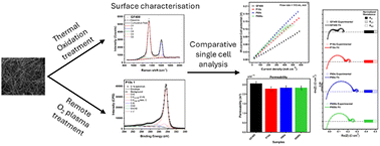
Analysis of the impact of remote oxygen plasma treatment on the surface chemistry and electrochemical properties of graphite felt electrodes for redox flow batteries

The effects of a remote oxygen plasma (ROP) treatment on the surface of commercial graphite felts were investigated and compared against a conventional thermal treatment. In contrast to methodologies where the sample is directly exposed to the plasma, ROP allows for a high control of sample-plasma interaction, thereby avoiding extensive etching processes on the fibre…

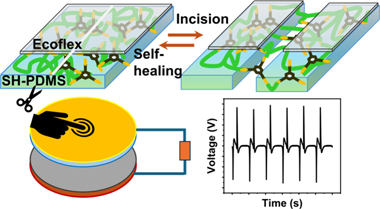
Tailoring of Self-Healable Polydimethylsiloxane Films for Mechanical Energy Harvesting

Triboelectric nanogenerators (TENGs) have emerged as potential energy sources, as they are capable of harvesting energy from low-frequency mechanical actions such as biological movements, moving parts of machines, mild wind, rain droplets, and others. However, periodic mechanical motion can have a detrimental effect on the triboelectric materials that constitute a TENG device. This study introduces…

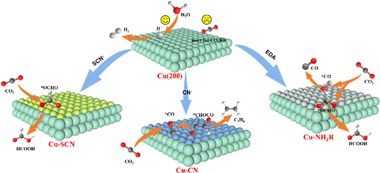
Efficient tuning of the selectivity of Cu-based interface for electrocatalytic CO2 reduction by ligand modification

The development of efficient strategies to tune the CO2RR selectivity of Cu-based catalytic interfaces, especially on specific domains, such as Cu (200) facets with high activity toward competitive hydrogenation evolution reaction (HER), remains a challenging task. In this work, Cu-based catalytic layers with thiocyanate (-SCN), cyanide (-CN), or ethylenediamine (-NH2R) coordination linkages are prepared on…

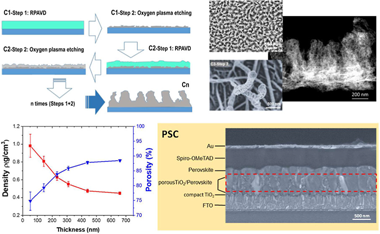
Conformal TiO2 Aerogel-Like Films by Plasma Deposition: from Omniphobic Antireflective Coatings to Perovskite Solar Cell Photoelectrodesh

The ability to control the porosity of thin oxide films is a key factor determining their properties. Despite the abundance of dry processes for synthesizing oxide porous layers, a high porosity range is typically achieved by spin-coating-based wet chemical methods. Besides, special techniques such as supercritical drying are required to replace the pore liquid with…

Synergistic Integration of Nanogenerators and Solar Cells: Advanced Hybrid Structures and Applications

The rapid growth of global energy consumption and the increasing demand for sustainable and renewable energy sources have urged vast research into harnessing energy from various sources. Among them, the most promising approaches are nanogenerators (NGs) and solar cells (SCs), which independently offer innovative solutions for energy harvesting. This review paper presents a comprehensive analysis…

Highly Stable Photoluminescence in Vacuum-Processed Halide Perovskite Core–Shell 1D Nanostructures

Hybrid organometal halide perovskites (HP) present exceptional optoelectronic properties, but their poor long-term stability is a major bottleneck for their commercialization. Herein, a solvent-free approach to growing single-crystal organic nanowires (ONW) is presented, along with nanoporous metal oxide scaffolds and HP, to form a core@multishell architecture. The synthesis is carried out under mild vacuum conditions…

Harnessing a Vibroacoustic Mode for Enabling Smart Functions on Surface Acoustic Wave Devices – Application to Icing Monitoring and Deicing

Microacoustic wave devices are essential components in the radio frequency (RF) electronics and microelectromechanical systems (MEMS) industry with increasing impact in various sensing and actuation applications. Reliable and smart operation of acoustic wave devices at low costs will cause a crucial advancement. Herein, this study presents the enablement of temperature and mechanical sensing capabilities in…