


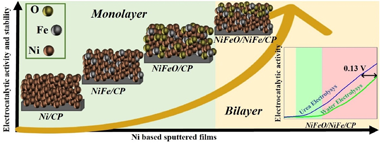
In this work a set of mono- and bi-layered nanostructured Ni-Fe electrocatalysts prepared by magnetron sputtering deposition in an oblique angle configuration have been tested as anodes for urea assisted water electrolysis. In a three -electrode cell, it was found that an oxide/metal bilayer outperforms single metal or oxide layer configurations for the urea electro-oxidation. It is also found that the incorporation of Fe within the Ni structure stabilizes the electrodes likely because it produces a decrease in the surface poisoning of the electrocatalyst. The improved performance observed for the oxide/metal bilayer configuration has been attributed to a synergetic effect between the active (oxy)hydroxide Ni-Fe catalytic species at the outer layers and a high electrical conductivity through the underlying metallic layer. The bilayer electrocatalyst tested in an anion exchange membrane water electrolyser showed an overpotential decrease of 0.13 V when comparing urea oxidation vs. pure water electrolysis. Results prove a synergetic effect between the hydrogen production through water electrolysis and the removal of organic pollutants in water.