Wetting angles and photocatalytic activities of illuminated TiO2 thin films

TiO2 thin films have been prepared by physical vapour deposition (PVD) and plasma enhanced chemical vapour deposition (PECVD) to study the UV-induced photo-activity of this material. Wetting angle variations and photo-catalytic activity for the degradation of dyes upon UV illumination have been compared for thin films with different crystalline structure (amorphous, rutile and anatase), microstructure…

Molecular dynamics simulation of the effect of pH on the adsorption of rhodamine laser dyes on TiO2 hydroxylated surfaces

We have carried out a study of adsorption, on the (1 0 1) surface of anatase TiO2, of two industrially relevant rhodamine molecules [rhodamine 6G (R6G) and rhodamine 800 (R800)] employing molecular dynamics. These theoretical studies have shown that R6G must adsorb on surfaces under basic conditions. Moreover, the adsorption of this molecule shows a…

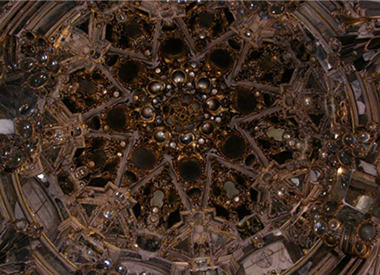
Study by grazing incident diffraction and surface spectroscopy of amalgams from ancient mirrors

Characterization of four amalgam surfaces, with different alteration degrees from Andalusia historical mirrors, has been carried out by grazing-incidence X-ray diffraction (GIXRD), and other spectroscopic techniques (SEM/EDX, XPS, and REELS). The combination of all these techniques allows determining the corrosion state of the amalgams. The results show that the amalgams are composed in all cases…

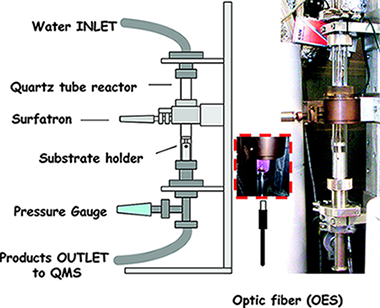
Growth Mechanism and Chemical Structure of Amorphous Hydrogenated Silicon Carbide (a-SiC:H) Films Formed by Remote Hydrogen Microwave Plasma CVD From a Triethylsilane Precursor: Part 1

Amorphous hydrogenated silicon carbide (a-SiC:H) films are produced by remote microwave hydrogen plasma (RHP)CVD using triethylsilane (TrES) as the single-source precursor. The reactivity of particular bonds of the precursor in the activation step is examined using tetraethylsilane as a model compound for the RHP-CVD experiments. The susceptibility of a TrES precursor towards film formation is…

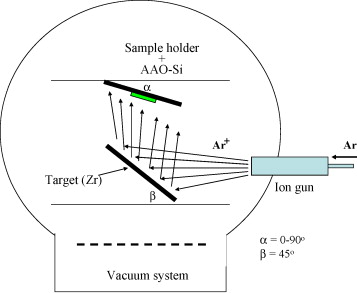
Fabrication of ordered crystalline zirconium nanoporous membranes by an one-step procedure

Crystalline porous zirconium membranes were obtained by physical vapor deposition on AAO templates at room temperature. These membranes were found to have similar hexagonal nanohole arrays as the template and high crystallinity. The pore size of the synthesized metallic membranes could be controlled during the synthesis through appropriate parameters in the experimental procedure.

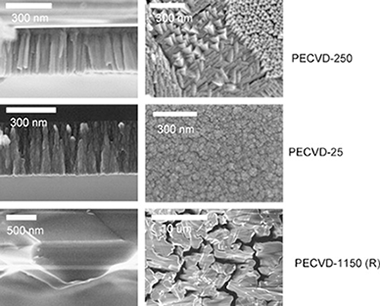
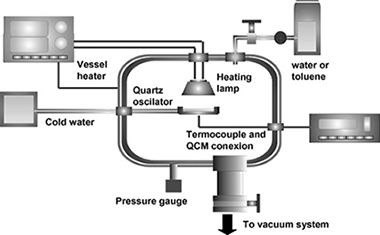
Porosity and microstructure of plasma deposited TiO2 thin films

The microstructure of TiO2 thin films prepared by plasma enhanced chemical vapour deposition has been assessed by using water adsorption–desorption isotherms measured by means of a quartz crystal monitor (QCM). Thin films have been deposited by using titanium tetraisopropoxide as a precursor and by changing different experimental parameters of the deposition procedure such as temperature…

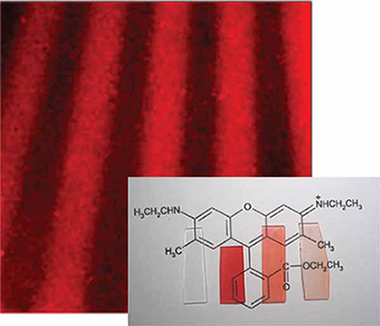
Luminescent and Optical Properties of Nanocomposite Thin Films Deposited by Remote Plasma Polymerization of Rhodamine 6G

Mechanically stable and insoluble fluorescent thin films have been deposited by sublimating Rhodamine 6G laser dye in the downstream region of a low-power microwave ECR plasma using an experimental set-up designed to control the interaction of the dye molecule with the glow discharge. The use of reactive organosilane plasmas allows to control the dye distribution…