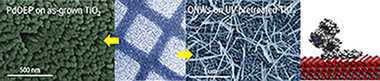
Ultraviolet Pretreatment of Titanium Dioxide and Tin-Doped Indium Oxide Surfaces as a Promoter of the Adsorption of Organic Molecules in Dry Deposition Processes: Light Patterning of Organic Nanowires

In this article we present the preactivation of TiO2 and ITO by UV irradiation under ambient conditions as a tool to enhance the incorporation of organic molecules on these oxides by evaporation at low pressures. The deposition of p-stacked molecules on TiO2 and ITO at controlled substrate temperature and in the presence of Ar is…
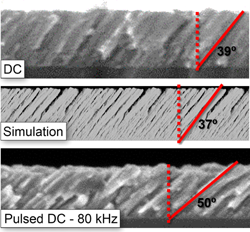

Nanocolumnar 1-dimensional TiO2 photoanodes deposited by PVD-OAD for perovskite solar cell fabrication

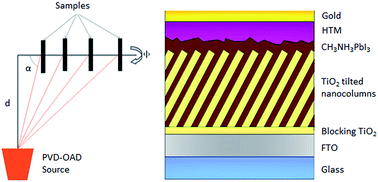
Perovskite solar cells have attracted increasing interest among the photovoltaic community in the last few years owing to their unique properties and high efficiency. In the present work, we report the fabrication of perovskite solar cells based on highly ordered 1-dimensional porous TiO2 photoanodes, which are uniform on a large area. These nanocolumnar porous TiO2…

New Copper wide range nanosensor electrode prepared by physical vapor deposition at oblique angles for the non-enzimatic determination of glucose

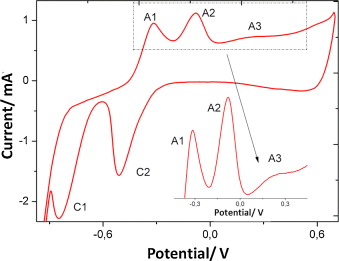
In this work a novel Cu nanostructured electrode is presented. Cu tilted nanocolumnar and porous thin films have been prepared by physical vapor deposition (PVD) in an oblique angle configuration and characterized by different techniques. Cyclic voltammetry and amperometry were used to study the sensing ability of the copper films deposited on ITO to quantitatively…

A novel and improved surfactant-modified Prussian Blue electrode for amperometric detection of free chlorine in water

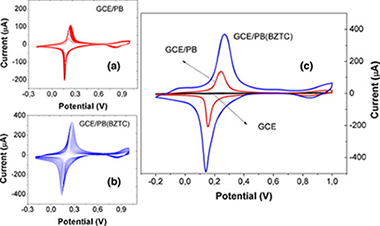
A surfactant-modified Prussian Blue (PB) electrochemical sensor has been developed. Benzethonium was used to assist the electrodeposition of PB onto a glassy carbon electrode (GCE). The surface coverage ( [View the MathML source] ) was 7.75 × 10−8 mol cm−2, five times higher than the value obtained in the absence of surfactant, and the film thickness of ca. 123 nm.…

Core-shell polydopamine magnetic nanoparticles as sorbent in micro-dispersive solid-phase extraction for the determination of estrogenic compounds in water samples prior to high-performance liquid chromatography-mass spectrometry analysis

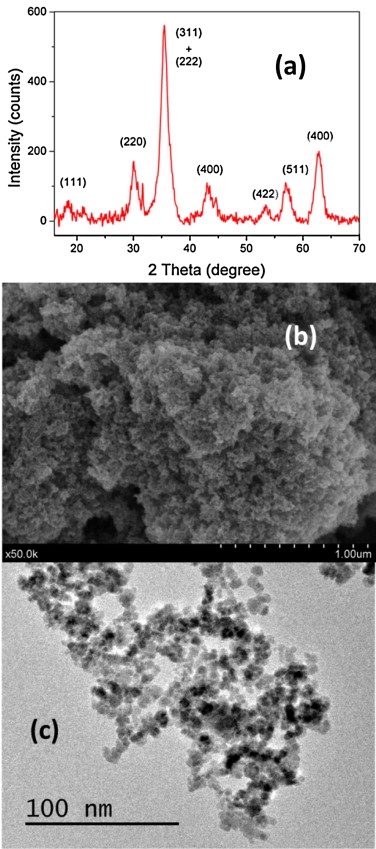
In this work, core-shell Fe3O4@poly(dopamine) magnetic nanoparticles (m-NPs) were prepared and characterized in our laboratory and applied as sorbents for the magnetic-micro solid phase extraction (m-mu SPE) of twelve estrogenic compounds of interest (i.e. 17 alpha-estradiol, 17 beta-estradiol, estrone, hexestrol, 17 alpha-ethynylestradiol, diethylstibestrol, dienestrol, zearalenone, alpha-zearalanol,beta-zearalanol, alpha-zearalenol and beta-zearalenol) from different water samples. Separation, determination…

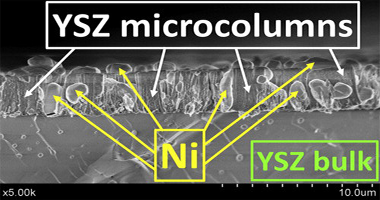
Porous, robust highly conducting Ni-YSZ thin film anodes prepared by magnetron sputtering at oblique angles for application as anodes and buffer layers in solid oxide fuel cells

Uniform, highly porous, columnar thin films incorporating YSZ and NiO prepared by magnetron sputtering with deposition at glancing incidence exhibited stoichiometries close to that of the Y-Zr-Ni sputter target. Characterization by means of SEM, XRD, XPS and RBS revealed that the uniformly distributed nickel component in the as-deposited films consisted of NiO, and that the…

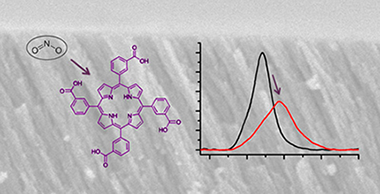
Free-Base Carboxyphenyl Porphyrin Films Using a TiO2 Columnar Matrix: Characterization and Application as NO2 Sensors

The anchoring effect on free-base carboxyphenyl porphyrin films using TiO2 microstructured columns as a host matrix and its influence on NO2 sensing have been studied in this work. Three porphyrins have been used: 5-(4-carboxyphenyl)10,15,20-triphenyl-21H,23H-porphyrin (MCTPP); 5,10,15,20-tetrakis(4-carboxyphenyl)-21H,23H-porphyrin (p-TCPP); and 5,10,15,20-tetrakis(3-carboxyphenyl)-21H,23H-porphyrin (m-TCPP). The analysis of UV-Vis spectra of MCTPP/TiO2, p-TCPP/TiO2 and m-TCPP/TiO2 composite films has revealed that m-TCPP/TiO2 films are the most stable, showing less…