Hydrogenation of 2,2,2-trifluoroacetophenone: Molecular insight into the role of solvent in enantioselection

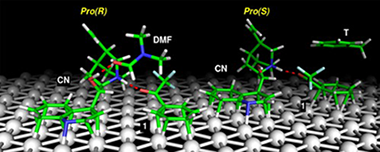
The unique solvent effect in the enantioselective hydrogenation of α-fluorinated ketones has been investigated in ten different solvents using the  hydrogenation of 2,2,2-trifluoroacetophenone (1) on cinchonine (CN)-modified Pt/Al2O3 as a model reaction. Application of strongly basic solvents – but also increasing hydrogen pressure or conversion – inverted the sense of enantiodifferentiation from (S)-alcohol (expected enantiomer…

Hydrogenation of 2,2,2-trifluoroacetophenone: Molecular insight into the role of solvent in enantioselection

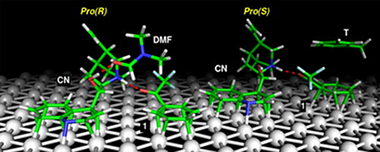
The unique solvent effect in the enantioselective hydrogenation of α-fluorinated ketones has been investigated in ten different solvents using the  hydrogenation of 2,2,2-trifluoroacetophenone (1) on cinchonine (CN)-modified Pt/Al2O3 as a model reaction. Application of strongly basic solvents – but also increasing hydrogen pressure or conversion – inverted the sense of enantiodifferentiation from (S)-alcohol (expected enantiomer…

Preparation of nanostructured nickel aluminate spinel powder from spent NiO/Al2O3 catalyst by mechano-chemical synthesis

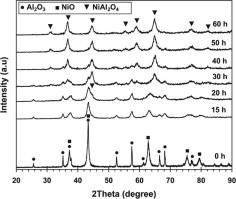
In this paper, the possibility of mechano-chemical synthesis, as a single step process for preparation of nanostructured nickel aluminate spinel powder from NiO/Al2O3 spent catalyst was investigated. Powder samples were characterized in terms of composition, morphology, structure, particle size and surface area using complementary techniques such as X-ray diffraction (XRD), scanning electron microscopy (SEM), transmission…

Effect of deposition of silver on structural characteristics and photoactivity of TiO2-based photocatalysts

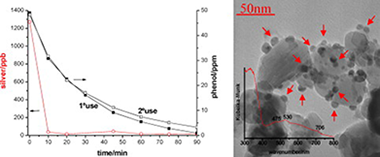
The homemade bare TiO2 photocatalyst obtained in a previous work was modified with nanosized silver particles by liquid impregnation and photodeposition methods to obtain different noble metal loadings (0.3–1 at.%). Characterization of the synthesized photocatalysts was carried out by the BET method, XPS, TEM, SEM-EDX, XRD and diffuse reflectance measurements. Photocatalytic activity of these silver-deposited…

Making Photo-selective TiO2 Materials by Cation–Anion Codoping: From Structure and Electronic Properties to Photoactivity

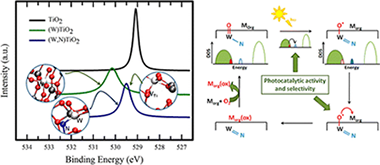
Photoselective oxidation yielding high-added value chemicals appears as a green novel process with potential to be explored. In this study we combine spectroscopic XPS (N 1s and O 1s) and multiwavelength Raman data with density functional theory calculations to explore the structural and electronic properties of W,N-codoped TiO2 anatase surfaces and interpret the outstanding photocatalytic…

Evidence of upconversion luminescence contribution to the improved photoactivity of erbium doped TiO2 systems

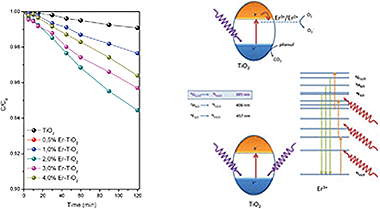
Er3+–TiO2 synthesized by a surfactant free hydrothermal method exhibits good photoactivities under sun-like excitation for the degradation of phenol. The presence of Er3+ does not affect the structural and morphological features of the TiO2 significantly. The best photocatalytic performance was attained for the samples with 2 wt% of Er. Different photocatalytic runs indicated that the…

LaNiO3 as a precursor of Ni/La2O3 for CO2 reforming of CH4: Effect of the presence of an amorphous NiO phase

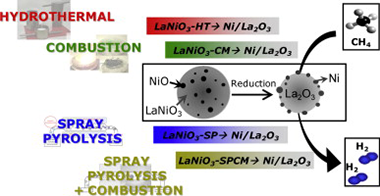
The objective of the present work has been the study of the physico-chemical and catalytic properties of Ni/La2O3 catalysts obtained by reduction of four LaNiO3 samples prepared by different methods. The LaNiO3 precursors as well as the resulting Ni/La2O3 catalysts, were characterized by scanning electron microscopy (SEM), X-ray diffraction (XRD), X-ray absorption spectroscopy (XAS), temperature…

Hydrothermal synthesis of BiVO4: Structural and morphological influence on the photocatalytic activity

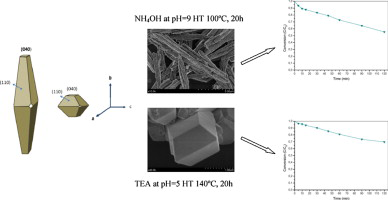
BiVO 4 hierarchical heterostructures are synthesized by means of a surfactant free hydrothermal method having good photoactivities for the degradation of methylene blue under UV-vis irradiation. From the structural and morphological characterization it has been stated that BiVO 4 present the monoclinic crystalline phase with different morphologies depending on the pH value, type of precipitating…

Advanced nanoarchitectures for solar photocatalytic applications

Advanced nanostructured materials that demonstrate useful activity under solar excitation in fields concerned with the elimination of pollutants, partial oxidation and the valorization of chemical compounds, water splitting and CO 2 reduction processes, are discussed. Point defects present in nanoparticulated anatase present both 5-fold- and 6-fold-coordinated titanium atoms, as well as 2-fold- and 3-fold-coordinated oxygens.…