Viability of adding gypsum and calcite for remediation of metal-contaminated soil: laboratory and pilot plant scales

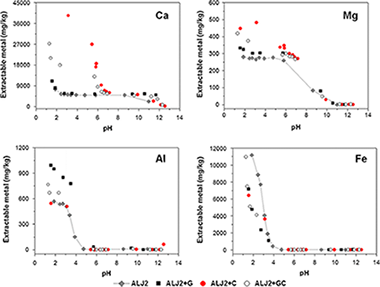
The effect of adding waste materials (gypsum and calcite) for the remediation of a soil contaminated by pyritic minerals was examined. Materials were characterised in terms of their acid neutralisation capacity (ANC), sorption capacity and structural components. Their effect on the contaminant leaching in soil + material mixtures over a wide range of pH was also evaluated.…

Fabrication of Optical Multi layer Devices from Porous Silicon Coatings with Closed Porosity by Magnetron Sputtering

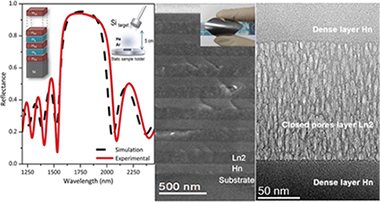
The fabrication of single-material photonic-multilayer devices is explored using a new methodology to produce porous silicon layers by magnetron sputtering. Our bottom-up methodology produces highly stable amorphous porous silicon films with a controlled refractive index using magnetron sputtering and incorporating a large amount of deposition gas inside the closed pores. The influence of the substrate…

Self-Assembling of Tetradecylammonium Chain on Swelling High Charge Micas (Na-Mica-3 and Na-Mica-2): Effect of Alkylammonium Concentration and Mica Layer Charge

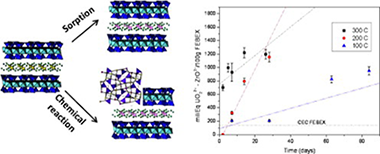
A family of tetradecylammonium micas is synthesized using synthetic swelling micas with high layer charge (NanSi8-nAln,Mg6F4O20 center dot XH2O, where n = 2 and 3) exchanged with tetradecylammonium cations. The molecular arrangement of the surfactant is,elucidated on the basis of XRD patterns and DTA. The ordering conformation of the surfactant molecules into the interlayer space…

Pectin-Lipid Self-Assembly: Influence on the Formation of Polyhydroxy Fatty Acids Nanoparticles

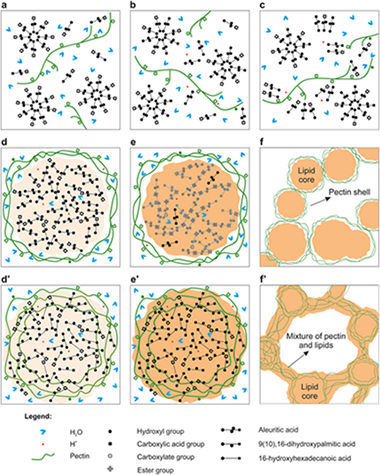
Nanoparticles, named cutinsomes, have been prepared from aleuritic (9,10,16-trihidroxipalmitic) acid and tomato fruit cutin monomers (a mixture of mainly 9(10), 16-dihydroxypalmitic acid (85%, w/w) and 16-hydroxyhexadecanoic acid (7.5%, w/w)) with pectin in aqueous solution. The process of formation of the nanoparticles of aleuritic acid plus pectin has been monitored by UV-Vis spectrophotometry, while their chemical…

Microstructure, elastic and inelastic properties of partially graphitized biomorphic carbons

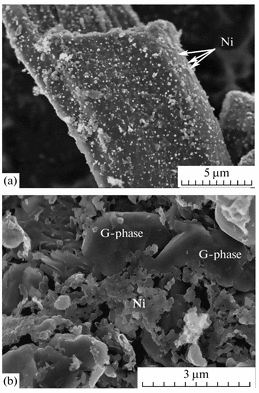
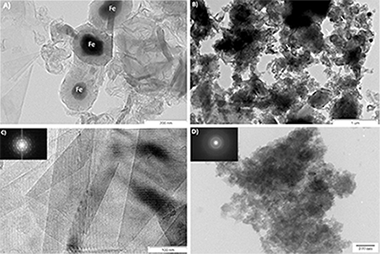
The microstructural characteristics and amplitude dependences of the Young’s modulus E and internal friction (logarithmic decrement delta) of biocarbon matrices prepared by beech wood carbonization at temperatures T (carb) = 850-1600A degrees C in the presence of a nickel-containing catalyst have been studied. Using X-ray diffraction and electron microscopy, it has been shown that the…

Sliding wear resistance of sintered SiC-fiber bonded ceramics

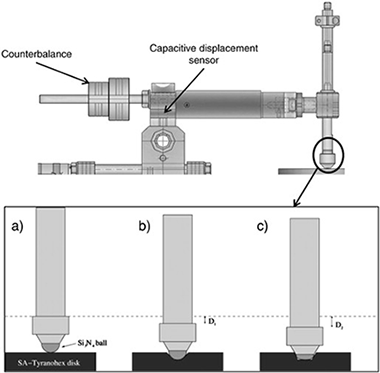
Advanced SiC-based ceramics and fiber reinforced composites are interesting materials for a wide variety of applications involving sliding wear conditions because of their excellent thermomechanical properties. The microstructure and wear resistance of sintered SiC fiber bonded ceramics (SA Tyrannohex) were studied. The material is composed of SiC-fibers in two orientations, with polygonal cross sections and…

Sliding wear resistance of biomorphic SiC ceramics

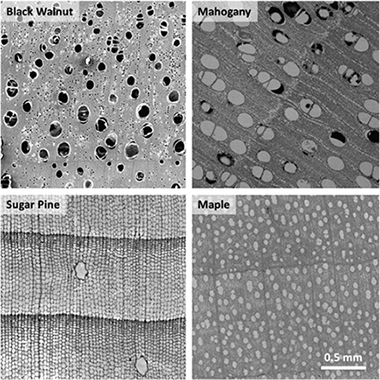
Biomorphic SiC ceramics were fabricated from four different wood precursors and their Knoop hardness and sliding wear resistance when sliding against a Si3N4 ball in air were studied. Tribological experiments were performed using a pin on disk apparatus, under normal loads of 2 and 5 N, at a sliding speed of 100 mm/s. The effects…

Effect of catalytic graphitization on the electrochemical behavior of wood derived carbons for use in supercapacitors

Porous graphitic carbons were successfully obtained from wood precursors through pyrolysis using a transition metal as catalyst. Once the catalyst is removed, the resulting material mimics the microstructure of the wood and presents high surface area, open and interconnected porosity and large pore volume, high crystallinity and good electrical conductivity, making these carbons interesting for…