



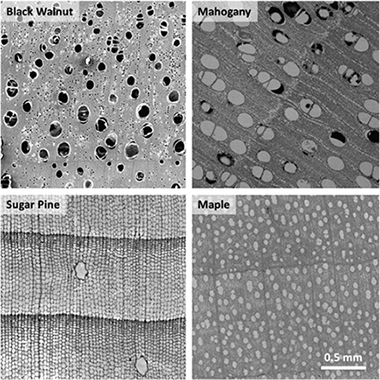
Biomorphic SiC ceramics were fabricated from four different wood precursors and their Knoop hardness and sliding wear resistance when sliding against a Si3N4 ball in air were studied. Tribological experiments were performed using a pin on disk apparatus, under normal loads of 2 and 5 N, at a sliding speed of 100 mm/s. The effects of specimen porosity and microstructure on measured wear were evaluated. A commercial sintered silicon carbide ceramic was also tested for comparison. Small differences in friction coefficient comparable to monolithic SiC ceramics were obtained. Several concurrent wear mechanisms are taking place: microfracture, plastic deformation in the Si phase and oxidation of the Si and/or SiC phase. The presence of an oxide tribolayer was assessed using fluorescence microscopy. Wear rates were found to scale with SiC content and depend on residual porosity in the composite.