


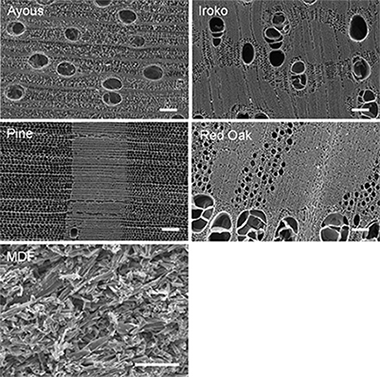
Biomorphic SiC is a SiC/Si composite made by the reactive infiltration of molten silicon by capillarity into a carbon preform from high-temperature pyrolysis of a wood porous precursor. When excess silicon is removed, a hierarchically porous SiC material with highly interconnected porosity is obtained. By choosing different wood precursors, different pore size distributions can be obtained thus tailoring the resulting properties.
We study the thermal conductivity of porous biomorphic SiC from five different precursors, including a recycled wood product, in order to determine the microstructure-conductivity correlation. Here, we remove the excess of silicon by a high temperature capillary extraction-evaporation method. We used the laser flash technique to measure thermal diffusivity in the range similar to 300 K to 973 K, in order to determine the thermal conductivity. Thermal conductivities in the range 4-88 W/m K were achieved. The temperature, porosity, pore shape and orientation, and the treatment used to remove the remaining silicon all have a significant impact in the resulting thermal conductivity. We explain this influence in a first approximation in terms of a geometrical model.