c- C4F8 Plasmas for the Deposition of Fluorinated Carbon Films

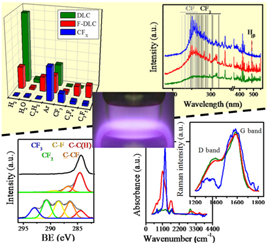
Highly fluorinated polymeric (CFX), fluorine containing diamond-like carbon (F-DLC) and, for comparison, diamond-like carbon (DLC) films have been plasma deposited in a RF parallel plate reactor by using c-C4F8 as fluorine precursor and different mixtures of argon, C2H2, and H2. Plasmas have been characterized by optical emission spectroscopy, mass spectrometry, and Langmuir probe measurements. Differences…

Comments on «an essay on contact angle measurements»: Determination of surface roughness and modeling of the wetting behavior

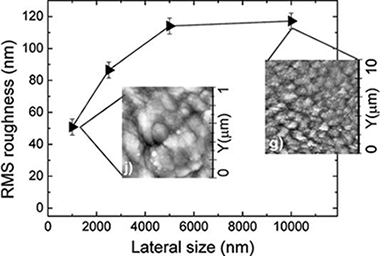
This commentary addresses the problem of determining surface roughness values and their use to assess the wetting behavior of surfaces. For very rough surfaces it is shown that depending on the observation scale by atomic force microscopy (AFM) quite different RMS roughness values can be obtained and that only the values taken at saturation can…

Identification of Ternary Phases in TiBC/a-C Nanocomposite Thin Films: Influence on the Electrical and Optical Properties

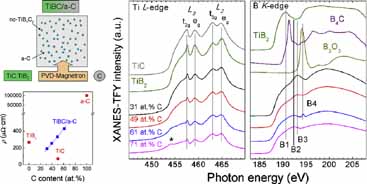
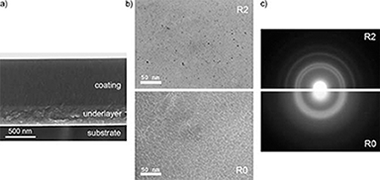
The local structure of TiBC and amorphous carbon (a-C) nanocomposite films (TiBC/a-C) was correlated with their optical and electrical properties. TiBC/a-C films with increasing C content were deposited by magnetron co-sputtering from TiC:TiB2 (60:40) and graphite targets. Chemical composition is determined by electron energy-loss spectroscopy. Grazing incidence X-ray diffraction reveals that the microstructure of the…

Bonding Structure and Mechanical Properties of Ti-B-C Coatings

Nanocomposite coatings combining hard phases (TiB2, TiC) with an amorphous carbon (a-C) were developed to provide a good compromise between mechanical and tribological properties for M2 steels used in a wide variety of applications such as cutting tools, bearings and gear mechanisms. A combined d.c.-pulsed and r.f.-magnetron deposition process was used to deposit nanocomposite TiBC/a-C…

Formation of Nitrogen Functional Groups on Plasma Treated DLC

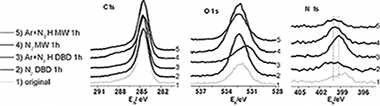
Diamond like carbon (DLC) thin films have been exposed to different nitrogen containing plasmas. A dielectric barrier discharge (DBD) at atmospheric pressure and a microwave discharge (MW) at low pressure using N2 and mixtures Ar + NH3 have been compared. Optical Emission and X-ray Photoelectron spectroscopies, Atomic Force Microscopy and contact angle measurements have been used for…

Thermal Stability and Oxidation Resistance of Nanocomposite TiC/a-C Protective Coatings

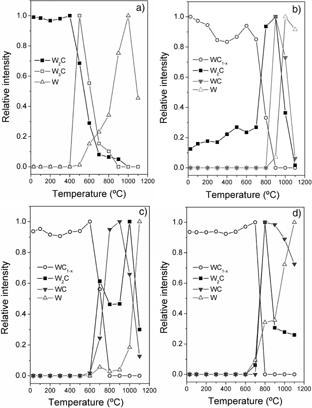
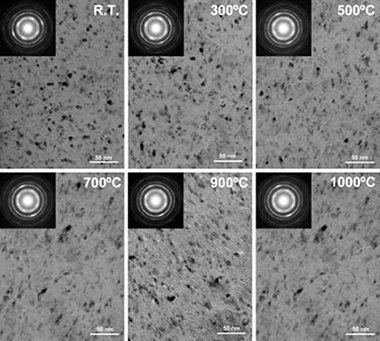
Nanocomposite films composed by small crystallites of hard phases embedded in an amorphous lubricant matrix have been extensively studied as protective coatings. These kinds of coatings have often to work in extreme environments, exposed to high temperatures (above 800–900 °C), and/or oxidizing/corrosive atmospheres, which may resist. As a result, it is important to study the behavior…

Luminescent and Optical Properties of Nanocomposite Thin Films Deposited by Remote Plasma Polymerization of Rhodamine 6G

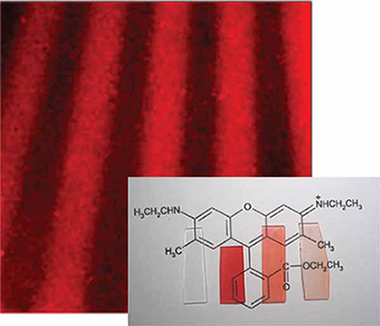
Mechanically stable and insoluble fluorescent thin films have been deposited by sublimating Rhodamine 6G laser dye in the downstream region of a low-power microwave ECR plasma using an experimental set-up designed to control the interaction of the dye molecule with the glow discharge. The use of reactive organosilane plasmas allows to control the dye distribution…

Luminescent and Optical Properties of Nanocomposite Thin Films Deposited by Remote Plasma Polymerization of Rhodamine 6G

Mechanically stable and insoluble fluorescent thin films have been deposited by sublimating Rhodamine 6G laser dye in the downstream region of a low-power microwave ECR plasma using an experimental set-up designed to control the interaction of the dye molecule with the glow discharge. The use of reactive organosilane plasmas allows to control the dye distribution…