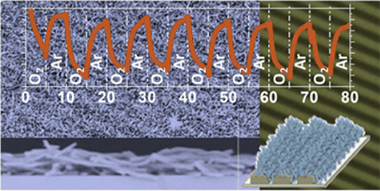
Facile integration of single-crystalline phthalocyanine nanowires and nanotrees as photo-enhanced conductometric sensors

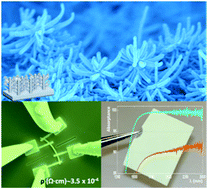
This article presents a reproducible and affordable methodology for fabricating organic nanowires (ONWs) and nanotrees (ONTs) as light-enhanced conductometric O2 sensors. This protocol is based on a solventless procedure for the formation of high-density arrays of nanowires and nanotrees on interdigitated electrodes. The synthesis combines physical vapour deposition for the self-assembled growth of free-phthalocyanine nanowires and soft plasma etching to prompt the nucleation sites on the as-grown ONWs to allow for the formation of nanotrees. Electrical conductivity in…

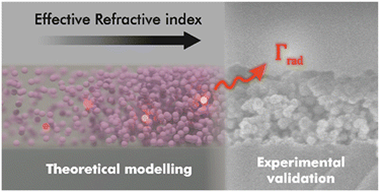
Effect of the effective refractive index on the radiative decay rate in nanoparticle thin films

In this work, we theoretically and experimentally study the influence of the optical environment on the radiative decay rate of rare-earth transitions in luminescent nanoparticles forming a thin film. We use electric dipole sources in finite-difference time-domain simulations to analyze the effect of modifying the effective refractive index of transparent layers made of phosphor nanocrystals…

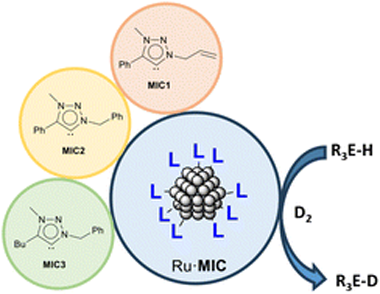
Ruthenium nanoparticles stabilized by 1,2,3-triazolylidene ligands in the hydrogen isotope exchange of E-H bonds (E = B, Si, Ge, Sn) using deuterium gas

  A series of ruthenium nanoparticles (Ru & BULL;MIC) stabilized with different mesoionic 1,2,3-triazolylidene (MIC) ligands were prepared by decomposition of the Ru(COD)(COT) (COD = 1,5-cyclooctadiene; COT = 1,3,5-cyclooctatriene) precursor with H-2 (3 bar) in the presence of substoichiometric amounts of the stabilizer (0.1-0.2 equiv.). Small and monodisperse nanoparticles exhibiting mean sizes between 1.1 and 1.2 nm were obtained, whose characterization was carried out by means of transmission electron microscopy (TEM), including high resolution TEM (HRTEM), inductively coupled plasma (ICP) analysis and X-ray photoelectron…

Feasibility of switchable dual function materials as a flexible technology for CO2 capture and utilisation and evidence of passive direct air capture

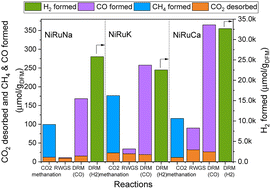
The feasibility of a Dual Function Material (DFM) with a versatile catalyst offering switchable chemical synthesis from carbon dioxide (CO2) was demonstrated for the first time, showing evidence of the ability of these DFMs to passively capture CO2 directly from the air as well. These DFMs open up possibilities in flexible chemical production from dilute…

One-reactor vacuum and plasma synthesis of transparent conducting oxide nanotubes and nanotrees: from single wire conductivity to ultra-broadband perfect absorbers in the NIR

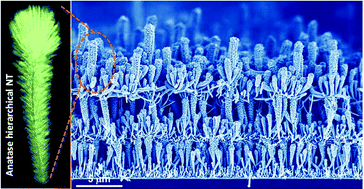
The eventual exploitation of one-dimensional nanomaterials needs the development of scalable, high yield, homogeneous and environmentally friendly methods capable of meeting the requirements for fabrication of functional nanomaterials with properties on demand. In this article, we demonstrate a vacuum and plasma one-reactor approach for the synthesis of fundamental common elements in solar energy and optoelectronics,…

Platinum nanoparticles stabilized by N-heterocyclic thiones. Synthesis and catalytic activity in mono- and di-hydroboration of alkynes

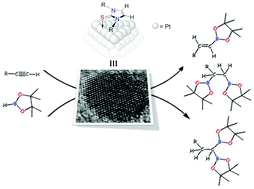
N-Heterocyclic Thiones (NHT) proved to be efficient ligands for the stabilization of small platinum nanoparticles (1.3-1.7 nm), synthesized by decomposition of [Pt(dba)(2)], under a H-2 atmosphere, in the presence of variable sub-stoichiometric amounts of the NHT. Full characterization by means of TEM, HR-TEM, NMR, ICP, TGA and XPS have been carried out, providing information about the nature of the metal nanoparticles and the interaction of the NHT ligands to the metal surface. Importantly, DFT calculations indicate that some NHT ligands interact with…

High vacuum synthesis and ambient stability of bottom-up graphene nanoribbons

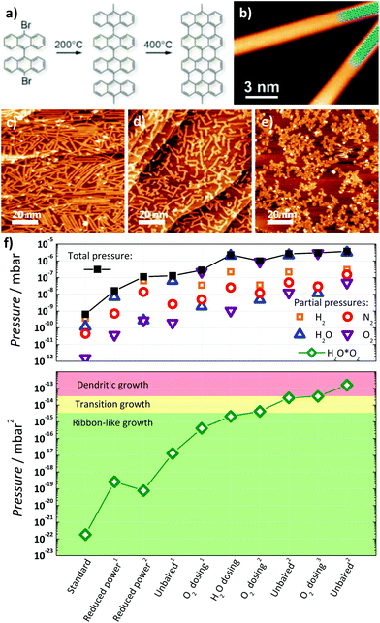
Carbon-based nanomaterials such as graphene are at a crucial point in application development, and their promising potential, which has been demonstrated at the laboratory scale, must be translated to an industrial setting for commercialization. Graphene nanoribbons in particular overcome one limitation of graphene in some electronic applications because they exhibit a sizeable bandgap. However, synthesis…