


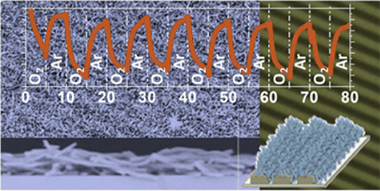
This article presents a reproducible and affordable methodology for fabricating organic nanowires (ONWs) and nanotrees (ONTs) as light-enhanced conductometric O2 sensors. This protocol is based on a solventless procedure for the formation of high-density arrays of nanowires and nanotrees on interdigitated electrodes. The synthesis combines physical vapour deposition for the self-assembled growth of free-phthalocyanine nanowires and soft plasma etching to prompt the nucleation sites on the as-grown ONWs to allow for the formation of nanotrees. Electrical conductivity in such low-dimensional electrodes was analysed in the context of density, length, and interconnection between nanowires and nanotrees. Furthermore, the electrodes were immersed in water to improve the nanowires’ connectivity. The response of the nanotrees as conductometric O2 sensors was tested at different temperatures (from room temperature to 100 degrees C), demonstrating that the higher surface area exposed by the nanotrees, in comparison with that of their polycrystalline thin film counterparts, effectively enhances the doping effect of oxygen and increases the response of the ONT-based sensor. Both organic nanowires and nanotrees were used as model systems to study the augmented response of the sensors provided by illumination with white or monochromatic light to organic semiconducting systems. Interestingly, the otherwise negligible sensor response at room temperature can be activated (On/Off) under LED illumination, and no dependency on the illumination wavelength in the visible range was observed. Thus, under low-power LED illumination with white light, we show a response to O2 of 16% and 37% in resistivity for organic nanotrees at room temperature and 100 degrees C, respectively. These results open the path to developing room temperature long-lasting gas sensors based on one- and three-dimensional single-crystalline small-molecule nanowires.