Advancements in the integration and understanding of the Sestak-Berggren generalized conversion function for heterogeneous kinetics

Kinetic models are relevant to describe heterogeneous kinetic processes; a number of kinetic models and their mathematical expressions have been reported in the literature, many of these based on idealistic conditions in terms of geometrical constrain and driving forces. Alternatively, the semi-empirical Sestak-Berggren (SB) conversion function, which was proposed as a general equation, encompasses a…

Ultraslow calorimetric studies of the martensitic transformation of NiFeGa alloys: detection and analysis of avalanche phenomena

We study the thermal properties of a bulk Ni55Fe19Ga26 Heusler alloy in a conduction calorimeter. At slow heating and cooling rates (∼1Kh-1), we compare as-cast and annealed samples. We report a smaller thermal hysteresis after the thermal treatment due to the stabilization of the 14 M modulated structure in the martensite phase. In ultraslow experiments (40mKh-1), we…

Predictions of polymer thermal degradation: relevance of selecting the proper kinetic model

Making predictions, such as lifetime estimations, is one of the main objectives of kinetic studies. Thus, from conventional thermal analysis experiments, the behavior of polymeric materials under processing or application conditions, usually far away from those used in the laboratory experiments, could be estimated. Conventional prediction procedures usually make use of oversimplified equations based on…

Characterization, thermal and ceramic properties of phyllite clays from southeast Spain

The present research studied a set of phyllite clays from several deposits in southeast Spain. These phyllite clays have traditionally been used as sealing material to impermeabilize roofs, embankments, ponds, construction and waste landfill, with recent applications in the preparation of new mortars. However, studies on thermal behaviour and ceramic properties of phyllite clays have been scarce. The present research showed a summary of previous characterization studies on representative phyllite clays from these deposits with additional results. Mineralogical, by X-ray diffraction, and chemical,…

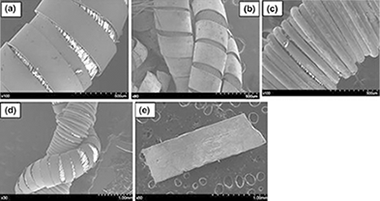
Study of the thermal decomposition of historical metal threads

In this work, it is reported that thermal analysis techniques such as differential thermal analysis and thermogravimetric analysis are very useful for evaluating metals threads and fibres used in the manufacture of historical artifacts. Thermal analysis has been used to characterize the silk, cotton and linen employed as supports and the copper, silver and aluminium…

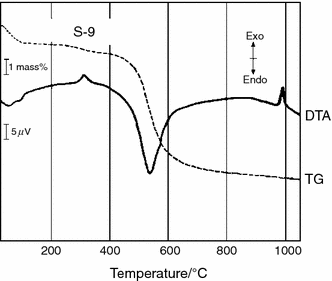
Thermal behaviour of sericite clays as precursors of mullite materials

Thermal analysis of some sericite clays, from several deposits in Spain, which are not exploited at this time, has been studied. The samples have been previously characterized by mineralogical and chemical analysis. Sericite clays have interesting properties, with implications in ceramics and advanced materials, in particular concerning the formation of mullite by heating. According to…

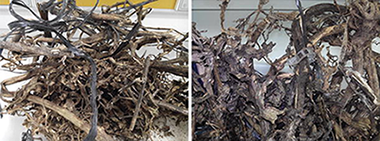
Thermal study of residues from greenhouse crops plant biomass

The principal aim of this work is to examine the effect of thermal treatments using a muffle furnace (static heating) and by simultaneous TG/DTA (dynamic heating) on selected greenhouse crops plant biomass investigated here as the first time. The effect of fractionation by sieving (<25 and <2.5 mm), preheating at 150 °C for 48 h and leaching with…