Turquoise hydrogen and carbon nanostructures from methane pyrolysis enable a dual approach to clean energy and asphalt enhancement

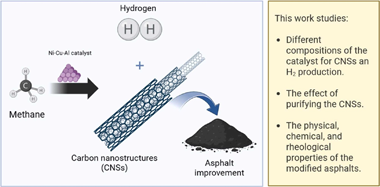
This study proposes a dual-purpose strategy that integrates turquoise H-2 production with the valorization of carbon nanostructures (CNSs) obtained from CH4 pyrolysis for use as asphalt modifiers. Ni-Cu-Al catalysts with different Ni/Cu ratios (0.5-4.0) were synthesized via combustion and evaluated for CH4 pyrolysis at 700 degrees C. The catalyst with Ni/Cu = 0.5 achieved 83…

From the lab to the river: Bimetallic clinoptilolite photocatalyst for antibiotic-resistant bacteria and emerging contaminants removal

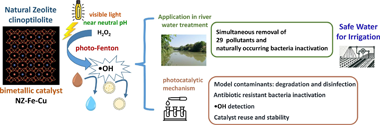
The presence of contaminants of emerging concern and antibiotic-resistant bacteria in aquatic environments is a major global challenge. Heterogeneous photo-Fenton-type treatments have proven effective; however, affordable and sustainable catalysts are needed to address real-world water treatment challenges. For the first time, we report the efficacy of a heterogeneous bimetallic Fe-Cu clinoptilolite catalyst, which can remove…

Solar light-driven degradation of thiacloprid by polymer composites based on P-doped TiO2 as photoactive phase: Theoretical and experimental assessment of the reaction mechanism and degradation pathway

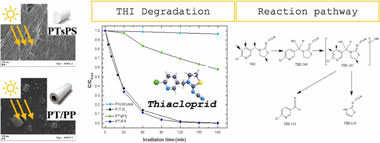
In this paper, visible light-activated phosphorus-doped TiO2 (P-TiO2) was used as a photoactive phase to prepare polymer composites for the degradation of the pesticide thiacloprid under direct sunlight irradiation. In particular, a monolithic composite aerogel, consisting of P-TiO2 embedded in syndiotactic polystyrene (PTsPS), and a composite polymer film, consisting of P-TiO2 immobilized on the surface…

Influence of the chemical activation with KOH/KNO3 on the CO2 adsorption capacity of activated carbons from pyrolysis of cellulose

Plant biomass is an attractive precursor to prepare activated carbons with high surface area for CO2 adsorption due to its low-cost and easy regeneration. Despite this interest, there are still remaining questions regarding the optimal processing conditions and the choice of activating agent. Moreover, since plant biomass shows a highly variable proportion of different biopolymers…

Impact of the biogas impurities on the quality of the precipitated calcium carbonate in the regenaration stage of a chemical absorption biogas upgrading unit

Combining Carbon Capture and Storage (CCS) with producing competitive secondary raw materials is key to decarbonizing industry and reducing resource extraction. Biogas upgrading to biomethane stand out as an alternative, but a significant gap remains in integrating this process within a circular economy framework. This issue has been recently addressed by a process that integrates…

Application of novel Zn-MIL53(Fe) for removal of micropollutants using an activated peroxymonosulphate system

Novel zinc-doped Metal-Organic Framework based on MIL53(Fe) (Zn-MIL53(Fe)) has been successfully synthesised in one-step, exhibiting dual applications as adsorbent and catalyst. Initially, the adsorption capacity of MIL53(Fe) and Zn-MIL53(Fe) for removing Rhodamine B was assessed through kinetic and isotherm studies. The bimetallic variant exhibited superior performance, showcasing enhanced adsorption capabilities, particularly in the context of…

Photoreforming of glycerol to produce hydrogen from natural water in a compound parabolic collector solar photoreactor

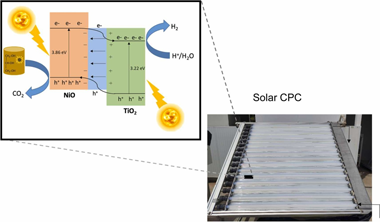
To improve TiO2 for H2 generation, one strategy for the separation of photogenerated charges is the formation of heterostructures with other materials. In particular, NiO is a photocatalyst known for its good stability and low cost. However, no studies at pilot scale using solar energy have been described. Consequently, an evaluation of a physical NiO:TiO2 mixture at pilot scale (25 L) with natural irradiation (2.10 m2 of sun-exposed surface) and with simultaneous glycerol photoreforming was explored.…

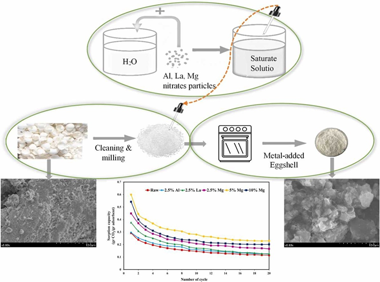
Metal- based eggshell particles prepared via successive incipient wetness impregnation method as a promoted sorbent for CO2 capturing in the calcium looping process

  Cyclic adsorption by using of bio-waste eggshell particles as a cheap, accessible and environmentally friendly CaCO3 source has been considered as one of the important methods to decrease or remove CO2 from the flue gas. However, deactivation of eggshell particles and CO2 capture capacity decaying with increasing the cycle’s number remained as an important…

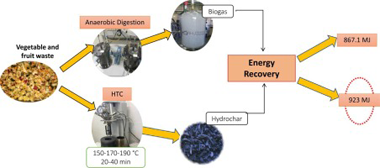
Hydrothermal carbonization vs. anaerobic digestion to valorize fruit and vegetable waste: A comparative technical and energy assessment

Herein, the valorization of vegetable and fruit waste was assessed via hydrothermal carbonization (HTC) and anaerobic digestion (AD) in terms of product characterization and energy requirements. HTC was conducted at reaction temperatures between 150 & DEG;C and 190 & DEG;C, and residence times between 20 min and 40 min. The increase in the process severity…

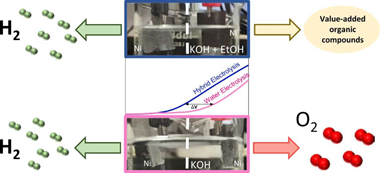
Nanostructured nickel based electrocatalysts for hybrid ethanol-water anion exchange membrane electrolysis

Ni and Ni-Fe nanostructured layers prepared by magnetron sputtering in an oblique angle deposition configuration (MS-OAD) have been used as anode and cathode catalysts for hybrid ethanol-water electrolysis in an anion exchange membrane (AEM) electrolyser. Physico-chemical and electrochemical characterization in a threeelectrode cell has been carried out to determine the optimal characteristics of the anodic…