


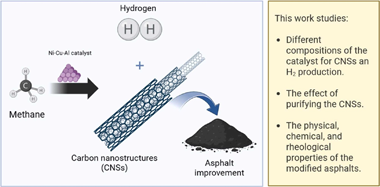
This study proposes a dual-purpose strategy that integrates turquoise H-2 production with the valorization of carbon nanostructures (CNSs) obtained from CH4 pyrolysis for use as asphalt modifiers. Ni-Cu-Al catalysts with different Ni/Cu ratios (0.5-4.0) were synthesized via combustion and evaluated for CH4 pyrolysis at 700 degrees C. The catalyst with Ni/Cu = 0.5 achieved 83 % CH4 conversion, 100 % H-2 selectivity, and a CNSs yield of 2.43 g & centerdot;gcat(-)& sup1; & centerdot;h(-)& sup1; . A mixture of carbon nanostructures, including nanofibers and nanotubes with multi-walled, bamboo-like, and octopus-like morphologies, was obtained, exhibiting low crystallinity. The effects of using unpurified CNSs, that is, CNSs obtained directly from the catalytic reactor or acid-purified, were evaluated. After purification, the CNSs exhibited improved graphitization, higher thermal stability, and low-residual metal content. Incorporating 2 wt% CNSs into 60/70 asphalt increased stiffness, reduced ductility, and improved aging resistance. Unpurified CNTs matched the performance of purified CNTs, reducing the cost and environmental impact by avoiding acid treatment. AFM imaging revealed a more homogeneous distribution of the catana-type morphology, characterized by better-defined elongated domains and a concomitant reduction in surface roughness. Rheological analysis confirmed greater rutting resistance (|G*|/sin delta > 2.2 kPa at 64 degrees C), better fatigue performance, and an upgraded PG (penetration grade) rating from 58/22-64/19. This approach enables the simultaneous generation of low-carbon H-2 and valorization of CNSs in asphalt applications.