CuOx supported LaCoO3 perovskite for the photoassisted reverse water gas shift reaction at low temperature

  CuOx/LaCoO3 systems have been studied for the rWGS reaction under thermal assisted photocatalytic conditions within low temperature range of 180-330 degrees C. CuOx species deposited from chemical reduction method over LaCoO3 homogeneously covered the perovskite surface. The reduction pretreatment before reaction leads to the partial Co reduction and the complete reduction of Cu. A…

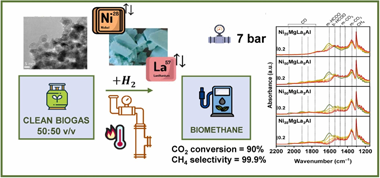
Synthetic natural gas production using CO2-rich waste stream from hydrothermal carbonization of biomass: Effect of impurities on the catalytic activity

The utilization of biomass and bio-waste, particularly through hydrothermal processes, has shown promise as a technology for converting these materials into valuable products. While most research has traditionally focused on the solid and liquid byproducts of these hydrothermal treatments, the gaseous phase has often been over-looked. This study specifically investigates the conversion of off-gases produced during hydrothermal carbonation (HTC) into synthetic natural gas, offering a readily marketable product with economic potential. Although the methanation of conventional flue gases has been extensively studied, dealing…

Switchable catalysis for methanol and synthetic natural gas synthesis from CO2: A techno-economic investigation

The oil and gas sector produces a considerable volume of greenhouse gas emissions, mainly generated from flaring and venting natural gas. Herein, a techno-economic analysis has been performed of a switchable catalytic process to convert the CH4 and CO2 in flared/vented natural gas into syngas or methanol. Specifically, it was shown that depending on greenhouse gas composition, dry methane reforming (DRM), reverse…

Experimental optimization of Ni/P atomic ratio for nickel phosphide catalysts in reverse water-gas shift

Nickel phosphide catalysts show a high level of selectivity for the reverse water-gas shift (RWGS) reaction, inhibiting the competing methanation reaction. This work investigates the extent to which suppression of methanation can be controlled by phosphidation and tests the stability of phosphide phases over 24-hour time on stream. Herein the synthesis of different phosphide crystal structures by varying Ni/P atomic…

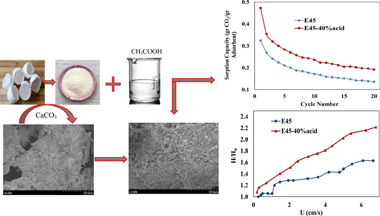
Improvement in cyclic CO2 capture performance and fluidization behavior of eggshell-derived CaCO3 particles modified with acetic acid used in calcium looping process

Although calcium-based materials are the most promising adsorbents used in calcium looping process for carbon dioxide removing, their CO2 capture capacity decaying besides poor fluidization, still are the important challenges. In the present investigation, eggshell as a cheap, easily available and unpolluted source of calcium carbonate was used for CO2 capturing in calcium looping process. Eggshell particles were treated with various volume concentrations of acetic acid to improve its sorption capacity. According to the TGA results after 20 carbonation/calcination cycles, the effective carbonation conversion of modified eggshell with 5%, 20%, 30% and…

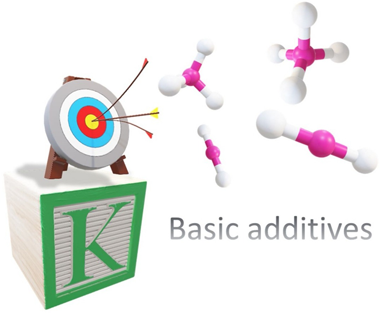
Effect of potassium loading on basic properties of Ni/MgAl2O4 catalyst for CO2 reforming of methane

Coke deposition is one of the key issues in the dry reforming of methane on Ni catalysts. In the present work, we investigate the effect of potassium addition for suppressing carbon deposition in the Dry Reforming of Methane. The results obtained demonstrated that potassium contents above 3 wt% promote carbon gasification, favouring both Reverse Water Gas Shift and Boudouard reaction.…

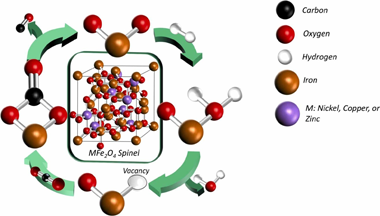
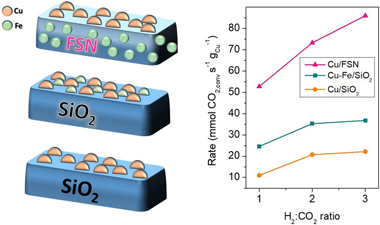
Cu supported Fe-SiO2 nanocomposites for reverse water gas shift reaction

This work analyses the catalytic activity displayed by Cu/SiO2, Cu-Fe/SiO2 and Cu/FSN (Fe-SiO2 nanocomposite) catalysts for the Reverse Water Gas Shift reaction. Compared to Cu/SiO2 catalyst, the presence of Fe resulted on higher CO?s selectivity and boosted resistances against the constitution of the deactivation carbonaceous species. Regarding the catalytic performance however, the extent of improvement…

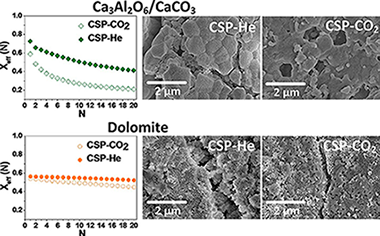
Role of calcium looping conditions on the performance of natural and synthetic Ca-based materials for energy storage

In this work, the multicycle activity of natural CaO precursors (limestone and dolomite) and Ca-based composites (Ca3Al2O6/CaCO3 and ZrO2/CaCO3 mixtures) has been studied for Thermochemical Energy Storage (TCES) in Concentrated Solar Power (CSP) plants by means of the Calcium-Looping process (CaL), using two integration schemes proposed elsewhere that differ in the calcination stages. Under CSP-He…