


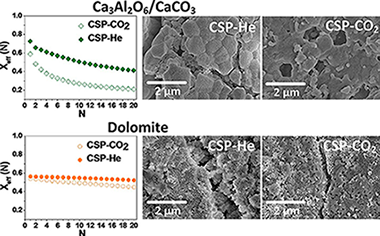
In this work, the multicycle activity of natural CaO precursors (limestone and dolomite) and Ca-based composites (Ca3Al2O6/CaCO3 and ZrO2/CaCO3 mixtures) has been studied for Thermochemical Energy Storage (TCES) in Concentrated Solar Power (CSP) plants by means of the Calcium-Looping process (CaL), using two integration schemes proposed elsewhere that differ in the calcination stages. Under CSP-He conditions, calcination for CaO regeneration is performed under pure He at low temperatures (725 degrees C) while under CPS-CO2 conditions calcination is carried out under pure CO2 at high temperatures (950 degrees C). The latter avoids the use of selective membranes to separate He from CO2 even though it requires the use of more expensive materials for solar receptors. Carbonation/calcination conditions drastically affect the multicycle CO2 uptake of the materials tested. Effective multicycle conversion is higher in CSP-He tests due to the mild conditions employed for calcination, which mitigates CaO sintering. On the other hand, the harsh calcination conditions used in CSP-CO2 tests enhance sintering of CaO derived from limestone and the Ca3Al2O6/CaCO3 composite due to the low Tammann temperature of Ca3Al2O6. CaO sintering is hindered by the presence of inert oxides with high Tammann temperatures, such as ZrO2 in the ZrO2/CaCO3 composite and MgO in dolomite. Dolomite derived CaO shows high effective conversion values along the carbonation/calcination cycles when tested under both types of conditions, as compared to limestone and the composites, which suggests that the integration scheme based on CSP-CO2 conditions would be a feasible alternative to CSP-He if natural dolomite were used as CaO precursor.