Nanophotonics for current and future white light-emitting devices

Photonic nanostructures have proven useful to enhance the performance of a wide variety of materials and devices for sensing, catalysis, light harvesting, or light conversion. Herein, we discuss the role of nanophotonics in current and next-generation designs of white light-emitting diodes (LEDs). We discuss recent developments on luminescent materials designed as alternatives to rare earth-doped…

Persistent luminescent nanoparticles: Challenges and opportunities for a shimmering future

Persistent phosphors are luminescent sources based on crystalline materials doped with rare-earth or transition metal cations able to produce light after the excitation source vanishes. Although known for centuries, these materials gained renewed interest after the discovery of Eu2+,RE3+ co-doped aluminates and silicates in the late 1990s due to their unprecedented afterglow properties. In contrast,…

Internal quantum efficiency and time signals from intensity-modulated photocurrent spectra of perovskite solar cells

Intensity Modulated Photocurrent Spectroscopy (IMPS) is a small-perturbation optoelectronic technique that measures the quantum efficiency of a photoelectrochemical device as a function of optical excitation frequency. Metal Halide Perovskites (MHPs) are mixed electronic-ionic semiconductors with an extraordinary complex optoelectronic behavior and a record efficiency surpassing 25%. In this paper, we propose a simplified procedure to…

Effect of temperature variations on equilibrium distances in levitating parallel dielectric plates interacting through Casimir forces

We study at thermal equilibrium the effect of temperature deviations around room temperature on the equilibrium distance (d(eq)) at which thin films made of Teflon, silica, or polystyrene immersed in glycerol levitate over a silicon substrate due to the balance of Casimir, gravity, and buoyancy forces. We find that the equilibrium nature (stable or unstable)…

Direct observation of doping incorporation pathways in self-catalytic GaMnAs

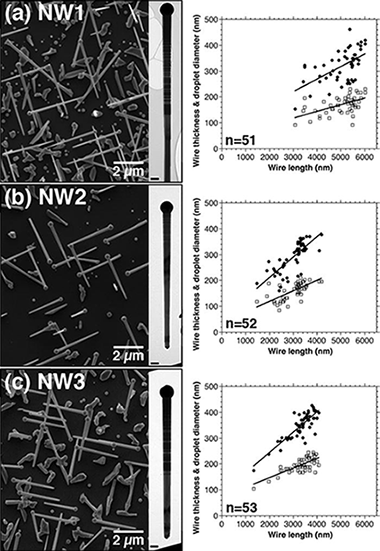
Doping mechanisms of Mn in GaAs nanowires (NWs) that have been grown self-catalytically at 600 °C by molecular beam epitaxy (MBE) are investigated using advanced electron microscopy techniques and atom probe tomography. Mn is found to be incorporated primarily in the form of non-magnetic tetragonal Ga0.82Mn0.18 nanocrystals in Ga catalyst droplets at the ends of the NWs, while trace amounts of Mn (22 ± 4 at. ppm) are also distributed randomly…

Influence of plasma-generated negative oxygen ion impingement on magnetron sputtered amorphous SiO2 thin films during growth at low temperatures

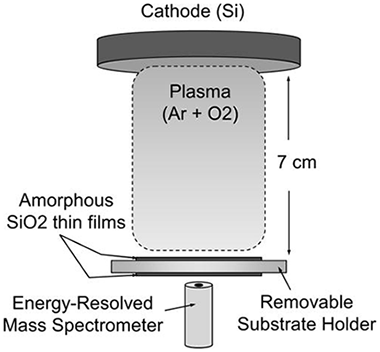
Growth of amorphous SiO2 thin films deposited by reactive magnetron sputtering at low temperatures has been studied under different oxygen partial pressure conditions. Film microstructures varied from coalescent vertical column-like to homogeneous compact microstructures, possessing all similar refractive indexes. A discussion on the process responsible for the different microstructures is carried out focusing on the…

Nanoscale mechanically induced structural and electrical changes in Ge 2Sb 2Te 5 films

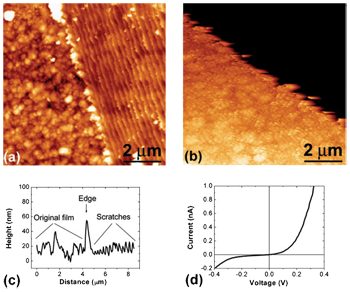
We demonstrate that the microstructure and electrical properties of Ge2Sb2Te5 films can be changed by a nanoscale mechanical process. Nanoscratching is used to define modified areas onto an as-deposited crystalline Ge2Sb2Te5 film. Scanning tunneling microscopy measurements show that the modified areas have a very low electrical conductivity. Micro-Raman measurements indicate that the mechanically induced microstructural…