Ionomer-Free Nickel-Iron bimetallic electrodes for efficient anion exchange membrane water electrolysis

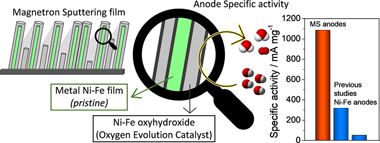
A bottleneck for the deployment of the Anion Exchange Membrane Water Electrolysis (AEMWE) is the manufacturing of efficient and long lasting anodes and cathodes for the cells. Highly performant bimetallic Ni/Fe catalyst films with various atomic ratios have been prepared by magnetron sputtering in an oblique angle configuration (MS-OAD) and used as anodes for AEMWE.…

Plasma assisted CO2 dissociation in pure and gas mixture streams with a ferroelectric packed-bed reactor in ambient conditions

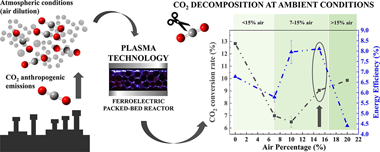
Carbon dioxide decomposition is a challenging target to combat climate change. Nonthermal plasmas are advantageous for this purpose because they operate at ambient conditions and can be easily scaled-up. In this study, we attempt the CO2 splitting into CO and O-2 in a parallel plate packed-bed plasma reactor moderated with Lead Zirconate Titanate (PZT) as…

Structure-sensitivity of formic acid dehydrogenation reaction over additive-free Pd NPs supported on activated carbon

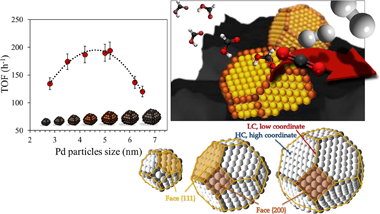
In this study the size-activity dependence of palladium based catalysts in formic acid dehydrogenation reaction was investigated and evaluated. A wide range of particle sizes was considered and the catalyst series were prepared upon variation of some synthetic parameters, precursor and solvent nature in particular. Synthesis method variations affect significantly Pd particle size and results…

Kinetics and cyclability of limestone (CaCO3) in presence of steam during calcination in the CaL scheme for thermochemical energy storage

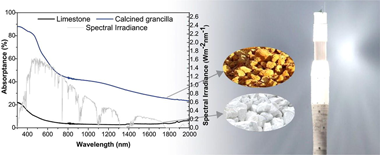
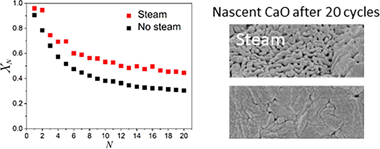
In the present work, we explore the use of steam in the CaCO3 calcination step of the Calcium Looping process devised for thermochemical energy storage (CaL-TCES). Steam produces a double benefit: firstly, it fastens calcination, allowing a reduction of the temperature needed to attain full calcination in short residence times, as those required in practice,…

Calcination under low CO2 pressure enhances the calcium Looping performance of limestone for thermochemical energy storage

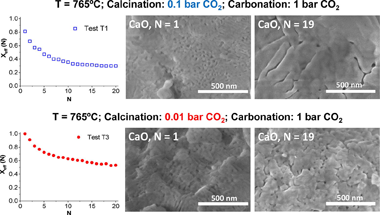
The Calcium Looping performance of limestone for thermochemical energy storage has been investigated under novel favorable conditions, which involve calcination at moderate temperatures under CO2 at low pressure (0.01 and 0.1 bar) and carbonation at high temperature under CO2 at atmospheric pressure. Calcining at low CO2 pressures allows to substantially reduce the temperature to achieve…

Multicycle CO2 capture activity and fluidizability of Al-based synthesized CaO sorbents

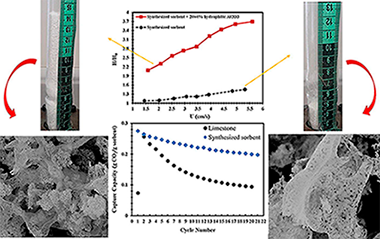
CaO-based materials have been identified as promising sorbents for highly efficient pre-combustion and post-combustion CO2 capture in fluidized beds operated at high temperatures by means of the Calcium Looping (CaL) process. However, Ca-based sorbents suffer from a decline of the capture capacity over multiple sorption/desorption cycles, mainly due to sintering, and from a markedly heterogeneous fluidization…

Does shaping catalysts modify active phase sites? A comprehensive in situ FTIR spectroscopic study on the performance of a model Ru/Al2O3 catalyst for the CO methanation

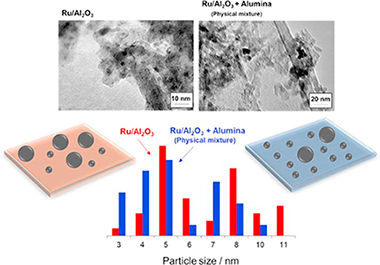
Routinely, it seems assumed that the catalytic layer coated on monoliths and microchannel reactors preserve the properties of the initial powder catalyst. However, this assumption should be reasonably demonstrated since the set of chemical and physical manipulations involved in the preparation of these catalytic devices hardly does not alter the surface of the starting catalyst…

Effect of milling mechanism on the CO2 capture performance of limestone in the Calcium Looping process

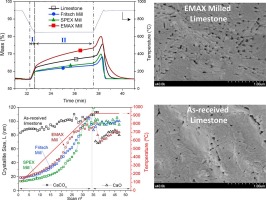
This work analyzes the relevant influence of milling on the CO2 capture performance of CaO derived from natural limestone. Diverse types of milling mechanisms produce contrasting effects on the microstructure of the CaO formed after calcination of the milled limestone samples, which affects crucially the kinetics of carbonation at conditions for CO2 capture. The capture…

Calcium-Looping performance of mechanically modified Al2O3-CaO composites for energy storage and CO2 capture

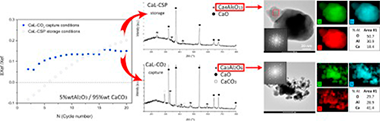
This work reports the Calcium-Looping (CaL) multicycle performance under energy storage and CO2 capture conditions of different Al-composites prepared by milling mixtures of nanoalumina and natural limestone powders. The micro-and nanostructure of the composites have been analyzed by X-ray diffraction, scanning electron microscopy and high-resolution transmission electron microscopy as affected by the type of CaL…