Carbonation tests in a kW-scale entrained flow reactor for thermochemical energy storage using the calcium looping-based system

Deploying reliable and sustainable large-scale energy storage is a significant challenge for the widespread adoption of renewable energy sources. Thermal energy storage solutions can provide scalable solutions for renewable power and industrial processes. The calcium looping-based energy storage system stands out for its high energy density, low cost, non-toxicity, and wide availability of limestone as…

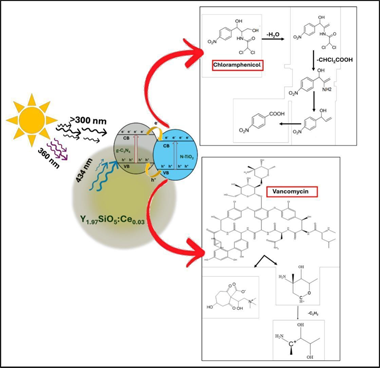
Enhanced photocatalytic degradation of organic pollutants in water by g-C3N4/N-TiO2/Y1.97SiO5:Ce0.03 heterostructure

A novel ternary heterostructure based on g-C3N4/N-TiO2/Y1.97SiO5:Ce-0.03 was synthesized via thermal treatment and evaluated for the photocatalytic degradation of two antibiotic pollutants, chloramphenicol (CAP) and vancomycin (VAN), in aqueous solution. The composite was designed to function as a photoactive platform, in which Ce3+-doped Y2SiO5 acts as an internal light converter, emitting at similar to 430…

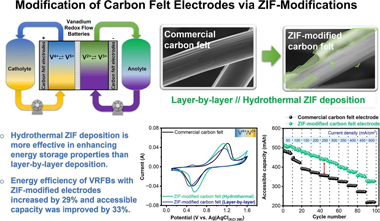
Improving energy storage properties of carbon felt electrodes for vanadium redox flow batteries via ZIF modifications

In this study, we successfully enhanced the electrochemical energy storage properties of commercial carbon felts by modifying their surface with metal-organic frameworks (MOFs) of the zeolitic imidazolate framework (ZIF) type, incorporating Fe, Co, Ni, Cu, and Zn as metal centres. These modifications were achieved through two distinct processes: layer-by-layer deposition and a hydrothermal synthesis method.…

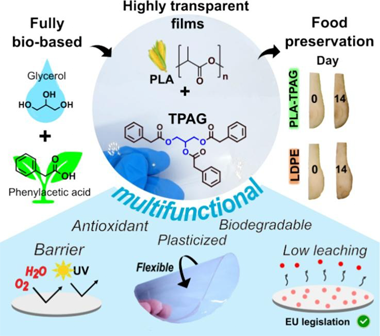
Triphenyl Acetic Glyceroate as a sustainable multifunctional additive for developing transparent, biodegradable, and flexible polylactide green alternative to polyethylene-based films for food packaging

Polylactide-based materials represent a promising bio-based alternative to traditional food packaging polymers. However, their widespread use is still limited due to significant drawbacks, such as brittleness, high gas permeability, and biodegradability only under specific conditions. This work introduces fully bio-based Triphenyl Acetic Glyceroate (TPAG), synthesized through a solvent-free and mild conditions valorization of glycerol and…

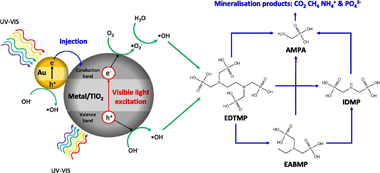
Improving the photocatalytic degradation of EDTMP: Effect of doped NPs (Na, Y, and K) into the lattice of modified Au/TiO2 nano-catalysts

This study presents the photocatalytic degradation of the aminophosphonate ethylenediaminetetra(methylenephosphonic acid) (EDTMP) with a range of different doped nanoparticles (NP). The photocatalysts were based on TiO2 benchmark P25 and gold (Au) doped either with sodium (Na), potassium (K) or yttrium (Y). The synthesized photocatalysts were characterized via TEM, XRF, XRD, UV-DRS (band gap estimation) and…

Unlocking synergistic benefits of the calcium looping-calcium hydroxide integration for energy storage: A perspective on sorbent performance

Calcium Looping has recently attracted attention as a high temperature thermochemical energy storage system. However, significant sintering due to the high temperatures hampers the recyclability of CaO. Hydration and hydroxylation has been explored as a method to regenerate the spent CaO. This study investigates a novel synergistic integration of carbonation (CaCO3/CaO) and hydroxylation (CaO/Ca(OH)2) reactions.…

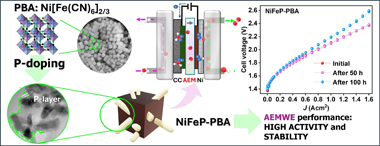
P-functionalization of Ni Fe − Electrocatalysts from Prussian blue analogue for enhanced anode in anion exchange membrane water electrolysers

Efficient hydrogen generation from water-splitting is widely acknowledged as a priority route to promote the hydrogen economy. Anion exchange membrane water electrolyzers (AEMWE) offer multiple advantages in improving performance and minimizing the cost limitations of current electrolysis technologies. However, the persistence of issues related to the limited electrocatalytic activity of such materials and their poor…

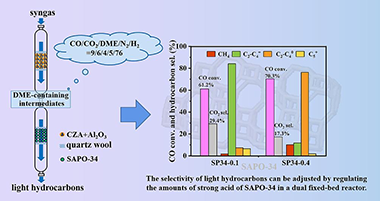
Catalytic conversion of syngas to light hydrocarbons via simulated intermediates CO/CO2/DME/N2/H2 over the regulated acidity of SAPO-34

  Direct conversion of syngas to light hydrocarbons has been intensively studied in recent years; however, the high selectivity of light hydrocarbons is still a challenging task to achieve a high CO conversion. Here, a bifunctional catalyst consisting of a methanol synthesis catalyst (CZA) and a methanol to dimethyl ether (DME) catalyst (Al2O3) was employed…

Shepherding reaction intermediates to optimize H-2 yield using composite-doped TiO2-based photocatalysts

Optimization of Pt-promoted TiO2-based is key to promote the photocatalytic production of hydrogen using sacrificial alcohol molecules. Combination of doping and surface decoration of the mentioned base photoactive material is here exploited to maximize hydrogen yield. Using the quantum efficiency parameter, it is shown that the resulting composite system can boost activity up to 7.3…