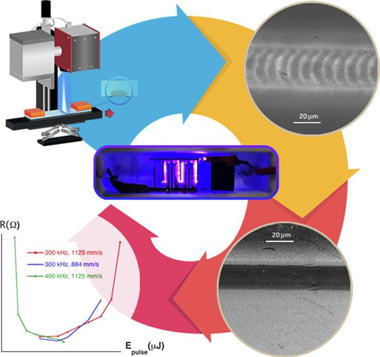
Laser-induced scanning transfer deposition of silver electrodes on glass surfaces: A green and scalable technology

A pulsed laser ablation backwriting technique with high repetitive rates is implemented for the fabrication of silver coatings on glass surfaces. This method enables geometrical constraint-free deposition of metallic coatings. These exhibit sufficiently low electrical resistance to be used as electrodes in dielectric barrier discharge (DBD) plasma elements. Ambient air deposition of metallic silver electrodes…

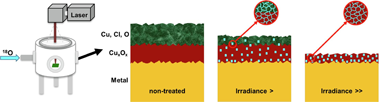
Novel procedure for studying laser-surface material interactions during scanning laser ablation cleaning processes on Cu-based alloys

Laser ablation is an effective method to clean Cu-based alloys. A novel procedure of characterisation was developed involving O-18 isotopes evaluated by ToF-SIMS spectroscopy to assess the driving mechanisms of laser-surface interactions. The presence of re-oxidised compounds was detected, discerning between the oxygen from the corrosion layer and the one introduced by the interaction with…

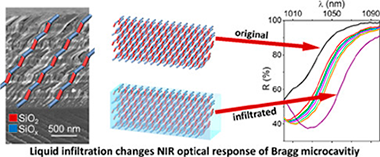
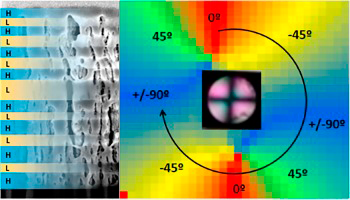
SiOx by magnetron sputtered revisited: Tailoring the photonic properties of multilayers

Traditionally porous silicon based photonic structures have been prepared by electrochemically etching of silicon. In this work, porous multilayers of nanocolumnar SiOx and SiO2 thin films acting as near infrared (NIR) 1D-photonic nanostructures are prepared by magnetron sputtering deposition at oblique angles (MS-OA). Simultaneous control of porosity and stoichiometry of the stacked films is achieved…

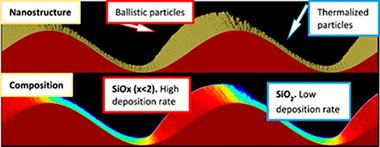
2D compositional self-patterning in magnetron sputtered thin films

Unlike topography patterning, widely used for numerous applications and produced by means of different technologies, there are no simple procedures to achieve surface compositional patterning at nanometric scales. In this work we have developed a simple method for 2D patterning the composition of thin films. The method relies on the magnetron sputtering deposition at oblique…

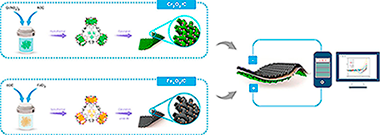
Controlled thermolysis of MIL-101(Fe, Cr) for synthesis of FexOy/porous carbon as negative electrode and Cr2O3/porous carbon as positive electrode of supercapacitor

In the present study, two kinds of metal oxide/carbon nanocomposite were prepared through calcination of MIL-101(Fe, Cr). The morphological and structural properties of the specimens were investigated using X-ray diffraction, Fourier-transform infrared spectroscopy, Brunauer, Emmett, and Teller analysis, energy dispersive Xray spectroscopy, X-ray photoelectron spectroscopy and scanning electron microscopy. The electrode materials were also electrochemically…

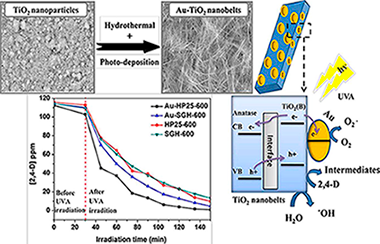
Photodegradation of 2,4-dichlorophenoxyacetic acid over TiO2(B)/anatase nanobelts and Au-TiO2(B)/anatase nanobelts

In this work, novel TiO2-based nanobelts with various phases were synthesized: biphasic TiO2(B)/anatase, pure TiO2(B) and pure anatase. These catalysts were obtained via hydrothermal reaction using two nanoparticulated TiO2 photocatalysts as precursors: Aeroxide TiO2 P25 (P25) and TiO2 synthesized via a sol-gel process (SG). In addition, the surface of the photocatalysts was modified with gold using a photodeposition…