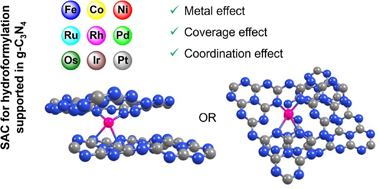
Computational and experimental insights into single-atom catalysts supported on g-C3N4: Unraveling the superior stability and catalytic activity of Rh in hydroformylation reactions

Single-atom catalysts (SACs) have emerged as a promising class of materials, leveraging the benefits of both homogeneous and heterogeneous catalysis to enhance efficiency and selectivity. In this work we have investigated the catalytic performance of SACs supported on graphitic carbon nitride (g-C3N4) for hydroformylation reactions. A systematic evaluation of nine transition metal SACs (Fe, Ru,…

Diffusion mechanisms and corrosion resistance of nanostructured ZrN-Cu coating obtained by hybrid HiPIMS-DCMS

Globalisation has brought numerous benefits regarding the cost-effective transportation of goods. Still, the shipping industry faces challenges such as corrosion, biofouling, and restrictions on heavy pollutant products used in paintings. This study proposes a solution using a multifunctional coating based on zirconium nitride and copper nano-structured coating, applying high-power impulse and direct current magnetron sputtering…

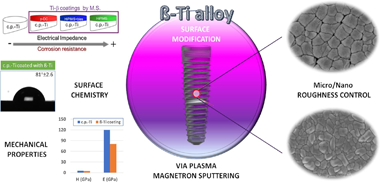
Magnetron sputtered ß-Ti coatings for biomedical application: A HiPIMS approach to improve corrosion resistance and mechanical behavior

This work presents the surface modification of commercially pure Ti specimens (c.p.-Ti) prepared by conventional powder metallurgy by depositing a thin film of a ß-Ti alloy (Ti-35Nb-7Zr-5Ta, wt. %, TNZT). Two types of pulsed technologies: conventional (p-DC) and high-power impulse magnetron sputtering (HiPIMS), with and without bias assistance (−60 V) under similar power conditions (250…

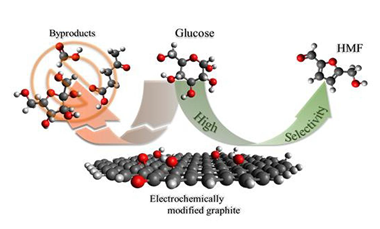
Electrochemical tailoring of graphite properties for tunable catalytic selectivity of glucose conversion to 5-hydroxymethylfurfural

This study presents a novel approach for boosting the selectivity of 5-hydroxymethylfurfural (HMF) production from glucose through electrochemical modification of graphite materials. Three distinct graphitic substrates were subjected to controlled electrochemical treatments utilizing sodium sulfate or phosphoric acid as electrolytes. The process expanded the graphite particles/pieces and introduced oxygenated functional groups to the exposed surfaces…

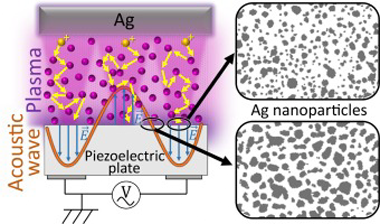
Nucleation and growth of plasma sputtered silver nanoparticles under acoustic wave activation

Early results on the plasma deposition of dielectric thin films on acoustic wave (AW) activated substrates revealed a densification pattern arisen from the focusing of plasma ions and their impact on specific areas of the piezoelectric substrate. Herein, we extend this methodology to tailor the plasma deposition of metals onto AW-activated LiNbO3 piezoelectric substrates. Our investigation…

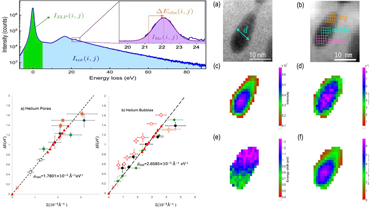
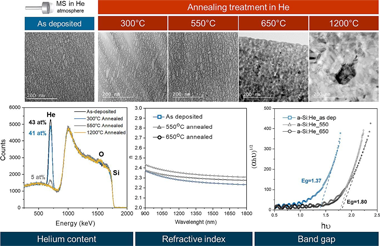
Microstructural evolution and properties of He-charged a-Si coatings prepared by magnetron sputtering

The introduction of porosity in nanomaterials via magnetron sputtering in helium atmospheres is an interesting strategy for the design of functional materials. Amorphous silicon coatings, with high concentration of He incorporated in the form of overpressurized nano-bubbles, present modified optical properties in comparison with dense coatings of similar composition. In this work, annealing process in…

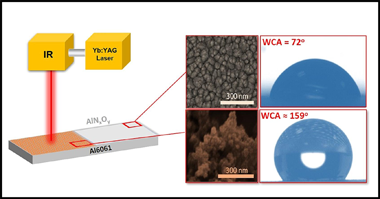
Exalted dual-scale surface roughening in laser ablated aluminum capped with a transparent thin film: Wetting and anti-icing behavior

Near infrared laser ablation of metals, specifically aluminum, has been systematically applied to generate surface roughness. Very high laser fluences may even lead to a so called «explosive» ablation regime where roughness becomes dramatically enhanced. In the present work we have developed an alternative methodology that, uti-lizing milder laser irradiation conditions (i.e. laser fluences from…

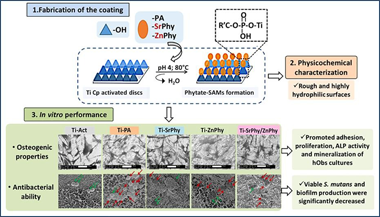
Strontium/zinc phytate-based self-assembled monolayers on titanium surfaces enhance osteogenesis and antibacterial performance in vitro

The accumulation of bacteria over implant surfaces is still the first cause of failure, and the development of antimicrobial surfaces constitutes a first line in implant research. Besides, the durability and mechanical performance of implants, in special in the dental area, are mainly determined by their osseointegration capacity into the maxillofacial bone and the appearance…

Insights into the structural and physicochemical properties of Zn-Bi-O composites for efficient photodegradation of caffeic acid, rhodamine B and methyl orange

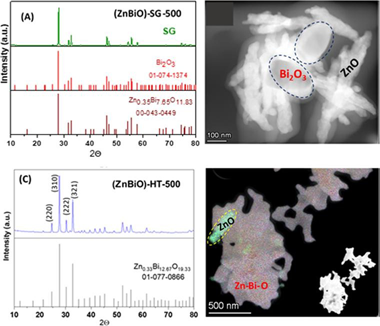
Different Zn-Bi-O composites were synthesized following the starting chemical molar composition of ZnBi2O4 spinels by a sol–gel method, (ZnBiO)-SG, and its subsequent hydrothermal treatment, (ZnBiO)-HT. The acquired X-ray diffractograms after sequential thermal treatments at a programmed rate indicate that both precursors evolved, after calcination at 500 °C, to materials (ZnBiO) with different stoichiometry. The use of different…