In situ generation of Ni particles from CaTi1-xNixO3 perovskites used in CO2 methanation

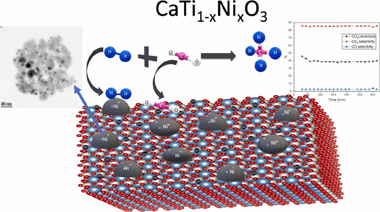
Ni nanoparticles were successfully generated from a CaTi1-xNixO3 perovskite structure and the effect of Ni substitution level, in the physicochemical characteristics and hence in its catalytic activity and stability in CO2 methanation reaction was evaluated. Particles were generated by a reduction process, where Ni particles were exsolved to perovskite surface. The samples were characterized by…

A critical view about use of scavengers for reactive species in heterogeneous photocatalysis

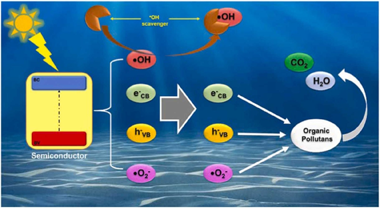
In heterogeneous photocatalysis, different reactive species generated from the excitation of the semiconductor are responsible for the degradation of different contaminants in aqueous solution. In order to evaluate the influence of each of these reactive species on the photocatalysis process, it is common to perform an analysis using different chemical compounds, which (in theory) react…

Tuning the co-catalyst loading for the optimization of thermo-photocatalytic hydrogen production over Cu/TiO2

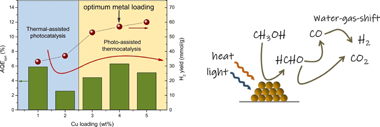
We have optimized the H-2 production by methanol thermo-photocatalytic reforming in the gas phase using Cu/TiO2 catalyst by tuning metal loading. Metal co-catalyst has been deposited by means of chemical reduction deposition. We have stated that thermo- and thermo-photocatalytic process leads to a notable H-2 production at 200 C. By in-situ FTIR studies we evidenced…

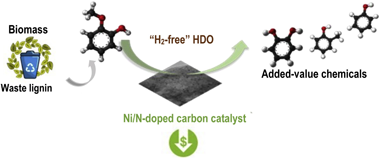
In-situ HDO of guaiacol over nitrogen-doped activated carbon supported nickel nanoparticles

In-situ hydrodeoxygenation of guaiacol over Ni-based nitrogen-doped activated carbon supported catalysts is presented in this paper as an economically viable route for bio-resources upgrading. The overriding concept of this paper is to use water as hydrogen donor for the HDO reaction, suppressing the input of external highpressure hydrogen. The effect of nitrogen sources, including polypyrrole…

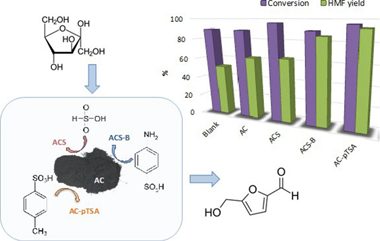
Effect of the sulphonating agent on the catalytic behavior of activated carbons in the dehydration reaction of fructose in DMSO

A series of -SO3R functionalized activated carbons (R=H, O, aryl) were prepared and applied in fructose dehydration reaction to 5-hydroxymethylfurfural. Different sulphonating methods introduce groups on catalyst surface with distinct donor-acceptor and hydrophilic properties. Their nature influences significantly not only activated carbon?s textural and chemical properties but also the product yields and selectivity in fructose…

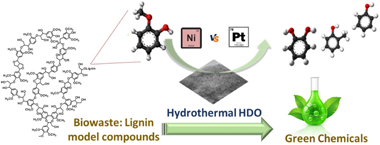
Guaiacol hydrodeoxygenation in hydrothermal conditions using N-doped reduced graphene oxide (RGO) supported Pt and Ni catalysts: Seeking for economically viable biomass upgrading alternatives

Herein we present an innovative route for model biomass compounds upgrading via “H2-free” hydrodeoxygenation (HDO) reactions. The underlaying idea is to implement a multifunctional catalyst able to activate water and subsequently use in-situ generated hydrogen for the HDO process. In this sense we have developed a series of effective Ni and Pt based catalysts supported on N-promoted…

Photocatalytic Escherichia coli inactivation by means of trivalent Er3+, Y3+ doping of BiVO4 system

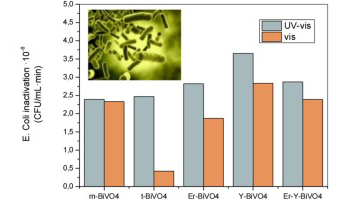
BiVO4 samples doped with different contents of Er3+ and Y3+ were prepared by a simple surfactant free hydrothermal method. X-ray diffraction reveals that the doped materials consist of a heterogeneous structure formed by a mixture of tetragonal and monoclinic phases, being found Er3+ and Y3+ co-doping clearly stabilize the tetragonal structure of BiVO4. The monoclinic…