Flexible and Adaptable Light-Emitting Coatings for Arbitrary Metal Surfaces based on Optical Tamm Mode Coupling

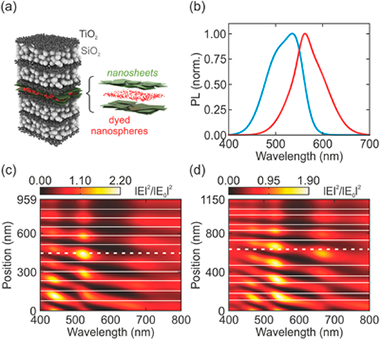
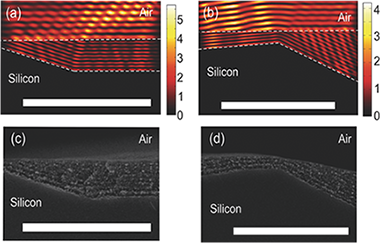
This study demonstrates a design that maximizes the power radiated into free space from a monolayer of nanoemitters embedded in a flexible distributed Bragg reflector conformably attached to a metal surface. This is achieved by positioning the light source at the precise depth within the multilayer for which optical Tamm states provide enhanced quantum yield…

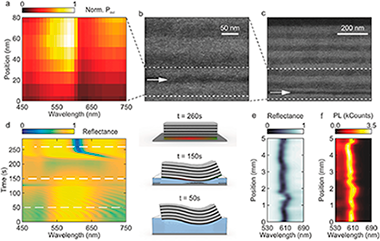
Fluorescent Humidity Sensors Based on Photonic Resonators

Among the different approaches to humidity sensing available, those based on fluorescent signals are gathering a great deal of attention due to their fast response and versatility of detection and design. So far, all proposals have focused on the use of luminescent probes whose emission is either triggered or inhibited by the presence of water…

Photonic Tuning of the Emission Color of Nanophosphor Films Processed at High Temperature

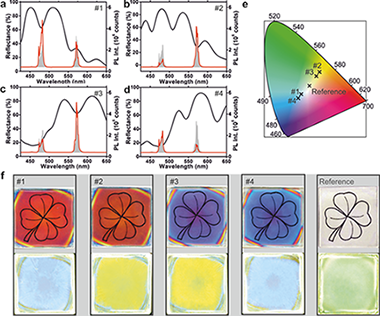
Photonics offers new possibilities to tailor the photoluminescence process in phosphor-converted light emitting diodes. Herein, it is demonstrated that the emission color of thin layers of rare-earth doped nanocrystals can be strongly modulated in tunable spectral ranges using optical resonators specifically designed to this end. GdVO4:Dy3+ nanoparticles of controlled size and shape are synthesized using a…

Design and Realization of a Novel Optically Disordered Material: A Demonstration of a Mie Glass

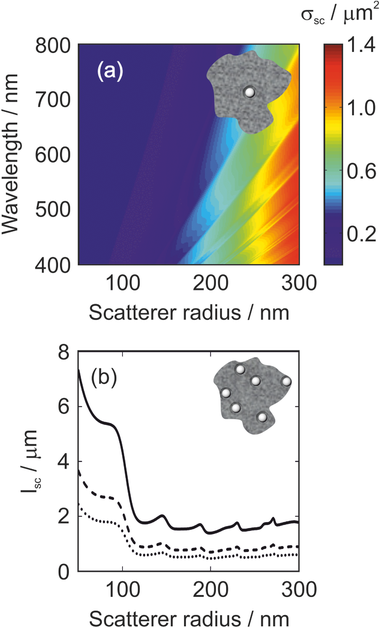
Herein, a diffusive material presenting optical disorder is introduced, which represents an example of a Mie glass. Comprising spherical crystalline TiO2 nanoparticles randomly dispersed in a mesoporous TiO2 matrix, it is proved that the scattering of light in this inhomogeneous solid can be predicted in an unprecedented manner from single-particle considerations employing Mie theory. To…

Strong Quantum Confinement and Fast Photoemission Activation in CH3NH3PbI3 Perovskite Nanocrystals Grown within Periodically Mesostructured Films

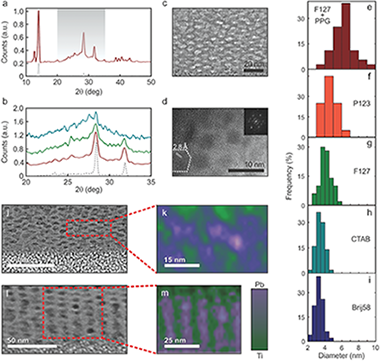
In this Communication, a synthetic route is demonstrated to obtain stabilized MAPbI3 nanocrystals embedded in thin metal oxide films that display well-defined and adjustable quantum confinement effects over a wide range of 0.34 eV. Mesostructured TiO2 and SiO2 films displaying an ordered 3D pore network are prepared by evaporation-induced self-assembly of a series of organic supramolecular templates in…

A Full Vacuum Approach for the Fabrication of Hybrid White-Light-Emitting Thin Films and Wide-Range In Situ Tunable Luminescent Microcavities

A wide-range in situ tunable 1D Bragg microcavity including a hybrid layer as white light emitter defect is shown by J. R. Sanchez-Valencia, A. Borras, and co-workers on page 1124. White emission is obtained by Förster resonance energy transfer between blue (1,3,5-triphenyl-2-pyrazoline) and orange (rubrene) dyes homogeneously infiltrated within the host nanocolumnar SiO2film, which is…

Integration of Photonic Crystals into Flexible Dye Solar Cells: A Route toward Bendable and Adaptable Optoelectronic Devices Displaying Structural Color and Enhanced Efficiency

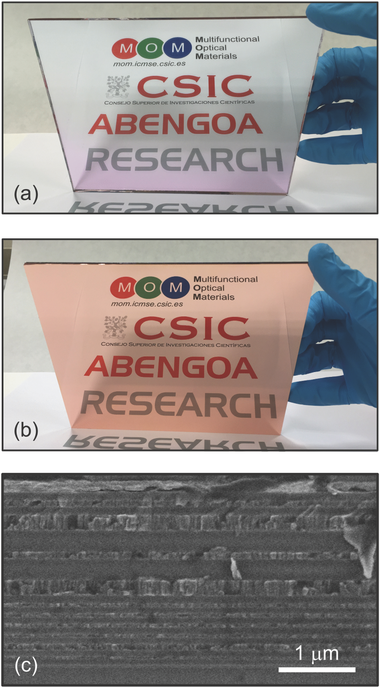
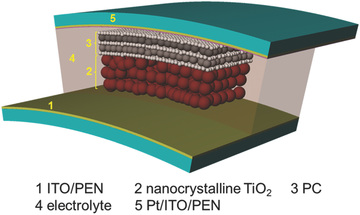
Herein is presented what is believed to be the first example of integration of photonic structures in a flexible optoelectronic device. The resulting devices may be designed to display any color in the visible range and, simultaneously, present enhanced power conversion efficiency as a consequence of the increased light harvesting caused by the colored back…

Adaptable Ultraviolet Reflecting Polymeric Multilayer Coatings of High Refractive Index Contrast

A synthetic route is demonstrated to build purely polymeric nanostructured multilayer coatings, adaptable to arbitrary surfaces, and capable of efficiently blocking by reflection a targeted and tunable ultraviolet (UV) range. Reflection properties are determined by optical interference between UV light beams reflected at the interfaces between polystyrene layers of different porosity and hence refractive index.…