Persistent Nanophosphors: Poised to Outperform Bulk Counterparts?

The design of advanced materials often reveals how apparent imperfections, such as structural defects or impurities, can be transformed into functional advantages. In insulating oxide matrices, the controlled introduction of dopant ions is the first step toward efficient photoluminescence. Later, the engineering of additional defects, often detrimental for photoluminescence, gives rise to unique capabilities for…

Persistent Luminescence Analysis in the Frequency Domain

Frequency-domain techniques offer a powerful means to disentangle overlapping physical processes with distinct characteristic timescales-yet remain underexplored in the context of complex photoluminescent materials. Here, frequency-domain analysis is applied to persistent luminescence (PersL) materials, which exhibit long-lasting emission following excitation due to charge trapping and detrapping processes spanning wide temporal ranges. Using SrAl2O4:Eu2(+),Dy3(+) (SAO:Eu,Dy) as…

Efficient Energy Transfer Between Ligand-Free FAPbBr3 Nanocrystals in a Mesoporous SiO2 Matrix

Lead halide perovskite nanocrystals (NCs) are promising materials for next-generation optoelectronic devices due to their exceptional optical properties. However, poor long-term stability remains a major challenge. In this study, formamidium lead bromide (FAPbBr3) NCs are embedded in a mesoporous silica matrix to enhance stability and explore exciton transport mechanisms. These NCs display a narrow photoluminescence…

Quantification of Emission Efficiency in Persistent Luminescent Materials

Accurate quantification of efficiency enables rigorous comparison between different photoluminescent materials, providing an optimization path critical to the development of next-generation light sources. Persistent luminescent materials exhibit delayed and long-lasting luminescence due to the temporary storage of optical energy in engineered structural defects. Standard characterization methods do not provide a universal comparison of phosphor performance,…

Intense and Stable Blue Light Emission From CsPbBr3/Cs4PbBr6 Heterostructures Embedded in Transparent Nanoporous Films

Lead halide perovskite nanocrystals are attractive for light emitting devices both as electroluminescent and color-converting materials since they combine intense and narrow emissions with good charge injection and transport properties. However, while most perovskite nanocrystals shine at green and red wavelengths, the observation of intense and stable blue emission still remains a challenging target. In…

Scattering Spheres Boost Afterglow: A Mie Glass Approach to Go Beyond the Limits Set by Persistent Phosphor Composition

Persistent luminescence phosphor nanoparticles (PersLNPs) offer exciting opportunities for anticounterfeiting, data storage, imaging displays, or AC-driven lighting applications owing to the possibility to process them as shapable thin coatings. However, despite unique delayed and long-lasting luminescence, the relatively low storage capacity of persistent phosphor nanoparticles combined with the difficulty of harvesting photons from transparent thin…

Enhanced Directional Light Extraction from Patterned Rare-Earth Phosphor Films

The combination of light‐emitting diodes (LEDs) and rare earth (RE) phosphors as color‐converting layers comprises the basis of solid‐state lighting. Indeed, most LED lamps include a photoluminescent coating made of phosphor material, i.e., crystalline matrix suitably doped with RE elements, to produce white light from a blue or ultraviolet LED chip. Transparent phosphor‐based films constitute…

Anisotropic Resistivity Surfaces Produced in ITO Films by Laser-Induced Nanoscale Self-organization

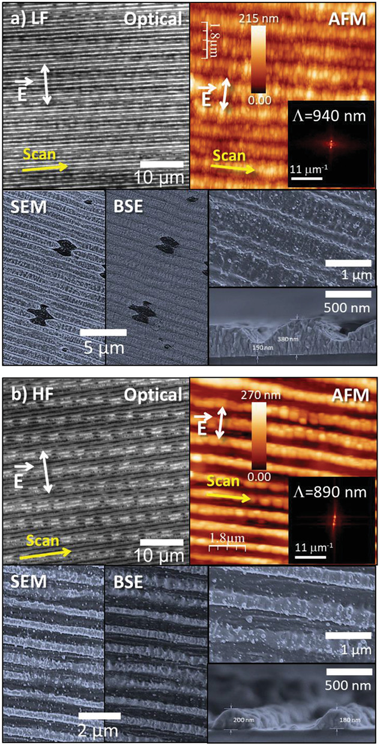
Highly anisotropic resistivity surfaces are produced in indium tin oxide (ITO) films by nanoscale self-organization upon irradiation with a fs-laser beam operating at 1030 nm. Anisotropy is caused by the formation of laser-induced periodic surface structures (LIPSS) extended over cm-sized regions. Two types of optimized structures are observed. At high fluence, nearly complete ablation at…

Finite Size Effects on Light Propagation throughout Random Media: Relation between Optical Properties and Scattering Event Statistics

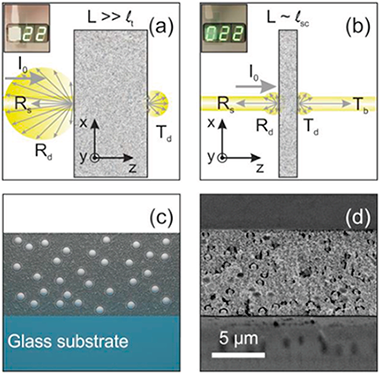
This work introduces a thorough analysis of light transport in thin optically disordered media. The diffusive properties of a turbid material are generally dictated by the transport mean free path, lt. For depths larger than this characteristic length, light propagation can be considered fully randomized. There is however a range of thicknesses for which light becomes…

Nanostructural Analysis of Porous Oblique Angle Deposited (OAD) Multilayer Systems by Grazing-Incidence Small-Angle X-Ray Scattering

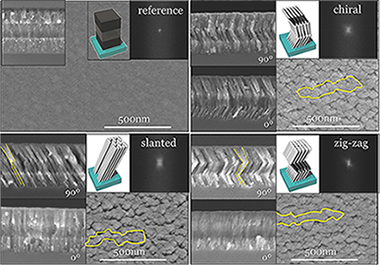
This work reports a thorough characterization analysis of various porous thin film multilayers by means of grazing-incidence small-angle X-ray scattering (GISAXS). Alternated TiO2/SiO2 nanocolumnar layers deposited at oblique angles are fabricated in slanted, chiral, and zig-zag configurations by rotating azimuthally the substrate from one layer to the next. Multilayer systems formed by the stacking of…