Synthesis and Characterization of Multilayered CrAlN/Al2O3 Tandem Coating Using HiPIMS for Solar Selective Applications at High Temperature

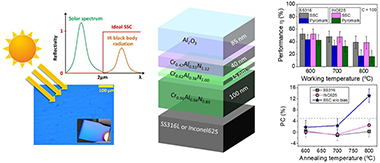
The effect of applying a negative bias during deposition of a previously designed multilayer solar selective absorber coating was studied on two types of substrates (316L stainless steel and Inconel 625). The solar selective coating is composed of different chromium aluminum nitride layers deposited using a combination of radiofrequency (RF), direct current (DC), and high-power…

Tribological Response of delta-Bi2O3 Coatings Deposited by RF Magnetron Sputtering

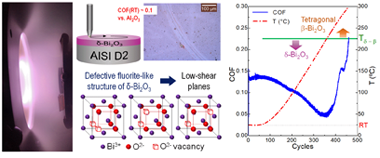
Bismuth oxide (Bi2O3) coatings and composite coatings containing this oxide have been studied due to their potential applications in gas sensing, optoelectronics, photocatalysis, and even tribology. Two parametric models based on chemical features have been proposed with the aim of predicting the lubricity response of oxides. However, such models predict contradictory values of the coefficient…

Influence of the carbon incorporation on the mechanical properties of TiB2 thin films prepared by HiPIMS

Nanostructured TiB2 and TiBC thin films with carbon contents up to 11 at. % were prepared by physical vapor deposition using high power impulse magnetron sputtering (HiPIMS) technology. The influence of carbon incorporation during the deposition of TiB2 coatings was investigated on the chemical composition, microstructure and mechanical properties by means of scanning electron microscopy,…

Nb-C thin films prepared by DC-MS and HiPIMS: Synthesis, structure, and tribomechanical properties

Nanostructured Nb-C thin films were prepared by direct current magnetron sputtering (DC-MS) and high-power impulse magnetron sputtering (HiPIMS). The films were characterized in depth by X-ray diffraction (XRD), grazing incidence X-ray diffraction, scanning electron microscopy, atomic force microscopy, electron probe microanalysis, and Raman spectroscopy. The mechanical properties were measured by nanoindentation, and the tribological properties…

Effect of Al content on the hardness and thermal stability study of AlTiN and AlTiBN coatings deposited by HiPIMS

The microstructure, mechanical properties and thermal stability of AT(x)Ti(1-x)N and Al1Ti1-xBN coatings grown by reactive high-power impulse magnetron sputtering (HiPIMS) have been analyzed as a function of Al/(Al + Ti) ratio (x) between 0.5 and 0.8. The coatings were predominantly formed by a face-centered cubic Ti(Al)N crystalline phase, both with and without B, even for…

Nb-C thin films prepared by DC-MS and HiPIMS: Synthesis, structure, and tribomechanical properties

Nanostructured Nb-C thin films were prepared by direct current magnetron sputtering (DC-MS) and high-power impulse magnetron sputtering (HiPIMS). The films were characterized in depth by X-ray diffraction (XRD), grazing incidence X-ray diffraction, scanning electron microscopy, atomic force microscopy, electron probe microanalysis, and Raman spectroscopy. The mechanical properties were measured by nanoindentation, and the tribological properties…

Insights into the role of the layer architecture of Cr-Ti-N based coatings in long-term high temperature oxidation experiments in steam atmosphere

Knowledge on hard coatings has been applied in the energy field extending their use as protecting coatings of steam power generation plants components. The role of the layer architecture of Cr-Ti-N based coatings deposited by reactive cathodic arc evaporation on P92 steel substrates was studied with the focus on their oxidation resistance at 650 degrees…

Long-term low friction maintenance and wear reduction on the ventral scales in snakes

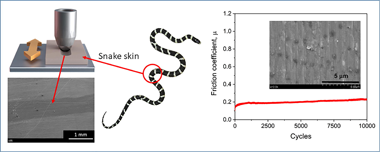
Snake skins evolved to withstand permanent friction and wear during sliding. Here, the microstructure of ventral scales of the snake Lampropeltis getula californiae was analyzed using scanning electron microscopy, and the long-term dynamic friction behavior was investigated by reciprocating sliding friction tests. A smooth epoxy resin with similar elasticity modulus and hardness was used for…