


ICTAC Kinetics Committee recommendations for analysis of thermal decomposition kinetics

In this review article, the Kinetics Committee of the International Confederation for Thermal Analysis and Calorimetry (ICTAC) delivers a collection of recommendations for the kinetic analysis of thermal decomposition processes. These recommendations specifically focus on the thermal decomposition processes in inorganic, organic, and polymeric materials, as well as biomass and solid fuels. A general introduction…
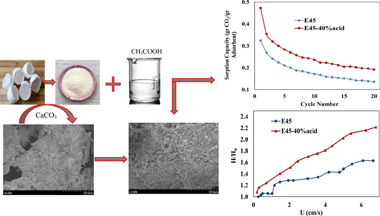
A novel, green, cost-effective and fluidizable SiO2-decorated calcium-based adsorbent recovered from eggshell waste for the CO2 capture process

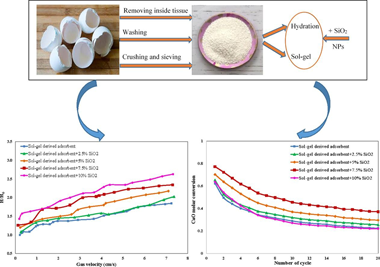
The reduction, storage, and reuse of greenhouse gas carbon dioxide (CO2) is a crucial concern in modern society. Bio-waste adsorbents have recently aroused the investigator’s attention as auspicious materials for CO2 capture. However, the adsorption capacity decaying and poor fluidizability during carbonation/calcination cycles of all natural adsorbents used in the calcium-looping process (CaL) are important…

Theoretical Analysis of Polynuclear Zinc Complexes Isolobally Related to Hydrocarbons

Based on the isolobal analogy of ZnCp (Cp = eta(5)-C5H5) and ZnR (R = alkyl or aryl group) fragments with hydrogen atom and fragment [Zn(CO)(2)] with a CH2 carbene, the following complexes [(ZnCp)(2){mu-Zn(CO)(2)}], 1, [(ZnPh)(2){mu-Zn(CO)(2)}], 2, [(ZnPh){mu-Zn(CO)(2)}(ZnCp)], 3, [(ZnCp)(2){mu-Zn-2(CO)(4)}], 4, [(ZnPh)(2){mu-Zn-2(CO)(4)}], 5, [(ZnPh){mu-Zn(CO)(2)}(2)(ZnCp)], 6, [Zn-3(CO)(6)], 7 and [Zn-5(CO)(10)], 8, were built. These polynuclear zinc compounds…

Theoretical Analysis of Polynuclear Zinc Complexes Isolobally Related to Hydrocarbons

Based on the isolobal analogy of ZnCp (Cp = eta(5)-C5H5) and ZnR (R = alkyl or aryl group) fragments with hydrogen atom and fragment [Zn(CO)(2)] with a CH2 carbene, the following complexes [(ZnCp)(2){mu-Zn(CO)(2)}], 1, [(ZnPh)(2){mu-Zn(CO)(2)}], 2, [(ZnPh){mu-Zn(CO)(2)}(ZnCp)], 3, [(ZnCp)(2){mu-Zn-2(CO)(4)}], 4, [(ZnPh)(2){mu-Zn-2(CO)(4)}], 5, [(ZnPh){mu-Zn(CO)(2)}(2)(ZnCp)], 6, [Zn-3(CO)(6)], 7 and [Zn-5(CO)(10)], 8, were built. These polynuclear zinc compounds…

Supercooled sodium acetate aqueous solution for long-term heat storage to support heating decarbonisation

Heating decarbonisation through electrification requires the development of novel heat batteries. They should be suitable for the specific application and match the operation conditions of domestic renewable energy sources. Supercooled liquids, often considered a drawback of phase change materials, are among the most promising technologies supporting heating decarbonisation. Although some studies have shed light on…

Improvement in cyclic CO2 capture performance and fluidization behavior of eggshell-derived CaCO3 particles modified with acetic acid used in calcium looping process

Although calcium-based materials are the most promising adsorbents used in calcium looping process for carbon dioxide removing, their CO2 capture capacity decaying besides poor fluidization, still are the important challenges. In the present investigation, eggshell as a cheap, easily available and unpolluted source of calcium carbonate was used for CO2 capturing in calcium looping process. Eggshell particles were treated with various volume concentrations of acetic acid to improve its sorption capacity. According to the TGA results after 20 carbonation/calcination cycles, the effective carbonation conversion of modified eggshell with 5%, 20%, 30% and…

Highly efficient electrical discharge machining of yttria-stabilized zirconia ceramics with graphene nanostructures as fillers

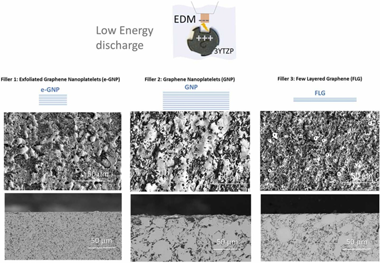
Electrical-discharge machining (EDM) of advanced ceramics allows the miniaturization of parts with complex shapes. Since electrical conductivity is required, non-conductive ceramics need a conductive second phase. This work assesses the feasibility of industrial EDM in advanced yttria-stabilized tetragonal zirconia (3YTZP) composites with 20 vol% graphene nanostructures with different morphology using different EDM energies. The structural integrity of the graphene nanostructures,…

Highly efficient electrical discharge machining of yttria-stabilized zirconia ceramics with graphene nanostructures as fillers

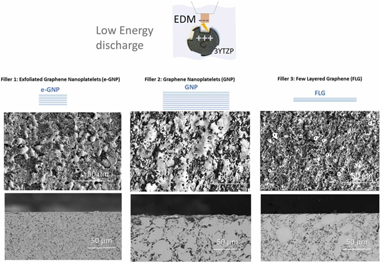
Electrical-discharge machining (EDM) of advanced ceramics allows the miniaturization of parts with complex shapes. Since electrical conductivity is required, non-conductive ceramics need a conductive second phase. This work assesses the feasibility of industrial EDM in advanced yttria-stabilized tetragonal zirconia (3YTZP) composites with 20 vol% graphene nanostructures with different morphology using different EDM energies. The structural integrity of the graphene nanostructures,…