On the athermal origin of flash sintering: Separating field-induced effects from Joule heating using a current ramp approach

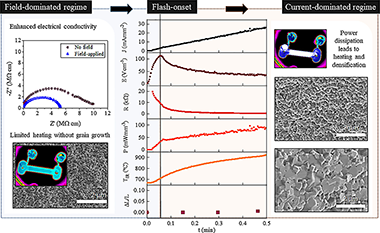
Joule heating is generally acknowledged as the main driving force behind Flash Sintering. However, this view is challenged by the presence of athermal phenomena and the similarities between the flash process and dielectric breakdown. This work offers new insights into flash as an electrical runaway. Using current ramps to perform flash experiments on zinc oxide,…

In situ study on enhanced plastic deformability of Lanthanum-doped Bismuth ferrite processed by flash sintering

BiFeO3 is a promising multiferroic material for versatile device applications due to its co-existence of magnetic (i.e., antiferromagnetic) and ferroelectric ordering at room temperature. While its functional properties have been extensively investigated, the exploration of its mechanical behavior was limited mostly to the thin-film form of BiFeO3. In this work, we conducted in situ micropillar…

Influence of graphene-based nanostructures processing routes and aspect ratio in flexural strength and fracture mechanisms of 3Y-TZP-matrix composites

In this work, the influence of the aspect ratio of graphene-based nanostructures (GBNs) and content on the mechanical properties of 3 mol% yttria tetragonal zirconia polycrystalline 3Y-TZP matrix composites was analysed. The influence of the dispersion method and sintering parameters on the flexural strength and elastic modulus of the composites was studied, and the fracture surfaces…

Ca-based materials derived from calcined cigarette butts for CO2 capture and thermochemical energy storage

Cigarette butts (CBs) are one of the most common types of litter in the world. Due to the toxic substances they contain, the waste generated poses a harmful risk to the environment, and therefore there is an urgent need for alternative solutions to landfill storage. Thus, this work presents a possible revalorization of this waste material, which implies interesting environmental…

Complex TiC-Ni-based composites joined to steel support by thermal explosion under load: synthesis, microstructure and tribological behavior

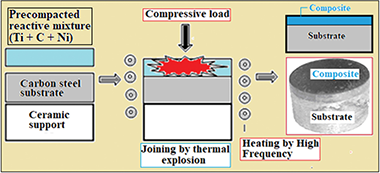
  The combustion in thermal explosion mode of reactive mixtures of Ti-Ni-graphite(carbides, borides, oxides), under load, was used to produce complex composite materials, densified and joined to a C55 carbon steel support. The ignition of the exothermic reaction, carried out thanks to the rapid high-frequency heating of a green compact up to 1573 K, was…

Al2O3/Y3Al5O12 (YAG)/ZrO2 composites by single-step powder synthesis and spark plasma sintering

Alumina-yttrium aluminum garnet (YAG)-zirconia composites are often produced by the melt solidification method. In the present study, we investigated the fabrication of α-Al2O3/Y3Al5O12 (YAG)/ZrO2 composite by Spark Plasma Sintering (SPS) of powders synthesized by Pechini’s sol-gel method. The ternary composites with homogenous microstructure and high density were produced by SPS at 1300 °C for 15 min. The addition of…

Ultraslow calorimetric studies of the martensitic transformation of NiFeGa alloys: detection and analysis of avalanche phenomena

We study the thermal properties of a bulk Ni55Fe19Ga26 Heusler alloy in a conduction calorimeter. At slow heating and cooling rates (∼1Kh-1), we compare as-cast and annealed samples. We report a smaller thermal hysteresis after the thermal treatment due to the stabilization of the 14 M modulated structure in the martensite phase. In ultraslow experiments (40mKh-1), we…

Sodium acetate-based thermochemical energy storage with low charging temperature and enhanced power density

The electrification of heat necessitates the development of innovative domestic heat batteries to effectively balance energy demand with renewable power supply. Thermochemical heat storage systems show great promise in supporting the electrification of heating, thanks to their high thermal energy storage density and minimal thermal losses. Among these systems, salt hydrate-based thermochemical systems are particularly…