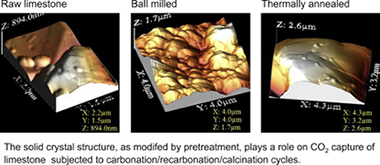
Role of crystal structure on CO2 capture by limestone derived CaO subjected to carbonation/recarbonation/calcination cycles at Ca-looping conditions

Large scale pilot plants are currently demonstrating the feasibility of the Calcium-looping (CaL) technology built on the multicyclic calcination/carbonation of natural limestone for post-combustion and precombustion CO2 capture. Yet, limestone derived CaO exhibits a drop of conversion when subjected to multiple carbonation/calcination cycles, which lessens the efficiency of the technology. In this paper we analyze…

Multicyclic conversion of limestone at Ca-looping conditions: The role of solid-sate diffusion controlled carbonation

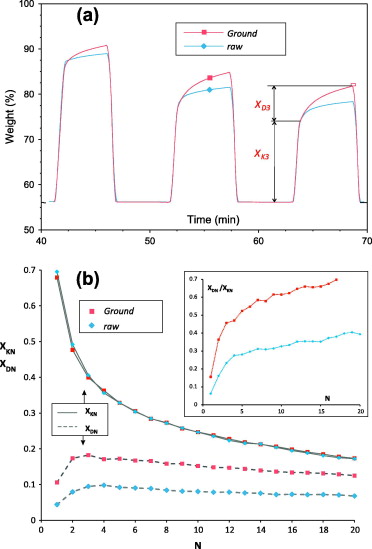
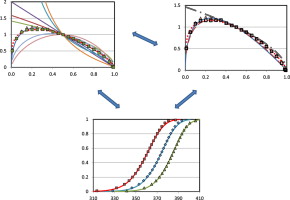
Limestone derived CaO conversion when subjected to multiple carbonation/calcination cycles is a subject of interest currently fueled by several industrial applications of the so-called Ca-looping (CaL) technology. The multicyclic CaO conversion at Ca-looping conditions exhibits two main features as demonstrated by thermogravimetric analysis (TGA). On one hand, carbonation occurs by two well differentiated phases: a…

The role of boron oxide and carbon amounts in the mechanosynthesis of ZrB2–SiC–ZrC nanocomposite via a self-sustaining reaction in the zircon/magnesium/boron oxide/graphite system

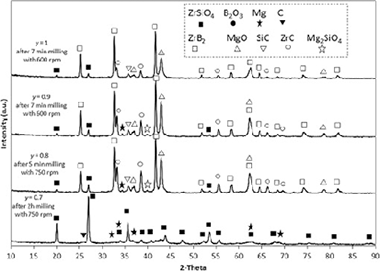
Herein, ZrSiO4/B2O3/Mg/C system was used to synthesize a ZrB2-based composite by means of a high energy ball milling process. A mechanically induced self-sustaining reaction was achieved in this system. A nanocomposite powder of ZrB2–SiC–ZrC was prepared with an ignition time of approximately 6 min of milling. The role of the stoichiometric amounts of B2O3 and…

Effect of high SWNT content on the room temperature mechanical properties of fully dense 3YTZP/SWNT composites

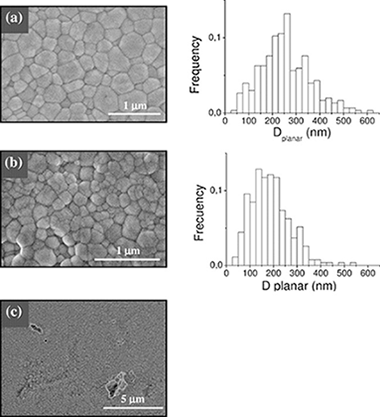
This paper is devoted to correlate the microstructure and room temperature mechanical properties of single-wall carbon nanotube (SWNT) reinforced 3 mol% yttria stabilized tetragonal zirconia with high SWNT content (2.5, 5 and 10 vol%). Fully dense composites were prepared by using a combination of aqueous colloidal powder processing and Spark Plasma Sintering. SWNTs were located…

Effect of Heat Pretreatment/Recarbonation in the Ca-Looping Process at Realistic Calcination Conditions

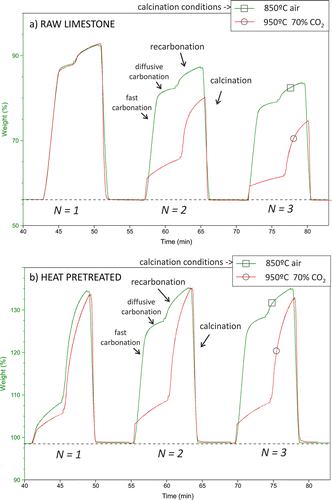
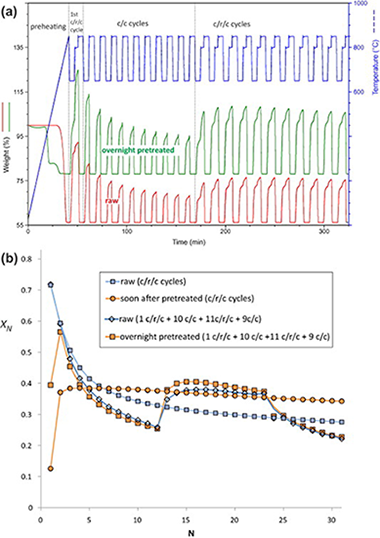
Even though an increasing number of pilot-scale plants are demonstrating the potential efficiency of the Ca-looping technology to capture CO2 at a commercial level, a still standing matter of concern is the loss of carbonation reactivity of the regenerated CaO by calcination, which is expected to be particularly marked at realistic conditions necessarily implying a…

Improvement of the thermal stability of branched poly(lactic acid) obtained by reactive extrusion

One-step reactive extrusion-calendering process (REX-calendering) has been used in order to obtain sheets of 1 mm from poly(lactic acid) modified with a styrene-acrylic multifunctional oligomeric agent. In a preliminary internal mixer study, torque versus time has been monitored in order to ascertain chain extender ratios and reaction time. Once all the parameters were optimized, reactive…

Phase assembly and electrical conductivity of spark plasma sintered CeO2-ZrO2 ceramics

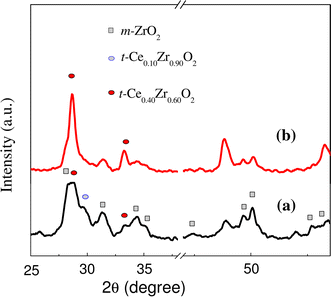
Cex Zr1−x O2 (x = 0.10, 0.16 and 0.33) nanocrystalline powders were obtained by a two-step synthesis technique and sintered by spark plasma sintering (SPS). As consequence of the reduction of Ce4+ to Ce3+ species by carbon in the graphite environment in SPS, phase assemblies including tetragonal, monoclinic and pyrochlore phases were generated in the ceramics during the sintering process. The electrical…

Processing and characterisation of cermet/hardmetal laminates with strong interfaces

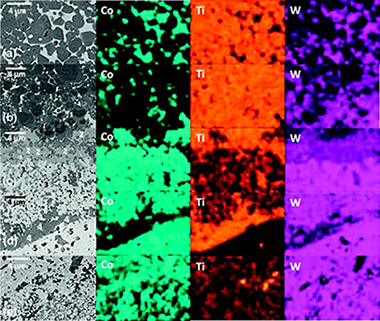
Cemented carbides and cermets are potential materials for high speed machining tools. However, cemented carbides are not chemically stable at high temperature and cermets present poor fracture toughness. Novel cermet/hardmetal multilayer systems show a huge potential for this intended application. It would be possible to achieve the right balance of the required thermomechanical properties using…

High and stable CO2 capture capacity of natural limestone at Ca-looping conditions by heat pretreatment and recarbonation synergy

The Ca-looping (CaL) process, based on the multicyclic carbonation/calcination of limestone derived CaO, has emerged recently as a potentially economically advantageous technology to achieve sustainable postcombustion and precombustion CO2 capture efficiencies. Yet, a drawback that hinders the efficiency of the CaL process is the drastic drop of limestone capture capacity as the number of carbonation/calcination…