High piezoelectric performance in lead-free BCHT fine-grained ceramics synthesized by mechanochemistry

Lead-free piezoelectric ceramics (Ba1-xCax) (Ti1-yHfy)O-3 with stoichiometries close to the morphotropic phase boundary (MPB) were synthesized by high-energy ball milling. The influence of Hf and Ca contents and the sintering method (conventional and hot-press) on the piezoelectric, dielectric, and ferroelectric response was investigated. It was confirmed that the different phases stabilized at room temperature and…

Descriptors for Predicting Single- and Multi-Phase Formation in High-Entropy Oxides: A Unified Framework Approach

High-entropy oxides, HEOs, represent a relatively new class of ceramic materials characterized by the incorporation of multiple cations, typically four or more, into a single-phase crystal structure. This extensive compositional flexibility allows for the introduction of specific chemical elements into a crystal lattice that would normally be unable to accommodate them, making it difficult to…

Thermal stability and electrical properties of XFe2O4 (X = Co,Cu,Fe,Mg,Mn Ni) high-entropy spinel ferrites prepared by reactive flash sintering

This study investigates the high-temperature stability and phase composition of two high-entropy oxides (HEOs), (Mn0.2Co0.2Ni0.2Cu0.2Fe0.2)Fe2O4 and (Mn0.2Co0.2Ni0.2Cu0.2Mg0.2)Fe2O4, prepared as single-phase samples using the reactive flash sintering technique. Results show that the annealing temperature in a nitrogen atmosphere has a significant impact on the stability of the compounds. The destabilization of the spinel structure occurs in…

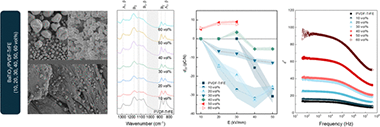
Piezoelectric and Dielectric Response of BaTiO3/PVDF-TrFE Composites with High β-Phase Content

The search for flexible piezoelectric materials to build adaptable sensors, electronics, and nanogenerators has become a key area of interest. The addition of piezoceramic particles to piezoelectric polymers, such as the copolymer poly(vinylidene fluoride-trifluoroethylene) (PVDF-TrFE), is one of the strategies used to enhance the piezoelectric response. In this work, the effect of BaTiO3 content on…

Production of Barium Sulfide from Low-Grade Barite Ores

The manufacture of barium sulfide or barium salts (BaS, BaCl2, Ba (OH)(2), among others) requires high-purity barite ores (>90%). In this study, a new method to produce barium sulfide from low-grade barite ores (60% purity) is proposed. The method involves gravitational concentration of barite ore on a shaking table followed by mechanical activation of the…

Processability and properties of cubic-BaTiO3/poly(vinylidene fluoride) composites for additive manufacturing: From powder compounding to 3D-printed parts

Poly(vinylidene fluoride) (PVDF) is a piezoelectric and thermoplastic material with great potential for additive manufacturing (AM) applications. Using barium titanate (BaTiO3) as filler, PVDF-based composite materials were developed, characterized, and processed by AM material extrusion (MEX). The morphological features and phase transformations occurring throughout the processing of BaTiO3-filled PVDF, from the compounding to the printed…

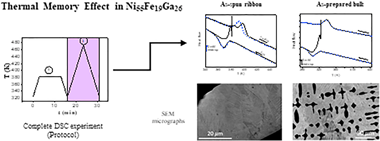
Phase dependence of the thermal memory effect in polycrystalline ribbon and bulk Ni55Fe19Ga26 Heusler alloys

The thermal memory effect, TME, has been studied in Ni55Fe19Ga26 shape memory alloys, fabricated as ribbons via melt-spinning and as pellets via arc-melting, to evaluate its dependence on the martensitic structure and the macrostructure of the samples. When the reverse martensitic transformation is interrupted, a kinetic delay in the subsequent complete transformation is only evident in…

A practical analysis to predict sample overheating in flash experiments using the current ramp methodology

This work presents a straightforward strategy for achieving specific overheating during flash experiments by adjusting the initial electrical parameters. To do that, an extensive experimental analysis was performed to evaluate the temperature evolution of dense ZnO specimens during controlled-current ramping at different furnace temperatures, which in turn modified the initial electrical resistance of the sample.…

Revisiting Stability Criteria in Ball-Milled High-Entropy Alloys: Do Hume-Rothery and Thermodynamic Rules Equally Apply?

Stability descriptors for the formation of solid solutions can be divided into two categories: inspired by Hume–Rothery rules (HRR) and derived from thermodynamic approaches. Herein, HRRs are extended from binary to high-entropy alloys (HEAs) focusing on compositions prepared by ball milling. Parameters describing stability criteria are interrelated and implicitly account for the microstrains’ storage energy,…