Influence of the Processing Route on the Carbon Nanotubes Dispersion and Creep Resistance of 3YTZP/SWCNTs Nanocomposites

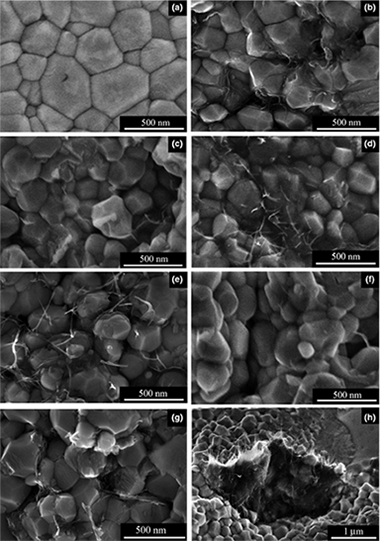
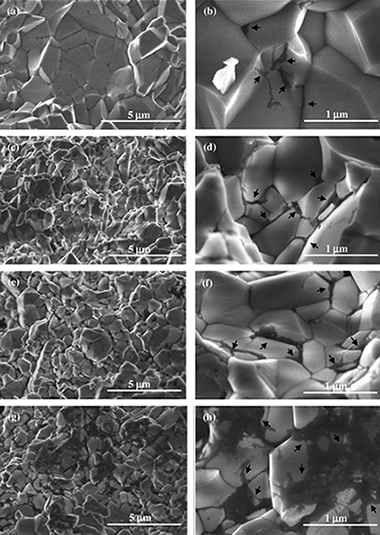
3YTZP matrix composites containing 2.5 vol% of single-walled carbon nanotubes (SWCNT) were fabricated by Spark Plasma Sintering (SPS) at 1250°C, following different processing routines with the aim of optimizing the SWCNTs dispersion throughout the ceramic matrix. Microstructural characterization of the as-fabricated samples has been performed by means of scanning electron microscopy (SEM). The specimens have been…

Uniform, luminescent Eu: LuF3 nanoparticles

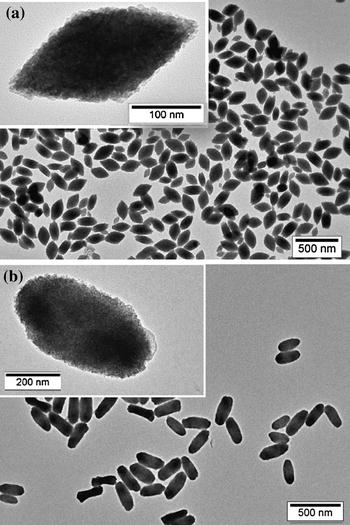
A simple procedure for the synthesis of orthorhombic, uniform, LuF3 particles with two different morphologies (rhombus- and cocoon-like) and nanometer and sub-micrometer size, respectively, is reported. The method consists in the aging, at 120 °C for 2 h, a solution containing [BMIM]BF4 ionic liquid (0.5 mL) and lutetium acetate (in the case of the rhombi) or lutetium nitrate (in the case…

New Insights on the Kinetic Analysis of Isothermal Data: The Independence of the Activation Energy from the Assumed Kinetic Model

Isothermal experiments are widely employed to study the kinetics of solid-state reactions or processes to extract essential kinetic information needed for modeling the processes at an industrial scale. The kinetic analysis of isothermal data requires finding or assuming a kinetic function that can properly fit the evolution of the reaction rate with time, so that…

Limestone Calcination Nearby Equilibrium: Kinetics, CaO Crystal Structure, Sintering and Reactivity

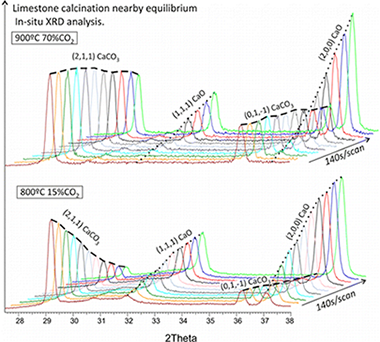
In this work, we analyze limestone calcination kinetics at environmental conditions involving a CO2 partial pressure P close to the equilibrium pressure Peq by means of in situ X-ray diffraction (XRD) and thermogravimetric (TG) analyses. In contrast with previous empirical observations carried out mostly at conditions far from equilibrium (P/Peq ≪ 1), our results show that the decarbonation rate decreases as…

Improvement of Vickers hardness measurement on SWNT/Al2O3 composites consolidated by spark plasma sintering

Dense alumina composites with different carbon nanotube content were prepared by colloidal processing and consolidated by Spark Plasma Sintering (SPS). Single-wall carbon nanotubes (SWNTs) were distributed at grain boundaries and also into agglomerates homogeneously dispersed. Carrying out Vickers hardness tests on the cross-section surfaces instead of top (or bottom) surfaces has shown a noticeable increase…

Role of precalcination and regeneration conditions on postcombustion CO2 capture in the Ca-looping technology

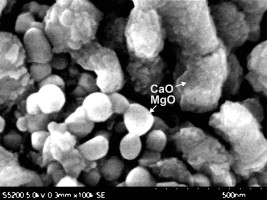
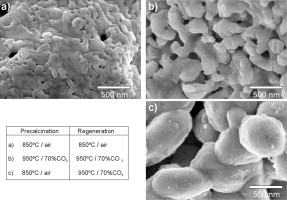
The Ca-looping (CaL) technology is already recognized as a potentially viable method to capture CO2 from postcombustion gas in coal fired power plants. In this process, CO2 is chemisorbed by CaO solid particles derived from precalcination of cheap and widely available natural limestone. The partially carbonated solids are regenerated by calcination under high CO2 concentration.…

Properties of mechanochemically synthesized nanocrystalline Bi2S3 particles

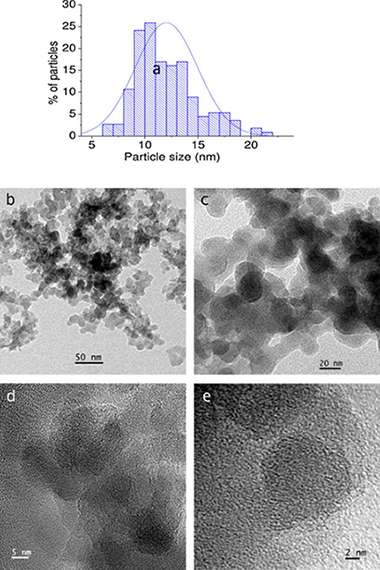
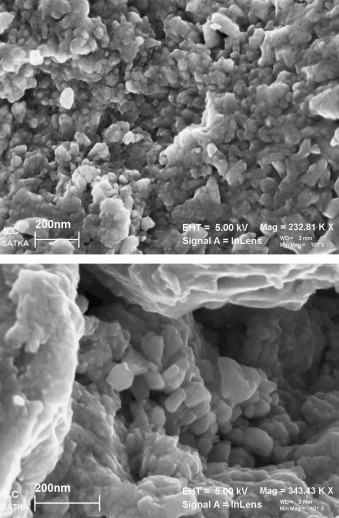
Nanocrystalline Bi2S3 particles have been synthesized from Bi and S powders by high-energy milling in a planetary mill. Structural and microstructural characterization of the prepared particles, including phase identification, specific surface area measurement and particle size analysis has been carried out. The optical properties were measured by spectroscopic methods and the structural stability up to 500 °C…