Constant rate thermal analysis of a dehydrogenation reaction

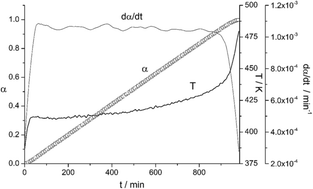
The Constant Rate Thermal Analysis (CRTA) procedure has been employed for the first time to study the kinetics of MgH2 dehydrogenation by thermogravimetry under high vacuum. CRTA implies controlling the temperature in such a way that the decomposition rate is maintained constant all over the process, employing the mass change as the experimental signal proportional to…

Targeted multifunctional tannic acid nanoparticles

Tannic acid (TA) has multiple effects against cancer, being especially promising in those types that overexpress the epidermal growth factor receptor (EGFR), as TA modulates its activation and downstream signaling pathways, triggering apoptosis. Nonetheless, despite the important role of this receptor in the pathogenesis and progression of a wide variety of tumors, no TA systems…

Mechanochemically synthesized nanocrystalline ternary CuInSe2 chalcogenide semiconductor

The synthesis of nanocrystalline ternary CuInSe2 particles prepared by high-energy milling in a planetary mill in an argon atmosphere from copper, indium and selenium was reported. CuInSe2 particles crystallize in the tetragonal structure with the crystallite size of about 30.5 nm. The Raman spectrum of CuInSe2 nanoparticles shows a strong peak at 176 cm−1 corresponds to the A1 phonon mode of tetragonal…

A hybrid silver-magnetite detector based on surface enhanced Raman scattering for differentiating organic compounds

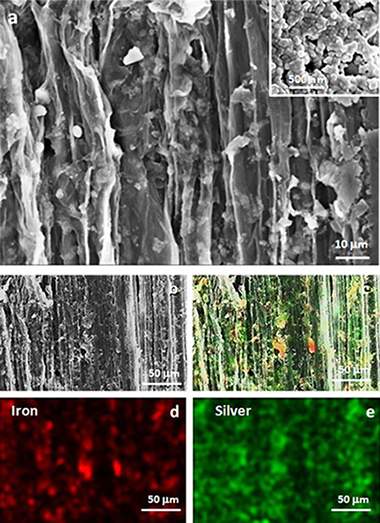
In this work a cheap detector of organic molecules is developed. It comprises a cellulose fiber doped with a mixture of magnetite and reduced silver nanoparticles, the latter ones synthesized anew. The nanoparticles and the fiber were characterized with well-established spectroscopic, microscopic and magnetic techniques, namely infrared, UV–vis spectroscopies, vibrating sample magnetometry and electronic microscopies.…

Template-Assisted Hydrothermal Growth of Aligned Zinc Oxide Nanowires for Piezoelectric Energy Harvesting Applications

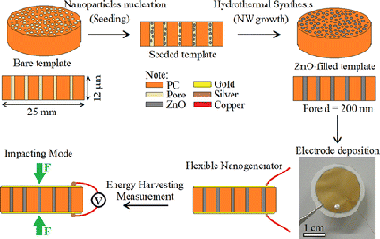
A flexible and robust piezoelectric nanogenerator (NG) based on a polymer-ceramic nanocomposite structure has been successfully fabricated via a cost-effective and scalable template assisted hydrothermal synthesis method. Vertically aligned arrays of dense and uniform zinc oxide (ZnO) nanowires (NWs) with high aspect ratio (diameter similar to 250 nm, length similar to 12 mu m) were…

Hot-pressing of (Ti,Mt)(C,N)-Co-Mo2C (Mt = Ta,Nb) powdered cermets synthesized by a mechanically induced self-sustaining reaction

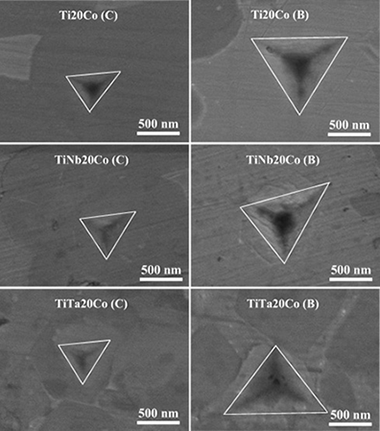
A mechanically induced self-sustaining reaction (MSR) has been successfully employed for manufacturing powdered cermets based on Ti, Ti–Ta and Ti–Nb carbonitrides using Co as the binder phase and Mo2C as the sintering additive. The powders were sintered by hot-pressing, and complete chemical, microstructural and mechanical characterizations were performed on the densified cermets. When elemental Ta,…

Electrical properties of reduced 3YTZP ceramics consolidated by spark plasma sintering

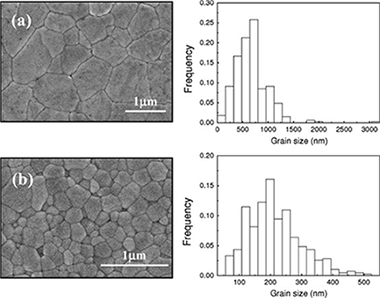
3 mol% Yttria doped zirconia ceramics were consolidated by spark plasma sintering (SPS) at two sintering temperatures with the aim of achieving two different reduction levels. Microstructural characterization of the ceramics was performed by scanning electron microscopy (SEM). Electrical properties were investigated by means of impedance spectroscopy from room temperature up to 500 degrees C.…

Effect of dolomite decomposition under CO2 on its multicycle CO2 capture behaviour under calcium looping conditions

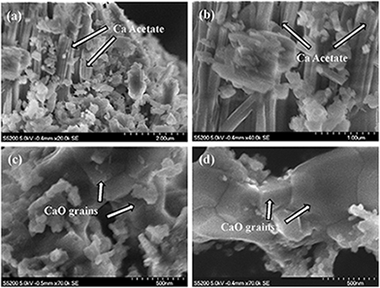
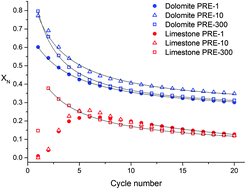
One of the major drawbacks that hinder the industrial competitiveness of the calcium looping (CaL) process for CO2 capture is the high temperature (∼930–950 °C) needed in practice to attain full calcination of limestone in a high CO2 partial pressure environment for short residence times as required. In this work, the multicycle CO2 capture performance of dolomite and…