Calcium-Looping performance of steel and blast furnace slags for thermochemical energy storage in concentrated solar power plants

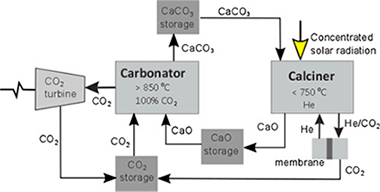
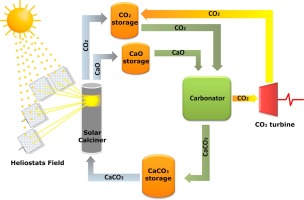
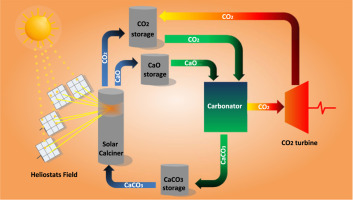
The Calcium Looping (CaL) process, based on the carbonation/calcination of CaO, has been proposed as a feasible technology for Thermochemical Energy Storage (TCES) in Concentrated Solar Power (CSP) plants. The CaL process usually employs limestone as CaO precursor for its very low cost, non-toxicity, abundance and wide geographical distribution. However, the multicycle activity of limestone…

Chalcogenide Quaternary Cu2FeSnS4 Nanocrystals for Solar Cells: Explosive Character of Mechanochemical Synthesis and Environmental Challenge

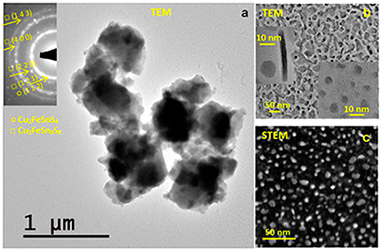
In this study we demonstrate the synthesis of quaternary semiconductor nanocrystals of stannite Cu2FeSnS4/rhodostannite Cu2FeSn3S8 (CFTS) via mechanochemical route using Cu, Fe, Sn and S elements as precursors in one-pot experiments. Methods of X-ray diffraction (XRD), nitrogen adsorption, high-resolution transmission electron microscopy (HRTEM), scanning transmission electron microscopy (STEM), energy-dispersive X-ray spectroscopy (EDX) and X-ray photoelectron…

Defect chemistry and electrical properties of BiFeO3

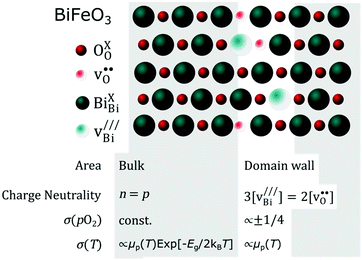
BiFeO3 attracts considerable attention for its rich functional properties, including room temperature coexistence of magnetic order and ferroelectricity and more recently, the discovery of conduction pathways along ferroelectric domain walls. Here, insights into the defect chemistry and electrical properties of BiFeO3 are obtained by in situ measurements of electrical conductivity, sigma, and Seebeck coefficient, a,…

Dense graphene nanoplatelet/yttria tetragonal zirconia composites: Processing, hardness and electrical conductivity

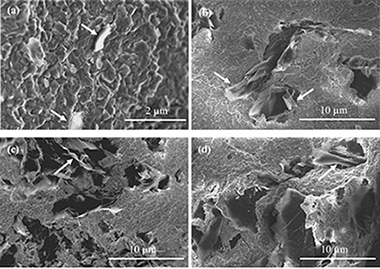
Yttria tetragonal zirconia ceramic composites with 1, 2.5, 5 and 10 vol% nominal contents of graphene nanoplatelets (GNPs) were fabricated and characterized. First, the GNP dispersion in isopropanol was optimized to de-agglomerate the GNPs without damaging their structure. Then, submicrometric fully dense composites were obtained via spark plasma sintering (SPS) at 1250 degrees C with…

Microstructure characterization of multifunctional As4S4/Fe3O4 nanocomposites prepared by high-energy mechanical milling

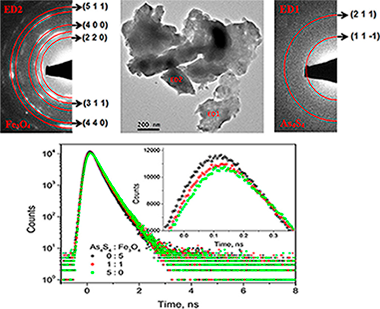
Multifunctional As4S4/Fe3O4 nanocomposites prepared by high-energy mechanical milling are probed by complementary methods of positron annihilation lifetime (PAL) spectroscopy, supported by microstructure characterization using X-ray powder diffraction (XRPD) with analysis applied to the first sharp diffraction peak (FSDP), morphology studies by transmission electron microscopy (TEM) with energy-dispersive spectroscopy (EDS) and high-resolution TEM (HRTEM).  These nanocomposites…

Influence of milling parameters on the solid-gas synthesis of TiCxN1-x by mechanically induced self-sustaining reaction

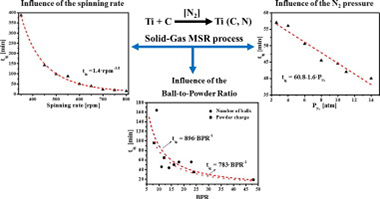
The synthesis of a titanium carbonitride solid solution (TiCxN1 − x) performed in a high-energy planetary mill by a solid-gas Mechanically induced Self-sustaining Reaction (MSR) was used to study the influence of a full set of experimental milling parameters on the ignition time (tig) as a measure of the mechanical dose rate provided by the mill. The…

Multicycle activity of natural CaCO3 minerals for thermochemical energy storage in Concentrated Solar Power plants

Thermochemical energy storage in Concentrated Solar Power plants by means of the Calcium-Looping process is a promising novel technology that would allow for a higher share of renewables. A main benefit of this technology is the use of widely available, non-toxic and environmentally friendly calcium carbonate minerals as raw materials to store energy. Efficient integration…

Lead-Free Polycrystalline Ferroelectric Nanowires with Enhanced Curie Temperature

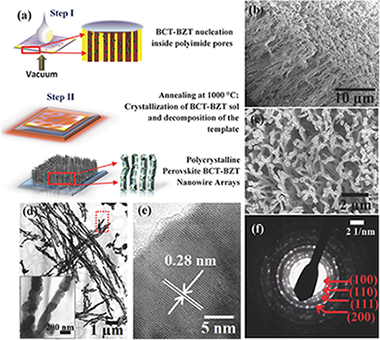
Ferroelectrics are important technological materials with wide-ranging applications in electronics, communication, health, and energy. While lead-based ferroelectrics have remained the predominant mainstay of industry for decades, environmentally friendly lead-free alternatives are limited due to relatively low Curie temperatures (T-C) and/or high cost in many cases. Efforts have been made to enhance T-C through strain engineering,…