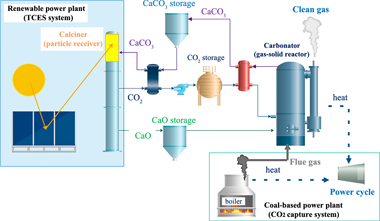
Scaling-up the Calcium-Looping Process for CO2 Capture and Energy Storage

The Calcium-Looping (CaL) process has emerged in the last years as a promising technology to face two key challenges within the future energy scenario: energy storage in renewable energy-based plants and CO2 capture from fossil fuel combustion. Based on the multicycle calcination-carbonation reaction of CaCO3 for both thermochemical energy storage and post-combustion CO2 capture applications,…

Pure perovskite BiFeO3-BaTiO3 ceramics prepared by reaction flash sintering of Bi2O3-Fe2O3-BaTiO3 mixed powders

In this work, the 0.67BiFeO(3)-0.33BaTiO(3) ferroelectric ceramic was prepared by Reaction Flash Sintering (RFS). This preparation technique combines synthesis and sintering in a single Flash experiment. The starting oxides reacted during the flash to produce a stoichiometric well-sintered solid solution at a temperature of 858 degrees C by applying a modest field of 35 V…

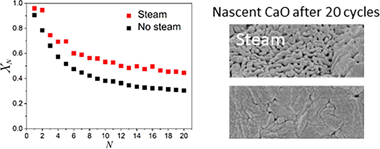
Kinetics and cyclability of limestone (CaCO3) in presence of steam during calcination in the CaL scheme for thermochemical energy storage

In the present work, we explore the use of steam in the CaCO3 calcination step of the Calcium Looping process devised for thermochemical energy storage (CaL-TCES). Steam produces a double benefit: firstly, it fastens calcination, allowing a reduction of the temperature needed to attain full calcination in short residence times, as those required in practice,…

Study of the Influence of Sintering Atmosphere and Mechanical Activation on the Synthesis of Bulk Ti2AlN MAX Phase Obtained by Spark Plasma Sintering

The influence of the mechanical activation process and sintering atmosphere on the microstructure and mechanical properties of bulk Ti2AlN has been investigated. The mixture of Ti and AlN powders was prepared in a 1:2 molar ratio, and a part of this powder mixture was subjected to a mechanical activation process under an argon atmosphere for…

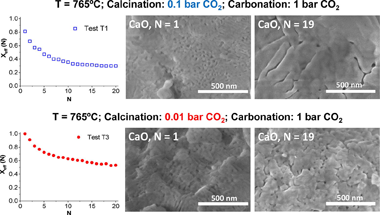
Calcination under low CO2 pressure enhances the calcium Looping performance of limestone for thermochemical energy storage

The Calcium Looping performance of limestone for thermochemical energy storage has been investigated under novel favorable conditions, which involve calcination at moderate temperatures under CO2 at low pressure (0.01 and 0.1 bar) and carbonation at high temperature under CO2 at atmospheric pressure. Calcining at low CO2 pressures allows to substantially reduce the temperature to achieve…

Mechanochemical synthesis of ternary chalcogenide chalcostibite CuSbS2 and its characterization

In this work, the very rapid one-step mechanochemical synthesis of nanocrystalline ternary chalcogenide chalcostibite CuSbS2 prepared from copper, antimony, and sulfur precursors by high-energy milling for only 30 min in a planetary mill is reported. XRD confirmed the orthorhombic crystal structure of CuSbS2. The crystallite size of CuSbS2 calculated by LeBail refinement of the X-ray…

Tuning the excitation wavelength of luminescent Mn2+-doped ZnSxSe1-x obtained by mechanically induced self-sustaining reaction

Mn2+-doped ZnSxSe1-x solid solution samples (Mn:ZnSxSe1-x) were synthesized by the mechanochemical process denoted as mechanically-induced self-sustaining reaction from Mn/Zn/S/Se powder elemental mixtures. The samples were characterized by X-ray diffraction, scanning electron microscopy, diffuse reflectance UV-Vis spectroscopy and emission and excitation photoluminescence measurements. The band-gap energy of samples was controlled by changing the stoichiometry, x, of…

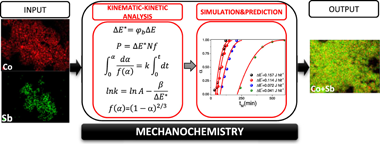
Paving the Way to Establish Protocols: Modeling and Predicting Mechanochemical Reactions

Parametrization of mechanochemical reactions, or relating the evolution of the reaction progress to the supplied input power, is required both to establish protocols and to gain insight into mechanochemical reactions. Thus, results could be compared, replicated, or scaled up even under different milling conditions, enlarging the domains of application of mechanochemistry. Here, we propose a…