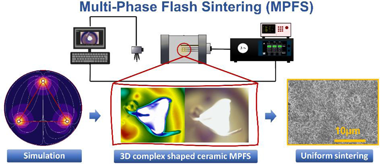
A novel Multi-Phase Flash Sintering (MPFS) technique for 3D complex-shaped ceramics

This work demonstrates the first proof-of-concept of Multi-Phase Flash Sintering (MPFS). This novel technique essentially consists of applying a rotating electric field to the sample by means of a multi-phase voltage source as furnace temperature increases. Several ceramic materials with different types of electrical conductivities are sintered within seconds at furnace temperatures much lower than…

Predictions of polymer thermal degradation: relevance of selecting the proper kinetic model

Making predictions, such as lifetime estimations, is one of the main objectives of kinetic studies. Thus, from conventional thermal analysis experiments, the behavior of polymeric materials under processing or application conditions, usually far away from those used in the laboratory experiments, could be estimated. Conventional prediction procedures usually make use of oversimplified equations based on…

Effect of the Processing Parameters on the Porosity and Mechanical Behavior of Titanium Samples with Bimodal Microstructure Produced via Hot Pressing

Commercially pure (c.p.) titanium grade IV with a bimodal microstructure is a promising material for biomedical implants. The influence of the processing parameters on the physical, microstructural, and mechanical properties was investigated. The bimodal microstructure was achieved from the blends of powder particles with different sizes, while the porous structure was obtained using the space-holder…

Flash Sintering Research Perspective: A Bibliometric Analysis

Flash Sintering (FS), a relatively new Field-Assisted Sintering Technique (FAST) for ceramic processing, was proposed for the first time in 2010 by Prof. Rishi Raj’s group from the University of Colorado at Boulder. It quickly grabbed the attention of the scientific community and since then, the field has rapidly evolved, constituting a true milestone in…

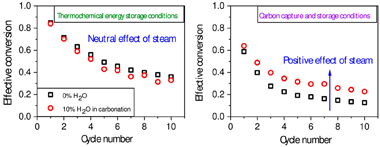
Effect of Steam Injection during Carbonation on the Multicyclic Performance of Limestone (CaCO3) under Different Calcium Looping Conditions: A Comparative Study

This study explores the effect of steam addition during carbonation on the multicyclic performance of limestone under calcium looping conditions compatible with (i) CO2 capture from postcombustion gases (CCS) and with (ii) thermochemical energy storage (TCES). Steam injection has been proposed to improve the CO2 uptake capacity of CaO-based sorbents when the calcination and carbonation…

Unravelling the optimization of few-layer graphene crystallinity and electrical conductivity in ceramic composites by Raman spectroscopy

Zirconia composites with few-layer graphene (FLG) were prepared by two powder processing routines-ultrasonic agitation or planetary ball milling-and spark plasma sintered at 1250 and 1300 degrees C. An in-depth study of the crystallinity of FLG, in terms of presence and nature of defects, was performed by Raman spectroscopy, revealing enhanced FLG crystallinity after sintering. This…

Advanced parametrisation of phase change materials through kinetic approach

Phase change materials (PCM) have been widely investigated for heat storage and transfer applications. Numerous numerical simulation approaches have been proposed for modelling their behaviour and predicting their performance in thermal applications. However, simulation approaches do not consider the kinetics of the phase transition processes, compromising the accuracy of their predictions. The phase change is…

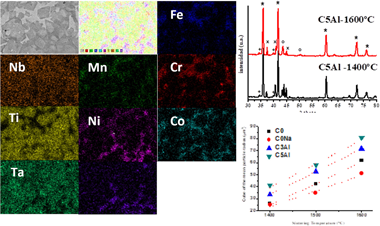
Fabrication and characterization of FeCoNiCrMn,(Al) high entropy alloy based (Ti,Ta,Nb)(C,N) cermet

From nanostructured mechanically synthesized powder a set of FeCoNiCrMn,(Al) based (Ti,Ta,Nb)(C,N) cermets were fabricated and sintered by a pressureless procedure. Highly dense cermets were obtained, and the nature of chemical change, microstructure, mechanical properties and coarsening kinetic of ceramic phase were characterized by image analysis, microindentation, scanning electron microscopy and X-ray diffraction. The design of…