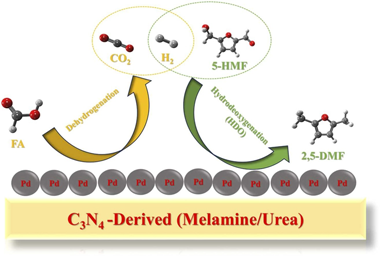
Formic acid dehydrogenation and use as H-donor in 5-hydroxymethylfur-fural hydrodeoxygenation over Pd/C3N4 catalysts

This work studies the behavior of a series of Pd/C3N4 catalyst in the reaction of formic acid dehydrogenation and the use of the latter as H-donor for 2,5-hydroxymethyl furfural hydrodeoxygenation. Firstly, a series of supports have been synthesized from melamine and urea as a function of precursors ratio and temperature of their condensation. The different…

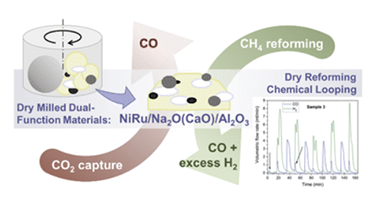
Integrated carbon capture and dry reforming of methane of mechanochemically synthesised dual-function materials

Herein we report a green mechanochemical synthesis with low energy input of dual-function materials for integrated CO2 capture and dry reforming of methane. The materials produced syngas during the CH4 step (up to 0.6 mmol g−1 CO and 7.7 mmol g−1 H2) and CO during the CO2 step (up to 3.1 mmol g−1) via the reverse Boudouard reaction due to the carbon…

Boosting Hydrogen Release: Optimized C3N4-Supported Palladium Catalysts for Formic Acid Dehydrogenation

Carbon nitride, C3N4, was synthesized through thermal polycondensation of melamine with varying temperature and time conditions. This approach represents a cost-effective, straightforward, and environmentally friendly synthetic method with lower energy consumption to obtain hierarchically structured carbon nitride. The resulting materials were subjected to comprehensive characterization to analyze their crystalline structure, textural properties, composition, and light…

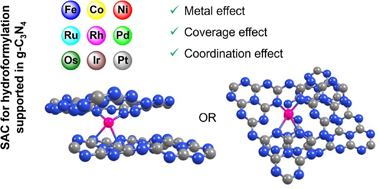
Computational and experimental insights into single-atom catalysts supported on g-C3N4: Unraveling the superior stability and catalytic activity of Rh in hydroformylation reactions

Single-atom catalysts (SACs) have emerged as a promising class of materials, leveraging the benefits of both homogeneous and heterogeneous catalysis to enhance efficiency and selectivity. In this work we have investigated the catalytic performance of SACs supported on graphitic carbon nitride (g-C3N4) for hydroformylation reactions. A systematic evaluation of nine transition metal SACs (Fe, Ru,…

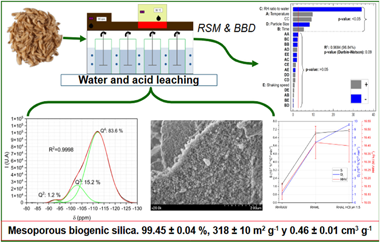
Comprehensive understanding of the experimental factors determining the leaching of rice husk, and their effect on the thermochemical properties and characteristics of bio-silica

Leaching is a pretreatment that removes ionic species responsible for undesired reactions during biomass thermochemical transformation. Despite numerous reported leaching conditions, the impact of specific factors on ionic species removal remains insufficiently understood for widespread application. This study investigates the relationship between experimental factors and their optimal levels in aqueous medium, focusing on the effects…

An efficient strategy for simultaneous gold deposition and obtention of hierarchical Au/TS-1 applied to liquid-phase propylene epoxidation

A novel and straightforward one-step method has been developed for the controlled deposition of gold nanoparticles (AuNPs) with uniform diameters onto the titanosilicate (TS-1) zeolitic surface via a direct anionic exchange (DAE) approach. This innovative process simultaneously introduces auxiliary mesoporosity into the zeolite framework, overcoming critical limitations associated with traditional microporous catalysts, including diffusion constraints…

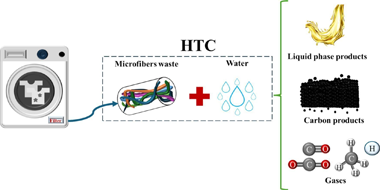
Upcycling textile derived microplastics waste collected from washer and dryers to carbonaceous products using hydrothermal carbonization

Microplastics are an emerging pollutant of concern. Many microplastics in the waters arise from washing synthetic textiles in residential and commercial washing machines. The present research evaluated the upcycling of this waste to carbon materials by hydrothermal carbonization. Real microfiber waste was collected using clothes washer and dryer microfilters. Via temperature and residence time screening…

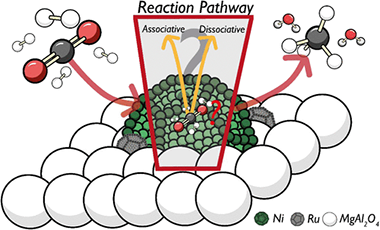
Exploring the Synergistic Interaction between Nickel- and Ruthenium-Based Catalysts for Carbon Dioxide Methanation Reaction

The utilization of nickel-ruthenium as bimetallic catalysts is widely recognized for its efficacy in enhancing the catalytic performance in the carbon dioxide methanation reaction. The present study focuses on the synergistic interplay between both active sites and their respective roles in the reaction mechanism through operando DRIFT-MS analysis. Findings reveal that the bimetallic catalyst is…