Boosting the activity of a Au/CeO2/Al2O3 catalyst for the WGS reaction

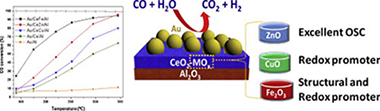
Herein a strategy to design highly efficient Au/CeO2/Al2O3 based WGS catalysts is proposed. The inclusion of transition metals, namely Fe, Cu and Zn as CeO2 dopant is considered. All the promoters successfully increased the WGS performance of the undoped sample. The activity improvement can be correlated to structural and/or redox features induced by the dopants. The comparative…

Microreactors technology for hydrogen purification: Effect of the catalytic layer thickness on CuOx/CeO2-coated microchannel reactors for the PROX reaction

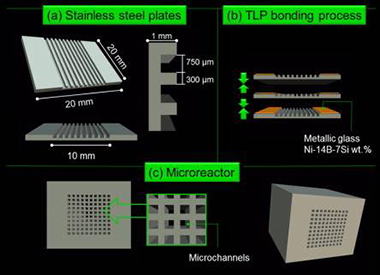
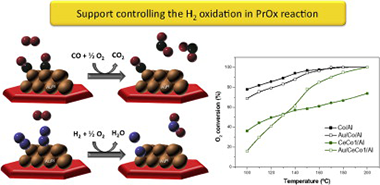
Two blocks of microreactors composed by 100 microchannels and coated, respectively, with 150 and 300 mg of a CuOx/CeO2 catalyst, were prepared and tested in the preferential oxidation of CO in presence of H2 (PROX). The deposition of different amount of catalyst resulted in different catalytic layer thicknesses thus modifying the catalytic performances of the microreactor. The evaluation…

Ni-CeO2/C Catalysts with Enhanced OSC for the WGS Reaction

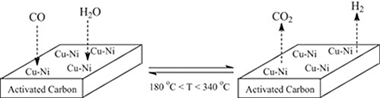
In this work, the WGS performance of a conventional Ni/CeO2 bulk catalyst is compared to that of a carbon-supported Ni-CeO2 catalyst. The carbon-supported sample resulted to be much more active than the bulk one. The higher activity of the Ni-CeO2/C catalyst is associated to its oxygen storage capacity, a parameter that strongly influences the WGS…

Ionic liquid immobilization on carbon nanofibers and zeolites: Catalyst design for the liquid-phase toluene chlorination

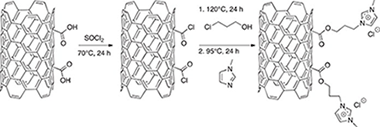
The environmental-friendly chlorination reaction of toluene by trichloroisocyanuric acid (TCCA, C3N3O3Cl3) was investigated applying immobilized ionic liquids (ILs) on different supports. Ionic liquids were grafted either on carbon nanofibers (CNF) or encapsulated in zeolites. Their influence on the chlorination activity as well as on the selectivity in different chlorinated products was studied. An unusually high…

Role of ruthenium on the catalytic properties of CeZr and CeZrCo mixed oxides for glycerol steam reforming reaction toward H2 production

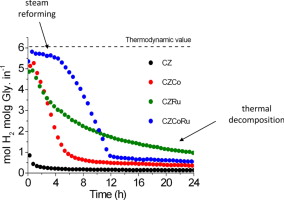
The effect of ruthenium on the physico-chemical properties of CeZr and CeZrCo mixed oxides for H2production by glycerol steam reforming reaction has been studied. The combination of in situ Raman spectroscopy under both reductive and oxidative conditions, H2/O2 pulses and XRD, Raman, BET analysis, H2-TPR and TPD-TPO analyses contributed to the determination of the structural and textural properties, redox behavior,…

Glycerol steam reforming on bimetallic NiSn/CeO2-MgO-Al2O3 catalysts: Influence of the support, reaction parameters and deactivation/regeneration processes

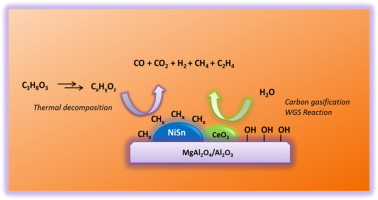
NiSn bimetallic catalysts supported over Al2O3 modified with different promoter (Mg and/or Ce) were prepared and characterized by powder X-ray diffraction (XRD), N2 sorptometry, and temperature programmed reduction (TPR). Hydrogen production by glycerol steam reforming over these catalysts was investigated. Among the catalysts, NiSn/AlMgCe catalyst shows the highest hydrogen yield as well as the best stability during…

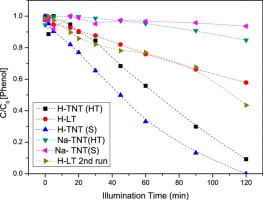
Synthesis and application of layered titanates in the photocatalytic degradation of phenol

This study proposes a direct synthetic route to single titanate sheets through the mild and versatile conditions of the “chimie douce”. The stages of the production include the complexation of the titanium alkoxide precursor by benzoic acid, the formation of titanium oxo-clusters and their controlled transformation into single sheet titanates during the hydrolysis stage. The…