Recycling of construction and demolition waste generated by building infrastructure for the production of glassy materials

The use of waste materials generated by construction and demolition industry to yield valuable glassy materials, i.e. enamel for glazed ceramic tiles and cellular glasses is presented in this study. Both types of materials are produced by one-step treatment at moderate temperatures after simple waste chemical composition adjust. The enamels are manufactured directly from the…

Liquid-phase oxidation with hydrogen peroxide of benzyl alcohol and xylenes on Ca-10(PO4)(6)(OH)(2) – CaWO4

A W-containing apatite (W/HAp) catalyst was prepared following a hydrothermal synthesis route and served as a model catalyst. Crystallographic analysis indicated that the resulting material contained hydroxyapatite, Ca10-3xWx(PO4)(6)(OH)(2), W-hydroxyapatite, calcium tungstate, CaWO4, and tricalcium phosphate, Ca-3(PO4)(2). The catalyst was investigated in liquid phase oxidation of benzyl alcohol and xylenes using hydrogen peroxide as an oxidant.…

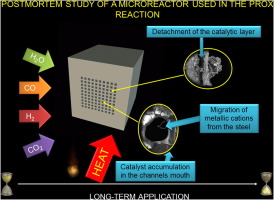
Forced deactivation and postmortem characterization of a metallic microchannel reactor employed for the preferential oxidation of CO (PROX)

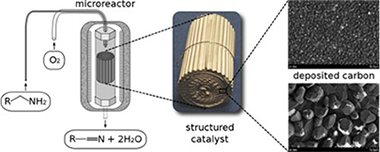
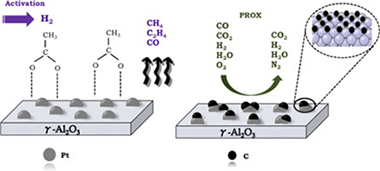
This manuscript is one of the few works presenting evidences of the effect of prolonged use of a microreactor. Our reactor has been designed for the PROX reaction. Near to 550 h of operation under different feed-streams, including CO2 and H2O, in the 100-300 degrees C temperature range, and several regeneration cycles, and a final…

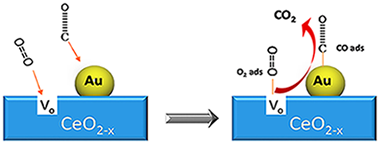
Au/CeO2 Catalysts: Structure and CO Oxidation Activity

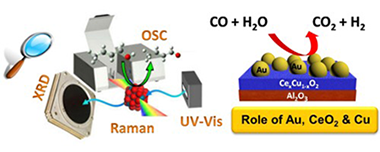
In this comprehensive review, the main aspects of using Au/CeO2 catalysts in oxidation reactions are considered. The influence of the preparation methods and synthetic parameters, as well as the characteristics of the ceria support (presence of doping cations, oxygen vacancies concentration, surface area, redox properties, etc.) in the dispersion and chemical state of gold are revised.…

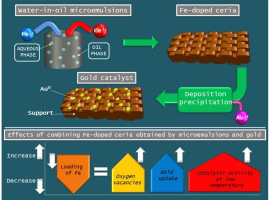
Au-supported on Fe-doped ceria solids prepared in water-in-oil microemulsions: Catalysts for CO oxidation

Gold catalysts were synthesized by deposition-precipitation employing Fe-doped ceria systems, previously obtained by means of the water-in-oil microemulsions methodology with different iron contents (10, 25 and 50 Fe at.%). The final catalysts were tested in the CO oxidation reaction in presence of H2. After gold deposition the crystalline structure of the supports was not altered.…

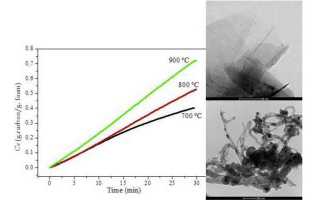
Growth of carbonaceous nanomaterials over stainless steel foams. Effect of activation temperature

Some of the problems that occur during the operation of chemical reactors based of structured catalytic substrates, as monoliths, foams, membranes, cloths, fibres and other systems, are related to the preparation of long term stable coatings. Frequently, the deposition of the catalytic layer is carried out by washcoating, requiring this step a cautious attention, especially…

Promoting effect of Sn on supported Ni catalyst during steam reforming of glycerol

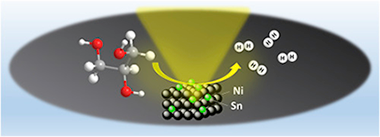
The promoting effect of Sn on the catalytic performance of supported Ni catalyst in the reaction of glycerol steam reforming was studied. The physico-chemical properties of the prepared samples were investigated by X-ray fluorescence (XRF), BET surface area, in situ X-ray diffraction (XRD), laser Raman spectroscopy, X-ray photoelectron spectroscopy (XPS), scanning electron microscopy (SEM) and temperature-programmed oxidation…