Influence of the preparation method in the metal-support interaction and reducibility of Ni-Mg-Al based catalysts for methane steam reforming

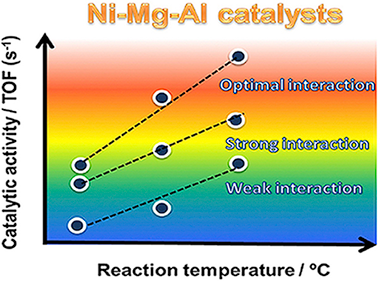
Ni-Mg-Al based catalysts were prepared using different preparation methods (impregnation, impregnation-coprecipitation and coprecipitation) and tested in steam reforming of methane. The differences observed in catalytic activity were directly correlated to the physicochemical properties and the different degree of Ni-Mg-Al interaction. The reducibility results showed that the catalyst prepared by the impregnation-coprecipitation method presented the most…

Phosphate-type supports for the design of WGS catalysts

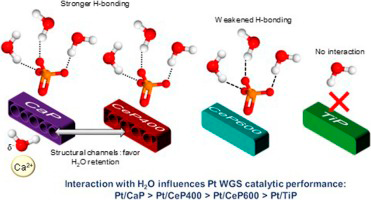
The importance of water availability during the WGS reaction has been extensively reported. Thus, the search of new supports able to interact with the water molecule is of great importance. In this work, a series of phosphate type supports containing Ce, Ca and Ti have been studied, demonstrating that water interaction with the support is…

Operando Spectroscopic Evidence of the Induced Effect of Residual Species in the Reaction Intermediates during CO2 Hydrogenation over Ruthenium Nanoparticles

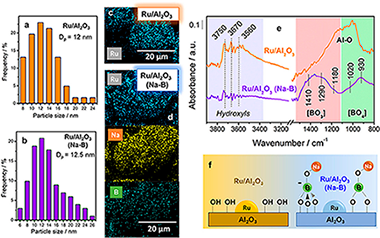
In this work, we present a highly active catalyst based on Ru nanoparticles dispersed on alumina, which showed an unexpected activity for CO2 methanation. This exceptional catalytic behavior was attributed to the presence of residual species that remained on the surface after synthesis. Furthermore, through Operando DRIFTS (diffuse reflectance infrared Fourier transform spectroscopy) measurements it…

Powder and Nanotubes Titania Modified by Dye Sensitization as Photocatalysts for the Organic Pollutants Elimination

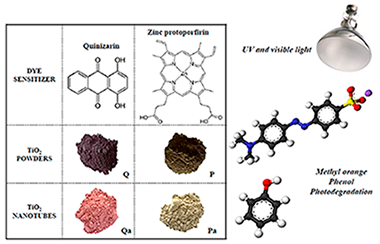
In this study, titanium dioxide powder obtained by the sol-gel method and TiO2 nanotubes, were prepared. In order to increase the TiO2 photoactivity, the powders and nanotubes obtained were modified by dye sensitization treatment during the oxide synthesis. The sensitizers applied were Quinizarin (Q) and Zinc protoporphyrin (P). The materials synthesized were extensively characterized and…

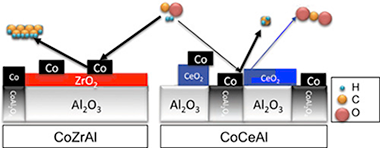
Promoting effect of CeO2, ZrO2 and Ce/Zr mixed oxides on Co/gamma-Al2O3 catalyst for Fischer-Tropsch synthesis

A series of cobalt-based catalysts have been synthesized using as support gamma-Al2O3 promoted by ceria/zirconia mixed oxides with a variable Ce/Zr molar ratio. The obtained catalysts demonstrated oxide promotion results in the protection of the major textural properties, especially for Zr-rich solids. Reducibility of cobalt species was enhanced by the presence of mixed oxides. The…

Promoting effect of CeO2, ZrO2 and Ce/Zr mixed oxides on Co/gamma-Al2O3 catalyst for Fischer-Tropsch synthesis

A series of cobalt-based catalysts have been synthesized using as support gamma-Al2O3 promoted by ceria/zirconia mixed oxides with a variable Ce/Zr molar ratio. The obtained catalysts demonstrated oxide promotion results in the protection of the major textural properties, especially for Zr-rich solids. Reducibility of cobalt species was enhanced by the presence of mixed oxides. The…

Immobilization of Stabilized Gold Nanoparticles on Various Ceria-Based Oxides: Influence of the Protecting Agent on the Glucose Oxidation Reaction

The influence of the protecting agent’s nature on gold particle size and dispersion was studied in this work over a series of gold-based catalysts. CO and glucose oxidation were chosen as catalytic reactions to determine the catalyst’s structure-activity relationship. The nature of the support appeared to be the predominant factor for the increase in activity,…

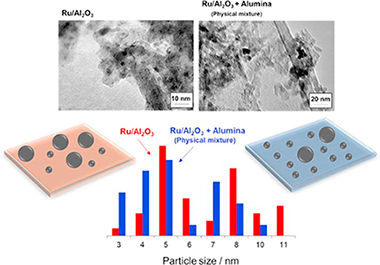
Does shaping catalysts modify active phase sites? A comprehensive in situ FTIR spectroscopic study on the performance of a model Ru/Al2O3 catalyst for the CO methanation

Routinely, it seems assumed that the catalytic layer coated on monoliths and microchannel reactors preserve the properties of the initial powder catalyst. However, this assumption should be reasonably demonstrated since the set of chemical and physical manipulations involved in the preparation of these catalytic devices hardly does not alter the surface of the starting catalyst…