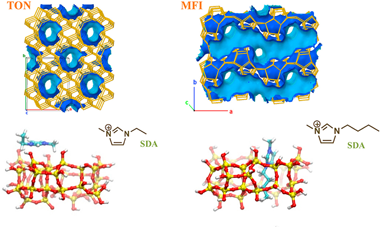
How a small modification in the imidazolium-based SDA can determine the zeolite structure? MFI vs. TON

The present study proposes an important contribution to the understanding of ionic liquid role as structure directing agent for zeolite synthesis. A series of imidazolium based ionic liquids are used for this purpose. While the anionic counterpart influences the micellar organization during the synthesis, the imidazolium cation clearly directs the structure to one or another…

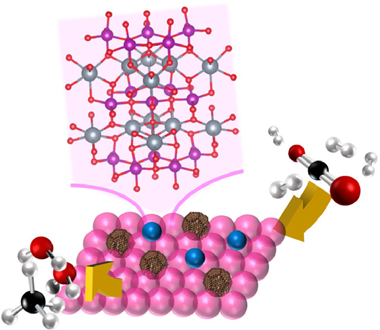
Ni/YMnO3 perovskite catalyst for CO2 methanation

This work proposes an innovative Ni catalyst supported over YMnO3 perovskite as a promising catalytic system for CO2 methanation reaction. Under reductive conditions, the attendance of Mn redox couples within the layered perovskite structure promotes the constitution of sub-stoichiometric YMnO3-x units which, by means of the flexible YMnO3-x reorganization capacity, results in boosted anionic mobility’s.…

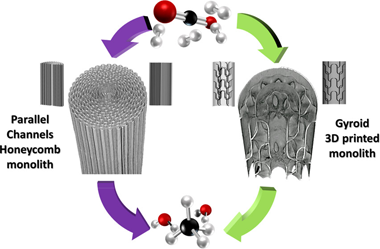
Stepping toward Efficient Microreactors for CO2 Methanation: 3D-Printed Gyroid Geometry

This work presents a comparative study toward the development of efficient microreactors based on three-dimensional (3D)-printed structures. Thus, the study evaluates the influence of the metal substrate geometry on the performance of structured catalysts for the CO2 methanation reaction. For this purpose, the 0.5%Ru-15%Ni/MgAl2O4 catalyst is washcoated over two different micromonolithic metal substrates: a conventional…

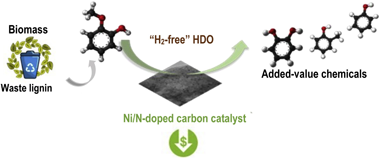
In-situ HDO of guaiacol over nitrogen-doped activated carbon supported nickel nanoparticles

In-situ hydrodeoxygenation of guaiacol over Ni-based nitrogen-doped activated carbon supported catalysts is presented in this paper as an economically viable route for bio-resources upgrading. The overriding concept of this paper is to use water as hydrogen donor for the HDO reaction, suppressing the input of external highpressure hydrogen. The effect of nitrogen sources, including polypyrrole…

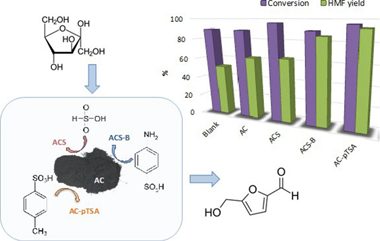
Effect of the sulphonating agent on the catalytic behavior of activated carbons in the dehydration reaction of fructose in DMSO

A series of -SO3R functionalized activated carbons (R=H, O, aryl) were prepared and applied in fructose dehydration reaction to 5-hydroxymethylfurfural. Different sulphonating methods introduce groups on catalyst surface with distinct donor-acceptor and hydrophilic properties. Their nature influences significantly not only activated carbon?s textural and chemical properties but also the product yields and selectivity in fructose…

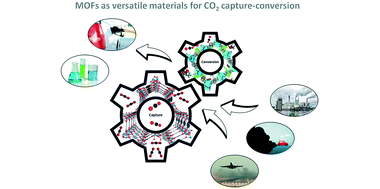
Understanding the opportunities of metal-organic frameworks (MOFs) for CO2 capture and gas-phase CO2 conversion processes: a comprehensive overview

The rapid increase in the concentration of atmospheric carbon dioxide is one of the most pressing problems facing our planet. This challenge has motivated the development of different strategies not only in the reduction of CO2 concentrations via green energy alternatives but also in the capture and conversion of CO2 into value-added products. Metal-organic frameworks…

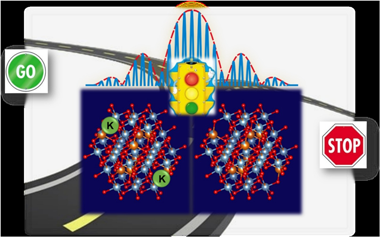
IR spectroscopic insights into the coking-resistance effect of potassium on nickel-based catalyst during dry reforming of methane

Dry reforming of methane (DRM) is an effective catalytic route for transforming CO2 and CH4 into valuable syngas and thus potentially attractive for mitigating the emission of environmental harmful gases. Therefore, it is crucial to develop rationally Ni-based catalysts highly resistant to coking and sintering. In this scenario, the addition of small amounts of potassium to nickel…

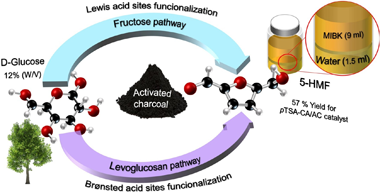
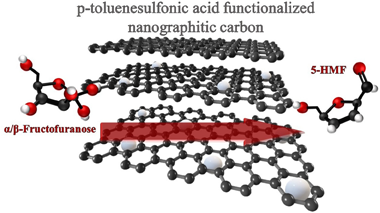
Fructose dehydration reaction over functionalized nanographitic catalysts in MIBK/H2O biphasic system

A series of functionalized nanographitic carbons is prepared, characterized and tested in fructose dehydration reaction to 5-hydroxymethylfurfural. The functionalization treatment was selected to introduce various Bro?nsted acid sites and to modify the textural and catalytic properties of the initial carbon material. Within the series, the sulfonated carbons present the most interesting catalytic behavior resulting in…