Formic Acid Dehydrogenation over a Monometallic Pd and Bimetallic Pd:Co Catalyst Supported on Activated Carbon

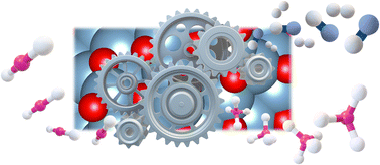
In this study, palladium is proposed as an active site for formic acid dehydrogenation reaction. Pd activity was modulated with Co metal with the final aim of finding a synergistic effect that makes possible efficient hydrogen production for a low noble metal content. For the monometallic catalysts, the metal loadings were optimized, and the increase in the reaction temperature and presence of additives were carefully considered. The…

MIL-100(Fe)-derived catalysts for CO2 conversion via low- and high-temperature reverse water-gas shift reaction

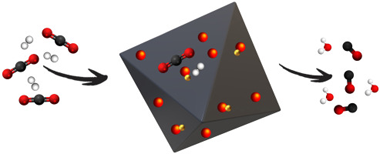
Fe-derived catalysts were synthesized by the pyrolysis of MIL-100 (Fe) metal-organic framework (MOF) and evaluated in the reverse water-gas shift (RWGS) reaction. The addition of Rh as a dopant by in-situ incorporation during the synthesis and wet impregnation was also considered. Our characterization data showed that the main active phase was a mixture of &…

Unravelling the CO2 capture and conversion mechanism of a NiRu-Na2O switchable dual-function material in various CO2 utilisation reactions

Time-resolved operando DRIFTS-MS was performed to elucidate the CO2 capture and conversion mechanisms of a NiRuNa/CeAl DFM in CO2 methanation, reverse water-gas shift, and dry reforming of methane. CO2 was captured mainly in the form of carbonyls and bidentate carbonates, and a spillover mechanism occurred to obtain the desired products.

The Need for Flexible Chemical Synthesis and How Dual-Function Materials Can Pave the Way

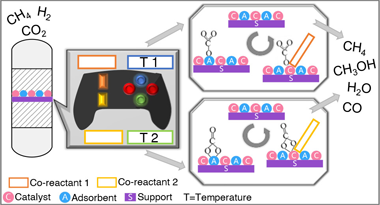
Since climate change keeps escalating, it is imperativethat theincreasing CO2 emissions be combated. Over recent years,research efforts have been aiming for the design and optimizationof materials for CO2 capture and conversion to enable acircular economy. The uncertainties in the energy sector and the variationsin supply and demand place an additional burden on the commercializationand implementation…

Scalable synthesis of 2D Ti2CTx MXene and molybdenum disulfide composites with excellent microwave absorbing performance

The signal crosstalk and electromagnetic interference (EMI) problems direly need to be resolved in the rapid development of modern microwave communication technology for a better working frequency and transmission power of electronic systems. Where the new absorbing materials such as molybdenum disulfide (MoS2)/titania (TiO2)/Ti2CTx and MoS2/Ti2CTx composites could meet the requirement of «thin, strong, light…

In-situ DRIFTS steady-state study of CO2 and CO methanation over Ni-promoted catalysts

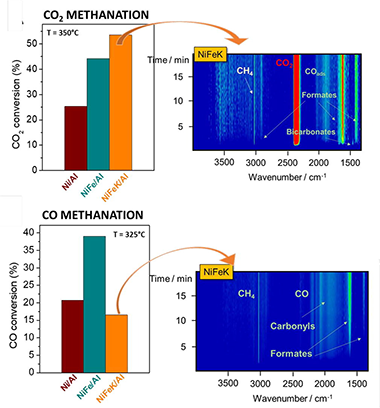
Promoting the performance of catalytic systems by incorporating small amount of alkali has been proved effective for several reactions whilst controversial outcomes are reported for the synthetic natural gas production. This work studies a series of Ni catalysts for CO2 and CO methanation reactions. In-situ DRIFTS spectroscopy evidenced similar reaction intermediates for all evaluated systems…

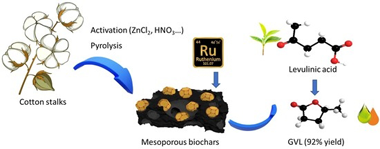
Functionalized Biochars as Supports for Ru/C Catalysts: Tunable and Efficient Materials for γ-Valerolactone Production

Cotton stalks-based biochars were prepared and used to synthetize Ru-supported catalysts for selective production of gamma-valerolactone from levulinic acid in aqueous media. Different biochars’ pre-treatments (HNO3, ZnCl2, CO2 or a combination of them) were carried out to activate the final carbonaceous support. Nitric acid treatment resulted in microporous biochars with high surface area, whereas the…

Engineering exsolved catalysts for CO2 conversion

Introduction: Innovating technologies to efficiently reduce carbon dioxide (CO2) emission or covert it into useful products has never been more crucial in light of the urgent need to transition to a net-zero economy by 2050. The design of efficient catalysts that can make the above a viable solution is of essence. Many noble metal catalysts…