


Switchable catalysis for methanol and synthetic natural gas synthesis from CO2: A techno-economic investigation

The oil and gas sector produces a considerable volume of greenhouse gas emissions, mainly generated from flaring and venting natural gas. Herein, a techno-economic analysis has been performed of a switchable catalytic process to convert the CH4 and CO2 in flared/vented natural gas into syngas or methanol. Specifically, it was shown that depending on greenhouse gas composition, dry methane reforming (DRM), reverse…
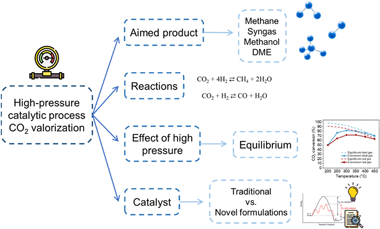
A review on high-pressure heterogeneous catalytic processes for gas-phase CO2 valorization

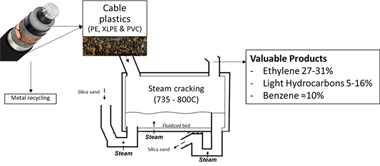
  This review discusses the importance of mitigating CO2 emissions by valorizing CO2 through high-pressure catalytic processes. It focuses on various key processes, including CO2 methanation, reverse water-gas shift, methane dry reforming, methanol, and dimethyl ether synthesis, emphasizing pros and cons of high-pressure operation. CO2 methanation, methanol synthesis, and dimethyl ether synthesis reactions are thermodynami-cally favored under high-pressure conditions. However, in the case of methane dry reforming and reverse water -gas shift, applying high pressure, results…

Natural hydrogen in the energy transition: Fundamentals, promise, and enigmas

Beyond its role as an energy vector, a growing number of natural hydrogen sources and reservoirs are being discovered all over the globe, which could represent a clean energy source. Although the hydrogen amounts in reservoirs are uncertain, they could be vast, and they could help decarbonize energy-intensive economic sectors and facilitate the energy transition. Natural hydrogen is mainly produced through a geochemical process known as serpentinization, which involves the reaction of water with low-silica, ferrous minerals. In favorable locations, the hydrogen produced…

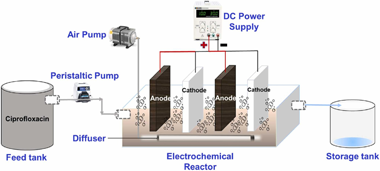
Optimized electrocatalytic degradation of ciprofloxacin using Co3O4 coated stainless steel electrodes

Ciprofloxacin (CIP) is a fluoroquinolone antibiotic that is widely used across the globe and its release is a serious concern due to its persistent nature, partial degradation, and simple transport through different environmental matrices. Pharmaceuticals have been degraded effectively by electrochemical oxidation. Exploring ways to in-crease the mineralization of these compounds while maintaining low power consumption is important. In…

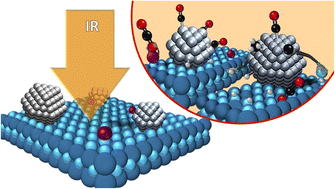
Subnanometric Pt clusters dispersed over Cs-doped TiO2 for CO2 upgrading via low-temperature RWGS: operando mechanistic insights to guide an optimal catalyst design

The RWGS reaction is gathering momentum as an effective route for CO2 valorisation and given its endothermic nature the challenge lies in the design of active low-temperature catalysts. Herein we have designed two catalysts based on subnanometric Pt clusters providing effective CO2 conversion and, more importantly, high CO selectivity in the low-temperature range. The impact of Cs…

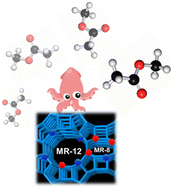
Mechanistic insights into methanol carbonylation to methyl acetate over an efficient organic template-free Cu-exchanged mordenite

Currently, acetic acid is produced via the carbonylation reaction of methanol with the main route entailing the use of homogeneous noble metal-based catalysts, which has certain limitations, including the use of polluting alkyl halide promoters and difficulty in catalyst recovery. To overcome these challenges, the exploration of alternative methods utilizing heterogeneous catalysts, particularly zeolites with copper as…

Alkane metathesis over immobilized pincer-ligated iridium complexes: Effect of support nature

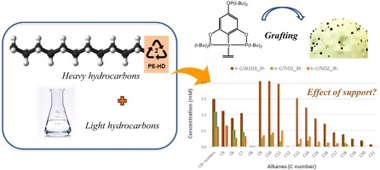
In this work, catalytic alkane metathesis has been evaluated as a suitable approach to upcycle hydrocarbons (polyolefins) at moderate temperatures. To this end, a pincer-ligated iridium complex (dehydrogenation catalyst) has been combined with a rhenium-based (metathesis) catalyst, being the effect of immobilizing the Ir complex over different supports deeply investigated. FTIR spectroscopy has been used to confirm the complex grafting and to elucidate the anchoring site…

Effect of zeolite topological structure in bifunctional catalyst on direct conversion of syngas to light olefins

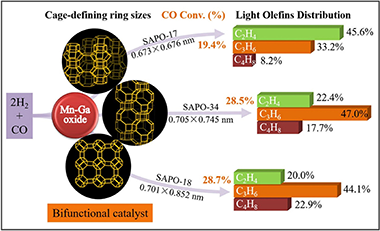
Bifunctional catalyst composed of metal oxide and zeolite (OX-ZEO) is a promising strategy for the direct conversion of syngas to light olefins (STO), where the structure of zeolite plays a vital role in determining the selectivity of product. Herein, three kinds of silicoaluminophosphate zeolites with different topological structures, i.e., the ERI(SP17), AEI(SP18) and CHA(SP34), were…

Glucose dehydration reaction over metal halides supported on activated charcoal catalysts

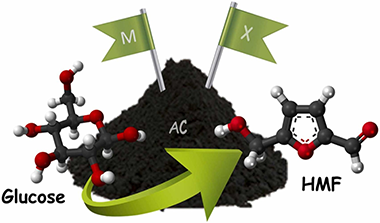
Different metal halide catalysts supported on a commercial active charcoal have been synthesized, activated, characterized and tested in glucose dehydration to 5-hydroxymethylfurfural using a biphasic water/methyl isobutyl ketone media. The influence of the cation nature (K+, Ca2+, Sr2+, Mg2+) and anion nature (F–, Cl–, Br–) on the catalytic performance of the solid is discussed in…