Incorporation and Thermal Evolution of Rhodamine 6G Dye Molecules Adsorbed in Porous Columnar Optical SiO2 Thin Films

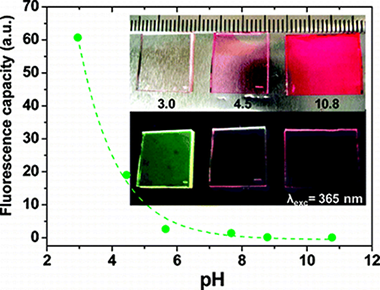
Rhodamine 6G (Rh6G) dye molecules have been incorporated into transparent and porous SiO2 thin films prepared by evaporation at glancing angles. The porosity of these films has been assessed by analyzing their water adsorption isotherms measured for the films deposited on a quartz crystal monitor. Composite Rh6G/SiO2 thin films were prepared by immersion of a…

Nanoindentation of TiO2 thin films with different microstructures

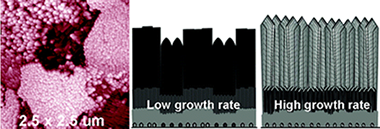
A series of nanoindentation tests has been carried out with TiO2 films produced by physical vapour deposition (PVD) under different conditions. Films with different microstructures and crystallographic structures have been prepared by changing experimental parameters such as the temperature of the substrate, the deposition angle (by the so-called glancing angle physical vapour deposition, GAPVD) or…

Chemical State of Nitrogen and Visible Surface and Schottky Barrier Driven Photoactivities of N-Doped TiO2 Thin Films

N-doped TiO2 thin films have been prepared by plasma enhanced chemical vapor deposition and by physical vapor deposition by adding nitrogen or ammonia to the gas phase. Different sets of N-doped TiO2 thin films have been obtained by changing the preparation conditions during the deposition. The samples have been characterized by X-ray diffraction, Raman, UV−vis…

Electrical characteristics of mixed Zr–Si oxide thin films prepared by ion beam induced chemical vapor deposition at room temperature

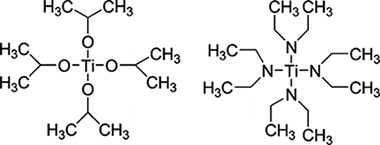
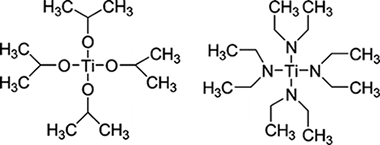
Mixed Zr–Si oxide thin films have been prepared at room temperature by ion beam decomposition of organometallic volatile precursors. The films were flat and amorphous. They did not present phase segregation of the pure single oxides. A significant amount of impurities (–C–, –CHx, –OH, and other radicals coming from partially decomposed precursors) remained incorporated in…

Chemical State of Nitrogen and Visible Surface and Schottky Barrier Driven Photoactivities of N-Doped TiO2 Thin Films

N-doped TiO2 thin films have been prepared by plasma enhanced chemical vapor deposition and by physical vapor deposition by adding nitrogen or ammonia to the gas phase. Different sets of N-doped TiO2 thin films have been obtained by changing the preparation conditions during the deposition. The samples have been characterized by X-ray diffraction, Raman, UV−vis…

Wetting angles and photocatalytic activities of illuminated TiO2 thin films

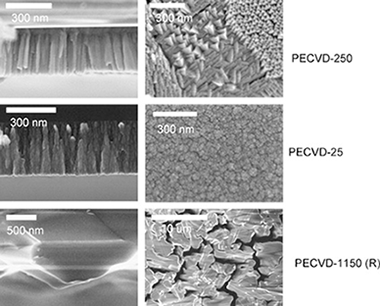
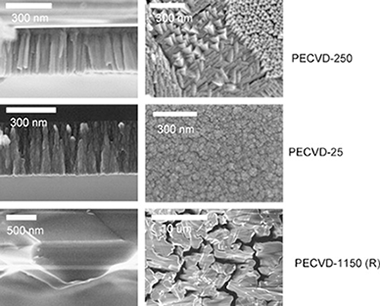
TiO2 thin films have been prepared by physical vapour deposition (PVD) and plasma enhanced chemical vapour deposition (PECVD) to study the UV-induced photo-activity of this material. Wetting angle variations and photo-catalytic activity for the degradation of dyes upon UV illumination have been compared for thin films with different crystalline structure (amorphous, rutile and anatase), microstructure…

Wetting angles and photocatalytic activities of illuminated TiO2 thin films

TiO2 thin films have been prepared by physical vapour deposition (PVD) and plasma enhanced chemical vapour deposition (PECVD) to study the UV-induced photo-activity of this material. Wetting angle variations and photo-catalytic activity for the degradation of dyes upon UV illumination have been compared for thin films with different crystalline structure (amorphous, rutile and anatase), microstructure…

Molecular dynamics simulation of the effect of pH on the adsorption of rhodamine laser dyes on TiO2 hydroxylated surfaces

We have carried out a study of adsorption, on the (1 0 1) surface of anatase TiO2, of two industrially relevant rhodamine molecules [rhodamine 6G (R6G) and rhodamine 800 (R800)] employing molecular dynamics. These theoretical studies have shown that R6G must adsorb on surfaces under basic conditions. Moreover, the adsorption of this molecule shows a…