Improved Non-Covalent Biofunctionalization of Multi-Walled Carbon Nanotubes Using Carbohydrate Amphiphiles with a Butterfly-Like Polyaromatic Tail

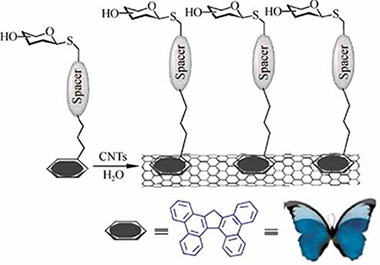
We have developed an efficient strategy for the non-covalent functionalization of multi-walled carbon nanotubes (MWCNTs) which allows a biomimetic presentation of carbohydrates on their surface by pi-pi stacking interactions. The strategy is based on the use of sugar-based amphiphiles functionalized with tetrabenzo[a,c,g,i] fluorene (Tbf), a polyaromatic compound with a topology that resembles a butterfly with…

Tilt angle control of nanocolumns grown by glancing angle sputtering at variable argon pressures

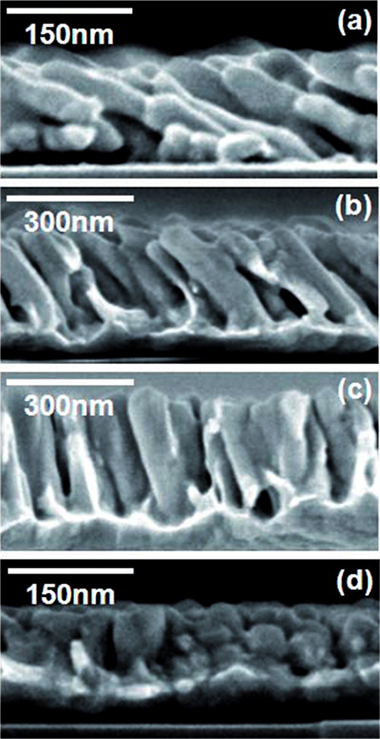
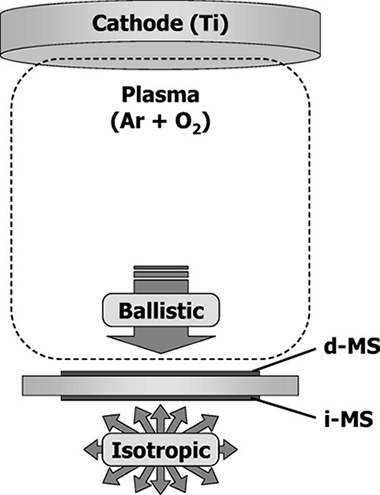
We show that the tilt angle of nanostructures obtained by glancing angle sputtering is finely tuned by selecting the adequate argon pressure. At low pressures, a ballistic deposition regime dominates, yielding high directional atoms that form tilted nanocolumns. High pressures lead to a diffusive regime which gives rise to vertical columnar growth. Monte Carlo simulations…

Wetting Properties of Polycrystalline TiO2 Surfaces: A Scaling Approach to the Roughness Factors

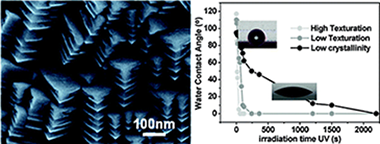
This work presents a thorough study on the wettability of polycrystalline anatase TiO2 thin films prepared at 250 degrees C in a microwave plasma enhanced chemical vapor deposition (MW-PECVD) reactor with Ar/O-2 plasmas. Anatase polycrystalline thin films with different microstructures, textures, and surface roughness were obtained as a function of their thickness. The water contact…

A transparent TMPyP/TiO2 composite thin film as an HCl sensitive optochemical gas sensor

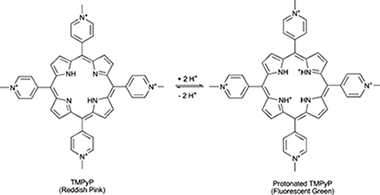
Tetracationic porphyrin (TMPyP) molecules were incorporated Into an optically transparent TiO2 thin film prepared by Glancing Angle Physical Vapour Deposition (GAPVD) by simple infiltration (at pH 6 4) The preparation of optically transparent TMPyP/TiO2 composite thin films provides a method for the integration of the porphyrin molecules Into photonic devices for direct monitoring of gases…

Tunable In-Plane Optical Anisotropy of Ag Nanoparticles Deposited by DC Sputtering onto SiO2 Nanocolumnar Films

This work reports an easy-to-handle method for growing two-dimensional assemblies of Ag nanostructures presenting a tunable in-plane optical anisotropy. Ag is deposited by DC sputtering in an Ar plasma at room temperature onto bundled nanocolumnar SiO2 thin films grown by glancing angle physical vapor deposition. In contrast with previously reported processes involving the grazing angle…

On the microstructure of thin films grown by an isotropically directed deposition flux

The influence of isotropically directed deposition flux on the formation of the thin film microstructure at low temperatures is studied. For this purpose we have deposited TiO2 thin films by two different deposition techniques: reactive magnetron sputtering, in two different experimental configurations, and plasma enhanced chemical vapor deposition. The obtained results indicate that films grown…

Characterization of Ti1-xAlxN coatings with selective IR reflectivity

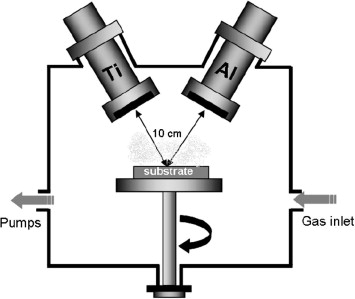
Ti1-xAlxN thin films were deposited by reactive magnetron sputtering. The obtained different stoichiometries give rise to different optical properties as the films change from metallic to dielectric. In this work the IR reflectivity of these coatings is investigated taking into account different application fields for IR selective Ti1-xAlxN thin films. Low Al content coatings present…