Vertical and tilted Ag-NPs@ZnO nanorods by plasma-enhanced chemical vapour deposition

Supported ZnO nanorods have been prepared at 405 K by plasma-enhanced chemical vapour deposition (PECVD) using diethylzinc as precursor, oxygen plasma and silver as the promotion layer. The nanorods are characterized by a hollow and porous microstructure where partially percolated silver nanoparticles are located. By changing different deposition parameters like the thickness of the silver…

Microstructural and chemical characterization of nanostructured Tialsin coatings with nanoscale resolution

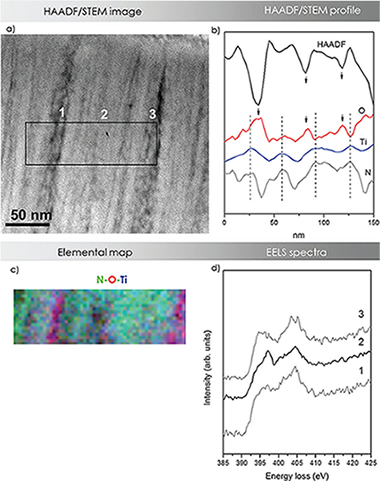
Nanoscale resolution electron microscopy analysis combined with ion beam assisted techniques are presented here, to give answers to full characterization of morphology, growth mode, phase formation, and compositional distribution in nanocomposite TiAlSiN coatings deposited under different energetic conditions. Samples were prepared by magnetron sputtering, and the effects of substrate temperature and bias were investigated. The…

Roughness assessment and wetting behavior of fluorocarbon surfaces

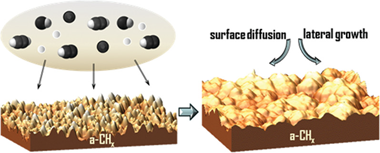
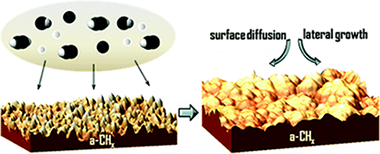
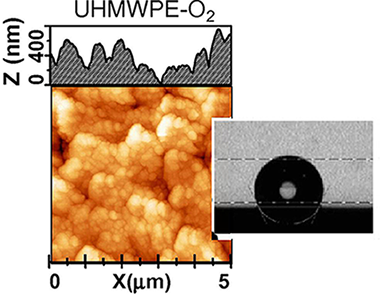
The wetting behavior of fluorocarbon materials has been studied with the aim of assessing the influence of the surface chemical composition and surface roughness on the water advancing and receding contact angles. Diamond like carbon and two fluorocarbon materials with different fluorine content have been prepared by plasma enhanced chemical vapor deposition and characterized by…

Correlation lengths, porosity and water adsorption in TiO2 thin films prepared by glancing angle deposition

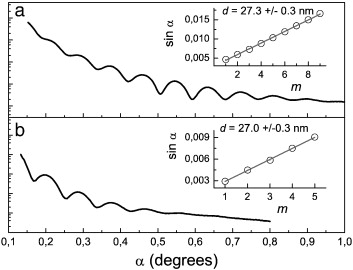
This paper reports a thorough microstructural characterization of glancing angle deposited (GLAD) TiO 2 thin films. Atomic force microscopy (afm), grazing-incidence small-angle x-ray scattering (GISAXS) and water adsorption isotherms have been used to determine the evolution of porosity and the existence of some correlation distances between the nanocolumns constituting the basic elements of the films…

Self-assembly at room temperature of thermally stable discrete and extended oligomers of polycyclic aromatics on Ag(100): induced dipoles and cooperative effects

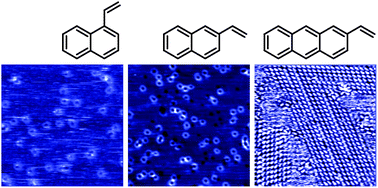
Thermally stable nanoarchitectures are realized on the Ag(100) surface by self-assembly of asymmetrically substituted arenes. The process is instigated by adsorption-induced molecule → surface charge transfer that gives rise to in-plane dipole moments. Observation and calculation indicate that cooperative interactions further enhance the stability of these polarizable systems.

Plasma deposition of perylene-adamantane nanocomposite thin films for NO 2 room-temperature optical sensing

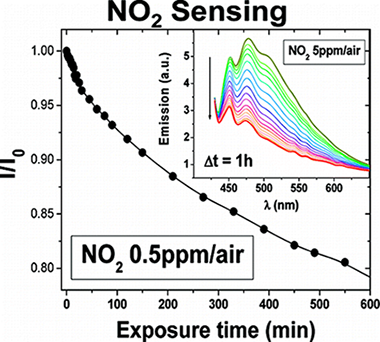
This work reports the preparation, by a new remote assisted plasma deposition process, of luminescent nanocomposite thin films consisting of an insoluble organic matrix where photonically active perylene molecules are embedded. The films are obtained by the remote plasma deposition of adamantane and perylene precursor molecules. The results show that the adamantane precursor is very…

Quantification of low levels of fluorine content in thin films

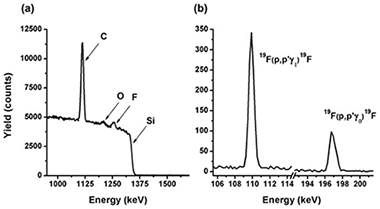
Fluorine quantification in thin film samples containing different amounts of fluorine atoms was accomplished by combining proton-Rutherford Backscattering Spectrometry (p-RBS) and proton induced gamma-ray emission (PIGE) using proton beams of 1550 and 2330 keV for p-RBS and PIGE measurements, respectively. The capabilities of the proposed quantification method are illustrated with examples of the analysis of…