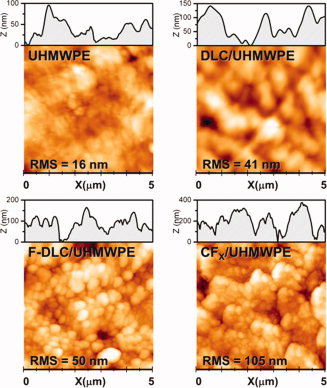
DLC coatings for UHMWPE: Relationship between bacterial adherence and surface properties

Development of intrinsically antibacterial surfaces is of key importance in the context of prostheses used in orthopedic surgery. This work presents a thorough study of several plasma-based coatings that may be used with this functionality: diamond-like carbon (DLC), fluorine-doped DLC (F-DLC), and a high-fluorine-content-carbon-fluor polymer (CFX). The coatings were obtained by a radio-frequency plasma-assisted deposition…

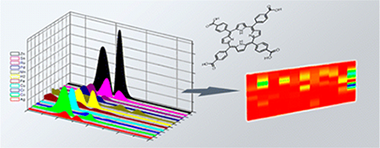
Selective Detection of Volatile Organic Compounds by Spectral Imaging of Porphyrin Derivatives Bound to TiO2 Porous Films

In this work, the carboxylic acid derivatives of a free-base porphyrin, 5,10,15,20-tetrakis(4-carboxyphenyl)-21H,23H-porphyrin, and 10 of its metal derivatives (TCPPs) have been used for optical gas sensing. For this purpose, microstructured columnar TiO2 thin films prepared by GAPVD (glancing angle physical vapor deposition) have been used as host materials for the porphyrins as they are non–dispersive…

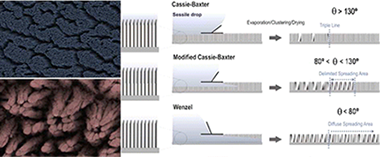
Following the Wetting of One-Dimensional Photoactive Surfaces

This article aims toward a full description of the wetting conversion from superhydrophobicity to superhydrophilicity under illumination with UV light of high-density ZnO nanorods surfaces by (i) following the evolution of the clusters and superstructures formed by the nanocarpet effect as a function of the water contact angle (WCA); (ii) characterization of the superhydrophobic and…

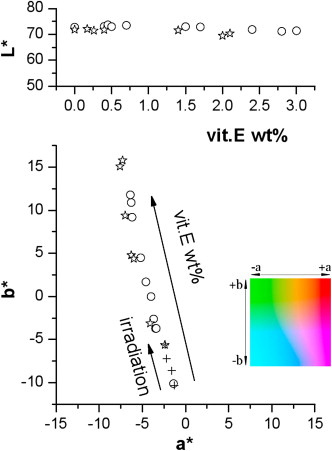
Characterization of highly crosslinked polyethylenes by colorimetry

Colour analysis appears to be a robust technique for characterizing vitamin E doping and gamma irradiation of medical grade polyethylene samples. The analysis procedure described in this paper is of great interest because it can easily distinguish between polyethylene samples with differences in vitamin E (α-tocopherol) doping of about 0.1 wt% and gamma irradiation doses of…

Critical thickness and nanoporosity of TiO2 optical thin films

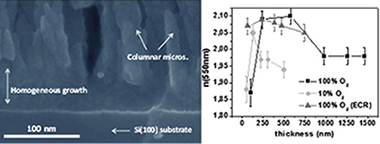
This work reports on the porosity and refraction index of TiO2 thin films as a function of the film thickness. Samples were fabricated by plasma enhanced chemical vapor deposition (PECVD) in a microwave electron cyclotron resonance (MW-ECR) reactor at room temperature using titanium tetra-isopropoxide (MP) as precursor. Experimental parameters such as plasma gas composition (pure…

Microstructural characterization of hydrophobic Ti1−xAlxN coatings with moth-eye-like surface morphology

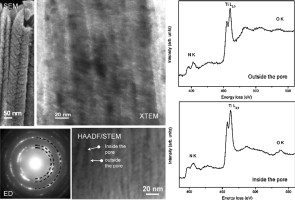
Ti1−xAlxN thin films with different Al content were deposited by magnetron sputtering. The combination of electron energy loss spectroscopy (EELS) and energy dispersive spectroscopy (EDS) was used to evaluate the composition of the coatings. The effect of Al content on the morphology and properties of the coatings was investigated. High resolution electron microscopy and related…

Charge collection properties of dye-sensitized solar cells based on 1-dimensional TiO2 porous nanostructures and ionic-liquid electrolytes

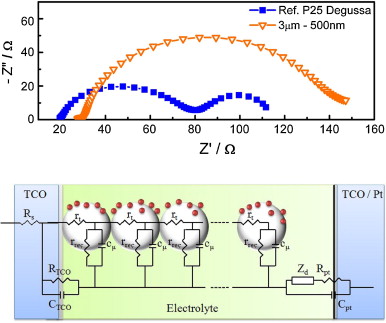
Dye solar cells consisting of mesoporous TiO 2 nanocolumnar films sensitized with a highly absorptive indoline dye were studied to estimate the charge collection efficiency provided by porous 1-dimensional (1-D) nanostructures in combination with viscous, fast-recombining electrolytes. The TiO 2 mesoporous nanostructured films were prepared by physical vapor deposition at glancing incidence (GLAD-PVD). Electrochemical Impedance…

The effect of nickel on alloy microstructure and electrochemical behaviour of AA1050 aluminium alloy in acid and alkaline solutions

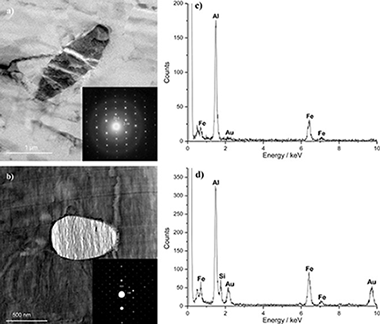
The study investigates the influence of nickel and magnesium additions to AA1050 aluminium alloy on the alloy electrochemical behaviour in sodium hydroxide and hydrochloric solutions under conditions relevant to industries that use alkaline etching as a standard surface treatment procedure and to the lithographic and electronic industries where surface convolution is assisted by pitting in…