Growth of silver on ZnO and SnO2 thin films intended for low emissivity applications

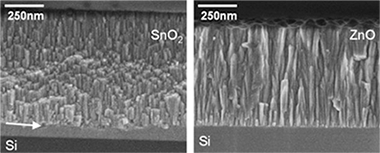
In the present work we have investigated the relationships existing between the optical properties and the growth mechanism, microstructure and surface roughness of SnO2 and ZnO oxide films prepared by magnetron sputtering under conditions resembling those utilized in industry. Thin films of these oxides with different thicknesses were characterized by atomic force microscopy, glancing incidence…

Laser induced enhancement of dichroism in supported silver nanoparticles deposited by evaporation at glancing angles

Silver nanoparticles (NPs) depicting well defined surface plasmon resonance (SPR) absorption were deposited on flat substrates by physical vapor deposition in a glancing angle configuration. The particles were characterized by scanning electron microscopy and atomic force microscopy and their optical properties examined by UV–vis absorption spectroscopy using linearly polarized light. It was found that, depending…

Valence band electronic structure characterization of the rutile TiO2 (110)-(1 x 2) reconstructed surface

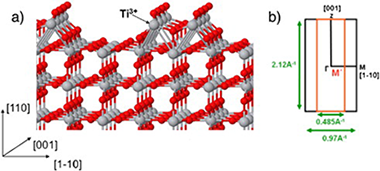
The electronic structure of the TiO2 (110)-(1 × 2) surface has been studied by means of angular resolved ultraviolet photoemission spectroscopy (ARUPS). The valence band dispersion along the high symmetry surface directions, [001] and [1–10], has been recorded. The experimental data show no dispersion of the band-gap Ti 3d states. However, the existence of dispersive…

Growth regimes of porous gold thin films deposited by magnetron sputtering at oblique incidence: from compact to columnar microstructures

Growth regimes of gold thin films deposited by magnetron sputtering at oblique angles and low temperatures are studied from both theoretical and experimental points of view. Thin films were deposited in a broad range of experimental conditions by varying the substrate tilt angle and background pressure, and were analyzed by field emission scanning electron microscopy…

Effects of plasma surface treatments of diamond-like carbon and polymeric substrata on the cellular behavior of human fibroblasts

Surface properties play an important role in the functioning of a biomaterial in the biological environment. This work describes the influence of the changes that occurred on diamond-like carbon (DLC) and polymeric substrata by different nitrogen and ammonia plasmas treatments and its effects on the cell proliferation on these materials. All substrata were additionally subjected…

Electrochromism in WOx and WxSiyOz Thin Films Prepared by Magnetron Sputtering at Glancing Angles

This work reports the electrochromic evaluation of WxSiyOz and WOx glad thin films deposited by reactive magnetron sputtering at glancing angle. Their electrochemical properties were assessed by the analysis of cyclic voltammetry and chronoamperometry measurements in 0.1 M HClO4, whereas their optical properties were determined by studying their transmission and absorption spectra under operation conditions.…

Reverse osmosis membranes oxidation by hypochlorite and chlorine dioxide: spectroscopic techniques vs. Fujiwara test

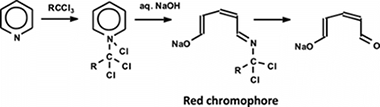
The aim of this work was the study of degradation of a commercial polyamide membrane by two commonly employed oxidants for disinfection in seawater desalination, hypochlorite, and chlorine dioxide. A conventional reverse osmosis (RO) membrane is a thin film composite membrane composed of three different layers, a polyester support web, a microporous polysulfone interlayer, and…

Small Pt nanoparticles on the TiO2 (110)–(1 × 2) surface

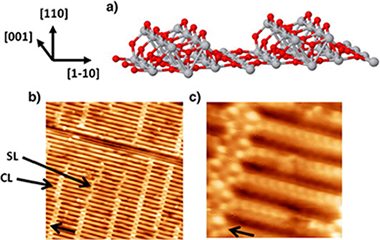
Scanning tunnelling microscopy (STM) has been used to study the initial stages of Pt deposition on the TiO2 (110)–(1 × 2) surface. Experimental STM images recorded for Pt coverage of 0.1 and 0.4 ML, suggest a Volmer-Weber growth. For low coverage and RT deposition, small clusters homogeneously distributed on the surface terraces are observed. However,…

Synthesis and functionalization of biocompatible Tb:CePO4 nanophosphors with spindle-like shape

Monoclinic Tb:CePO4 nanophosphors with a spindle-like morphology and tailored size (in the nanometer and micrometer range) have been prepared through a very simple procedure, which consists of aging, at low temperature (120 °C), ethylene glycol solutions containing only cerium and terbium acetylacetonates and phosphoric acid, not requiring the addition of surfactants or capping agents. The…

XPS and AES analyses of cerium conversion coatings generated on AA5083 by thermal activation

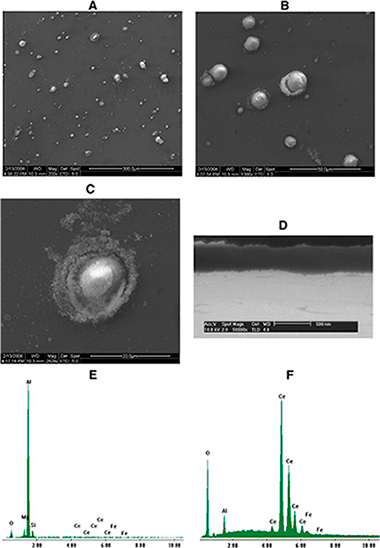
This paper describes the deep analysis of cerium conversion coatings developed with thermal activation on AA5083 under optimum processing conditions. Scanning electron microscopy (SEM), electron dispersive spectroscopy (EDX), X-ray photoelectron spectroscopy (XPS) and Auger electron spectroscopy (AES) were employed to study these layers. Ar+ sputtering was also employed to analyse the coatings’ core. Although conversion…