


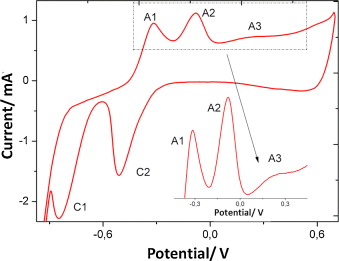
New Copper wide range nanosensor electrode prepared by physical vapor deposition at oblique angles for the non-enzimatic determination of glucose

In this work a novel Cu nanostructured electrode is presented. Cu tilted nanocolumnar and porous thin films have been prepared by physical vapor deposition (PVD) in an oblique angle configuration and characterized by different techniques. Cyclic voltammetry and amperometry were used to study the sensing ability of the copper films deposited on ITO to quantitatively…
A novel and improved surfactant-modified Prussian Blue electrode for amperometric detection of free chlorine in water

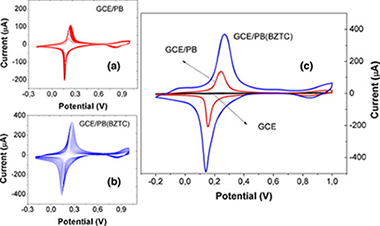
A surfactant-modified Prussian Blue (PB) electrochemical sensor has been developed. Benzethonium was used to assist the electrodeposition of PB onto a glassy carbon electrode (GCE). The surface coverage ( [View the MathML source] ) was 7.75 × 10−8 mol cm−2, five times higher than the value obtained in the absence of surfactant, and the film thickness of ca. 123 nm.…

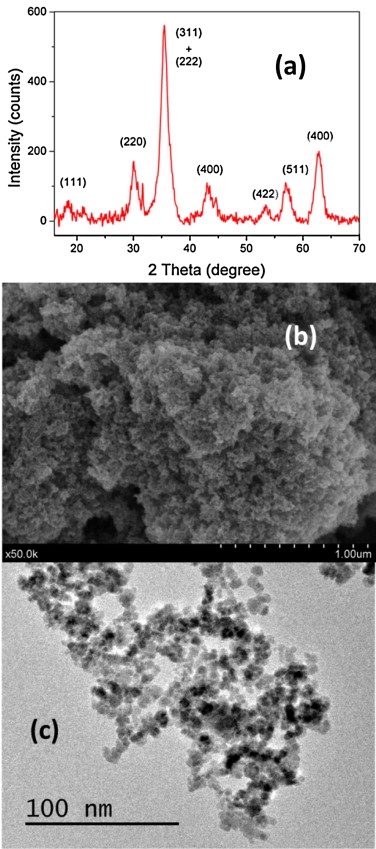
Core-shell polydopamine magnetic nanoparticles as sorbent in micro-dispersive solid-phase extraction for the determination of estrogenic compounds in water samples prior to high-performance liquid chromatography-mass spectrometry analysis

In this work, core-shell Fe3O4@poly(dopamine) magnetic nanoparticles (m-NPs) were prepared and characterized in our laboratory and applied as sorbents for the magnetic-micro solid phase extraction (m-mu SPE) of twelve estrogenic compounds of interest (i.e. 17 alpha-estradiol, 17 beta-estradiol, estrone, hexestrol, 17 alpha-ethynylestradiol, diethylstibestrol, dienestrol, zearalenone, alpha-zearalanol,beta-zearalanol, alpha-zearalenol and beta-zearalenol) from different water samples. Separation, determination…

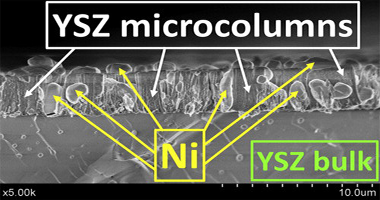
Porous, robust highly conducting Ni-YSZ thin film anodes prepared by magnetron sputtering at oblique angles for application as anodes and buffer layers in solid oxide fuel cells

Uniform, highly porous, columnar thin films incorporating YSZ and NiO prepared by magnetron sputtering with deposition at glancing incidence exhibited stoichiometries close to that of the Y-Zr-Ni sputter target. Characterization by means of SEM, XRD, XPS and RBS revealed that the uniformly distributed nickel component in the as-deposited films consisted of NiO, and that the…

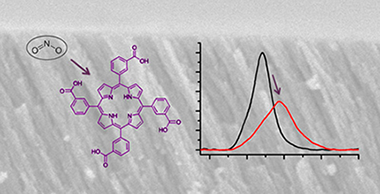
Free-Base Carboxyphenyl Porphyrin Films Using a TiO2 Columnar Matrix: Characterization and Application as NO2 Sensors

The anchoring effect on free-base carboxyphenyl porphyrin films using TiO2 microstructured columns as a host matrix and its influence on NO2 sensing have been studied in this work. Three porphyrins have been used: 5-(4-carboxyphenyl)10,15,20-triphenyl-21H,23H-porphyrin (MCTPP); 5,10,15,20-tetrakis(4-carboxyphenyl)-21H,23H-porphyrin (p-TCPP); and 5,10,15,20-tetrakis(3-carboxyphenyl)-21H,23H-porphyrin (m-TCPP). The analysis of UV-Vis spectra of MCTPP/TiO2, p-TCPP/TiO2 and m-TCPP/TiO2 composite films has revealed that m-TCPP/TiO2 films are the most stable, showing less…

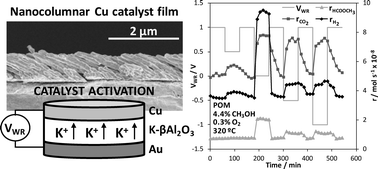
Electrochemical activation of an oblique angle deposited Cu catalyst film for H-2 production

A novel Cu catalyst film was prepared by oblique angle physical vapour deposition (OAD) on a K-βAl2O3 solid electrolyte (alkaline ionic conductor) for catalytic/electrocatalytic purposes. This technique allowed us to obtain a highly porous and electrically conductive Cu catalyst electrode which was tested in the partial oxidation of methanol (POM) reaction for H2 production and its catalytic…

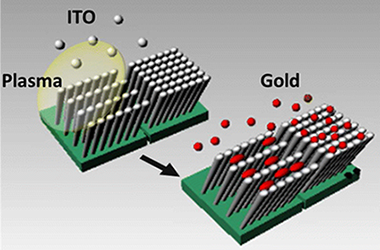
Anisotropic In-Plane Conductivity and Dichroic Gold Plasmon Resonance in Plasma-Assisted ITO Thin Films e-Beam-Evaporated at Oblique Angles

ITO thin films have been prepared by electron beam evaporation at oblique angles (OA), directly and while assisting their growth with a downstream plasma. The films microstructure, characterized by scanning electron microscopy, atomic force microscopy, and glancing incidence small-angle X-ray scattering, consisted of tilted and separated nanostructures. In the plasma assisted films, the tilting angle…

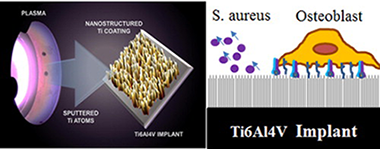
Nanocolumnar coatings with selective behavior towards osteoblast and Staphylococcus aureus proliferation

Bacterial colonization and biofilm formation on orthopedic implants is one of the worst scenarios in orthopedic surgery, in terms of both patient prognosis and healthcare costs. Tailoring the surfaces of implants at the nanoscale to actively promote bone bonding while avoiding bacterial colonization represents an interesting challenge to achieving better clinical outcomes. Herein, a Ti6Al4V…