Single-step fabrication process of 1-D photonic crystals coupled to nanocolumnar TiO2 layers to improve DSC efficiency

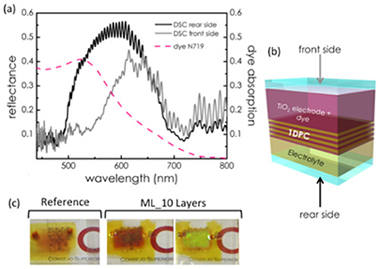
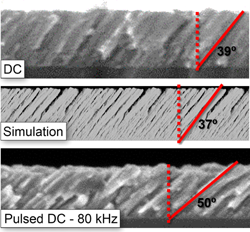
The present work proposes the use of a TiO2 electrode coupled to a one-dimensional photonic crystal (1DPC), all formed by the sequential deposition of nanocolumnar thin films by physical vapor oblique angle deposition (PV-OAD), to enhance the optical and electrical performance of DSCs while transparency is preserved. We demonstrate that this approach allows building an…

Amperometric magnetobiosensors using poly(dopamine)-modified Fe3O4 magnetic nanoparticles for the detection of phenolic compounds

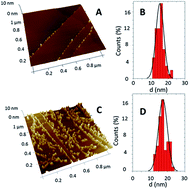
The synthesis of poly(dopamine)-modified magnetic nanoparticles (MNPs) and their application in preparing electrochemical enzyme biosensors that are useful to detect phenolic compounds is reported in this work. MNPs of about 16 nm were synthesized by a co-precipitation method and conveniently modified with poly(dopamine). Non-modified and modified MNPs were characterized using X-ray photoelectron spectroscopy (XPS), Raman…

Microstructure of mixed oxide thin films prepared by magnetron sputtering at oblique angles

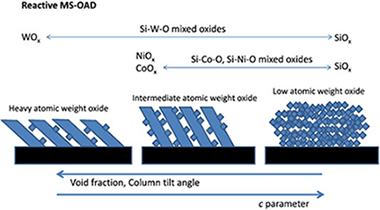
Several mixed oxide thin film series of samples (Si–Co–O, Si–Ni–O, Si–W–O) have been prepared by reactive magnetron sputtering at oblique angle geometries. The paper focuses on the description of microstructure of the films as a function of their stoichiometry. It is found that for identical process parameters (gas mixture, pressure, magnetron-substrate distance, incidence angle of…

Physiological Degradation Mechanisms of PLGA Membrane Films under Oxygen Plasma Treatment

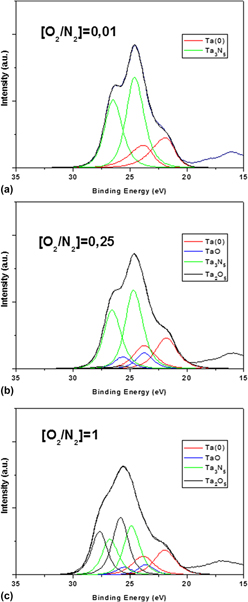
Degradation under simulated physiological conditions of poly(lactic-co-glycolic) (PLGA) copolymer membrane films subjected to an oxygen plasma treatment compared to its “as prepared” state has been studied by gas cluster ion beam assisted X-ray photoelectron spectroscopy for chemical depth profiling analysis. This investigation is complemented with atomic force microscopy, weight loss measurements, and visual inspection of…

Rapid Legionella pneumophila determination based on a disposable core–shell Fe3O4@poly(dopamine) magnetic nanoparticles immunoplatform

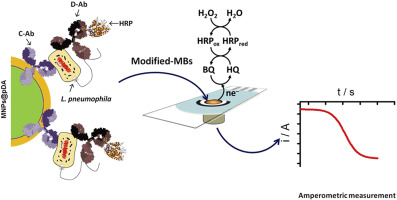
A novel amperometric magnetoimmunoassay, based on the use of core–shell magnetic nanoparticles and screen-printed carbon electrodes, was developed for the selective determination of Legionella pneumophila SG1. A specific capture antibody (Ab) was linked to the poly(dopamine)–modified magnetic nanoparticles (MNPs@pDA-Ab) and incubated with bacteria. The captured bacteria were sandwiched using the antibody labeled with horseradish peroxidase (Ab-HRP), and…

Ultraviolet Pretreatment of Titanium Dioxide and Tin-Doped Indium Oxide Surfaces as a Promoter of the Adsorption of Organic Molecules in Dry Deposition Processes: Light Patterning of Organic Nanowires

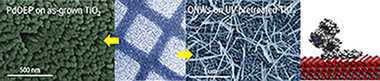
In this article we present the preactivation of TiO2 and ITO by UV irradiation under ambient conditions as a tool to enhance the incorporation of organic molecules on these oxides by evaporation at low pressures. The deposition of p-stacked molecules on TiO2 and ITO at controlled substrate temperature and in the presence of Ar is…

Nanocolumnar 1-dimensional TiO2 photoanodes deposited by PVD-OAD for perovskite solar cell fabrication

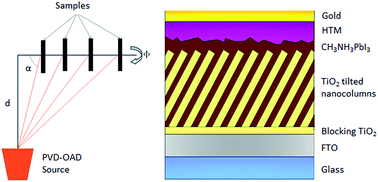
Perovskite solar cells have attracted increasing interest among the photovoltaic community in the last few years owing to their unique properties and high efficiency. In the present work, we report the fabrication of perovskite solar cells based on highly ordered 1-dimensional porous TiO2 photoanodes, which are uniform on a large area. These nanocolumnar porous TiO2…