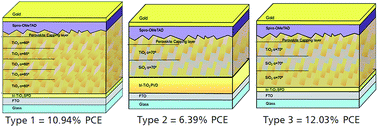
Light management: porous 1-dimensional nanocolumnar structures as effective photonic crystals for perovskite solar cells

Hybrid organic-inorganic perovskite solar cells are a topic of increasing interest, as in a short time span they are able to lead in the third generation photovoltaics. Organohalide perovskites possess exceptional optoelectronic and physical properties, thus making their implementation possible in many diverse configurations of photovoltaic devices. In this work, we present three different configurations…

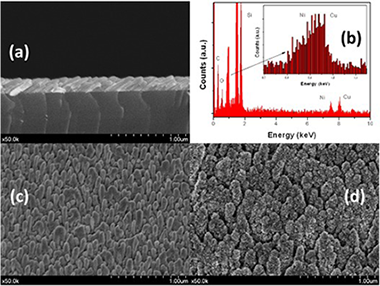
Nickel-copper bilayer nanoporous electrode prepared by physical vapor deposition at oblique angles for the non-enzymatic determination of glucose

This work presents a novel bilayer Ni/Cu porous nanostructured film electrode prepared by physical vapor deposition (PVD) in an oblique angle configuration. Scanning electron microscopy (SEM) data revealed that the film, with an approximate thickness of 200 nm, is formed by tilted nanocolumns of around 50 nm of diameter and an inclination of 30° with respect to…

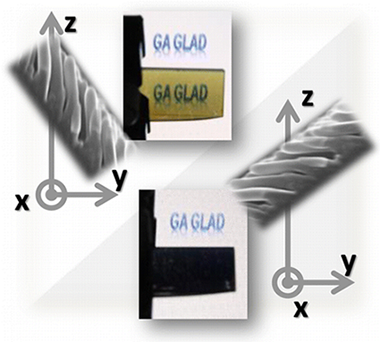
Growth Assisted by Glancing Angle Deposition: A New Technique to Fabricate Highly Porous Anisotropic Thin Films

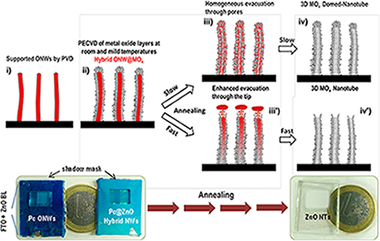
We report a new methodology based on glancing angle deposition (GLAD) of an organic molecule in combination with perpendicular growth of a second inorganic material. The resulting thin films retain a very well-defined tilted columnar microstructure characteristic of GLAD with the inorganic material embedded inside the columns. We refer to this new methodology as growth…

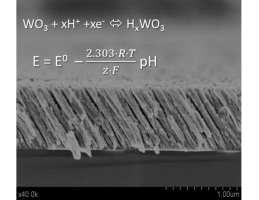
Characterization and application of a new pH sensor based on magnetron sputtered porous WO3 thin films deposited at oblique angles

In this communication we report about an outstanding solid-state pH sensor based on amorphous nanocolumnar porous thin film electrodes. Transparent WO3 thin films were deposited by reactive magnetron sputtering in an oblique angle configuration to enhance their porosity onto indium tin oxide (ITO) and screen printed electrodes (SPE). The potentiometric pH response of the nanoporous…

Perspectives on oblique angle deposition of thin films: From fundamentals to devices

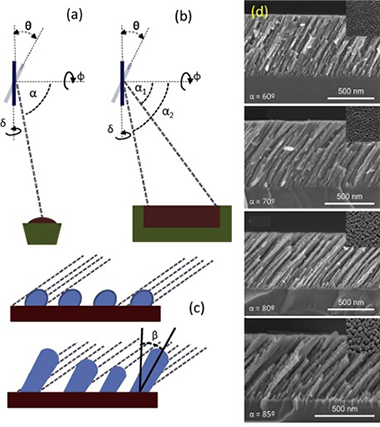
The oblique angle configuration has emerged as an invaluable tool for the deposition of nanostructured thin films. This review develops an up to date description of its principles, including the atomistic mechanisms governing film growth and nanostructuration possibilities, as well as a comprehensive description of the applications benefiting from its incorporation in actual devices. In…

Electrocatalytic System for the Simultaneous Hydrogen Production and Storage from Methanol

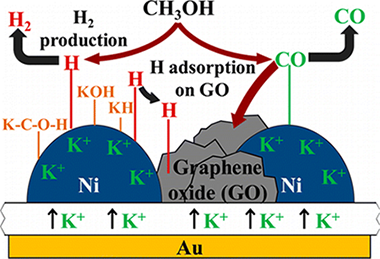
This paper reports a groundbreaking approach for simultaneous hydrogen production and storage that entails catalysis, electrochemistry, surface science, and materials synthesis. A novel electrocatalytic system is developed based on nickel nanocolumnar films of controlled microstructure prepared on K-βAl2O3 solid electrolyte supports by oblique angle physical vapor deposition. The outstanding characteristics of this system are a hydrogen…

Nanoindentation and scratch resistance of multilayered TiO2-SiO2 coatings with different nanocolumnar structures deposited by PV-OAD

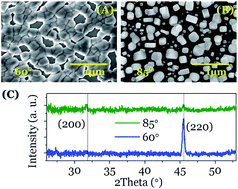
This paper presents a study of the mechanical properties and an evaluation of damage mechanisms of nanocolumnar TiO2-SiO2 multilayer coatings prepared by physical vapour oblique angle deposition at different configurations (slanted, zigzag or chiral) and two zenithal evaporation angles (70 degrees or 85 degrees). The characterization at micro-and nanometric length scales of the mechanical properties…

Ripening and recrystallization of NaCl nanocrystals in humid conditions

This study shows that Ostwald ripening, a universal mechanism responsible for the increase of crystal size during precipitation from solutions, can be meditated by ion diffusion through condensed monolayers of water that connect separated nanocrystals. In an environmental electron microscope we have observed «in situ» the time evolution of the number, shape, size and crystallographic…