Synthesis, characterization and performance of robust poison resistant ultrathin film yttria stabilized zirconia nickel anodes for application in solid electrolyte fuel cells

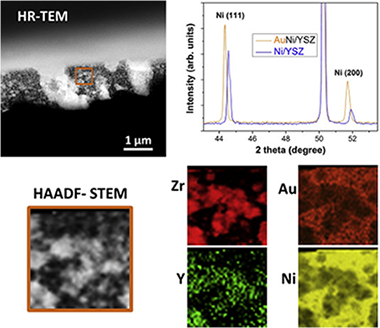
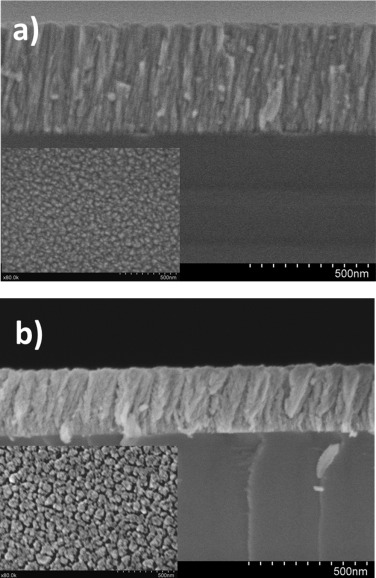
We report on the synthesis of undoped ∼5 μm YSZ-Ni porous thin films prepared by reactive pulsed DC magnetron sputtering at an oblique angle of incidence. Pre-calcination of the amorphous unmodified precursor layers followed by reduction produces a film consisting of uniformly distributed tilted columnar aggregates having extensive three-phase boundaries and favorable gas diffusion characteristics. Similarly…

Dye-based photonic sensing systems

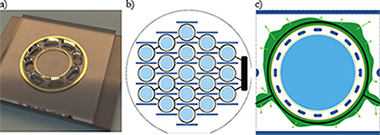
We report on dye-based photonic sensing systems which are fabricated and packaged at wafer scale. For the first time luminescent organic nanocomposite thin-films deposited by plasma technology are integrated in photonic sensing systems as active sensing elements. The realized dye-based photonic sensors include an environmental NO2 sensor and a sunlight ultraviolet light (UV) A+B sensor.…

Portable IR dye laser optofluidic microresonator as a temperature and chemical sensor

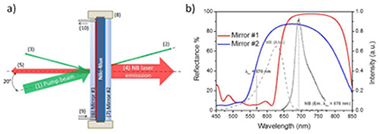
A compact and portable optofluidic microresonator has been fabricated and characterized. It is based on a Fabry-Perot microcavity consisting essentially of two tailored dichroic Bragg mirrors prepared by reactive magnetron sputtering deposition. The microresonator has been filled with an ethanol solution of Nile-Blue dye. Infrared laser emission has been measured with a pump threshold as…

A Full Vacuum Approach for the Fabrication of Hybrid White-Light-Emitting Thin Films and Wide-Range In Situ Tunable Luminescent Microcavities

A wide-range in situ tunable 1D Bragg microcavity including a hybrid layer as white light emitter defect is shown by J. R. Sanchez-Valencia, A. Borras, and co-workers on page 1124. White emission is obtained by Förster resonance energy transfer between blue (1,3,5-triphenyl-2-pyrazoline) and orange (rubrene) dyes homogeneously infiltrated within the host nanocolumnar SiO2film, which is…

The interaction between hybrid organic-inorganic halide perovskite and selective contacts in perovskite solar cells: an infrared spectroscopy study

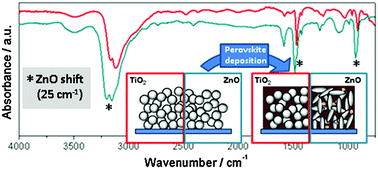
The interaction of hybrid organic-inorganic halide perovskite and selective contacts is crucial to get efficient, stable and hysteresis-free perovskite-based solar cells. In this report, we analyze the vibrational properties of methylammonium lead halide perovskites deposited on different substrates by infrared absorption (IR) measurements (4000-500 cm(-1)). The materials employed as substrates are not only characterized by…

Non-enzymatic Glucose electrochemical sensor made of porous NiO thin films prepared by reactive magnetron sputtering at oblique angles

Porous nanostructured NiO thin films have been prepared in one step by magnetron sputtering in an oblique angle configuration (MS-OAD) and used as electrodes for the non-enzymatic detection of glucose. The films have been thoroughly characterized by different complementary techniques and their performance for the analysis of glucose in basic solutions determined by electrochemical methods.…

Pre-prosthetic use of poly(lactic-co-glycolic acid) membranes treated with oxygen plasma and TiO2 nanocomposite particles for guided bone regeneration processes

Objectives: Guided bone regeneration (GBR) processes are frequently necessary to achieve appropriate substrates before the restoration of edentulous areas. This study aimed to evaluate the bone regeneration reliability of a new poly-lactic-co-glycolic acid (PLGA) membrane after treatment with oxygen plasma (PO2) and titanium dioxide (TiO2) composite nanoparticles.  Methods: Circumferential bone defects (diameter: 10 mm; depth:…